Orlando isn’t just the theme park capital of the world — it’s one of America’s most pool-saturated cities. From private backyard builds to luxury resort lagoons, pools are woven into the city’s housing market, lifestyle, and tourism economy.
In this data-driven guide to pool statistics for Orlando, you’ll find everything you need: ownership rates, construction costs, maintenance expenses, ROI figures, public pool distribution, hotel pool infrastructure, and critical safety benchmarks. Whether you’re a homeowner, investor, or industry professional, these numbers tell a bigger story about how pools shape Central Florida.
Florida is home to 1.59 million residential pools, ranking first nationally in total pool installations and second only to Arizona in per-capita concentration, with approximately one pool for every 14 residents. That level of saturation already positions Florida as one of the most pool-dense states in the country — but Orlando stands out even within Florida’s highly competitive landscape.
When you examine the data more closely, several key local indicators reinforce just how deeply pools are integrated into Orlando’s housing market and lifestyle:
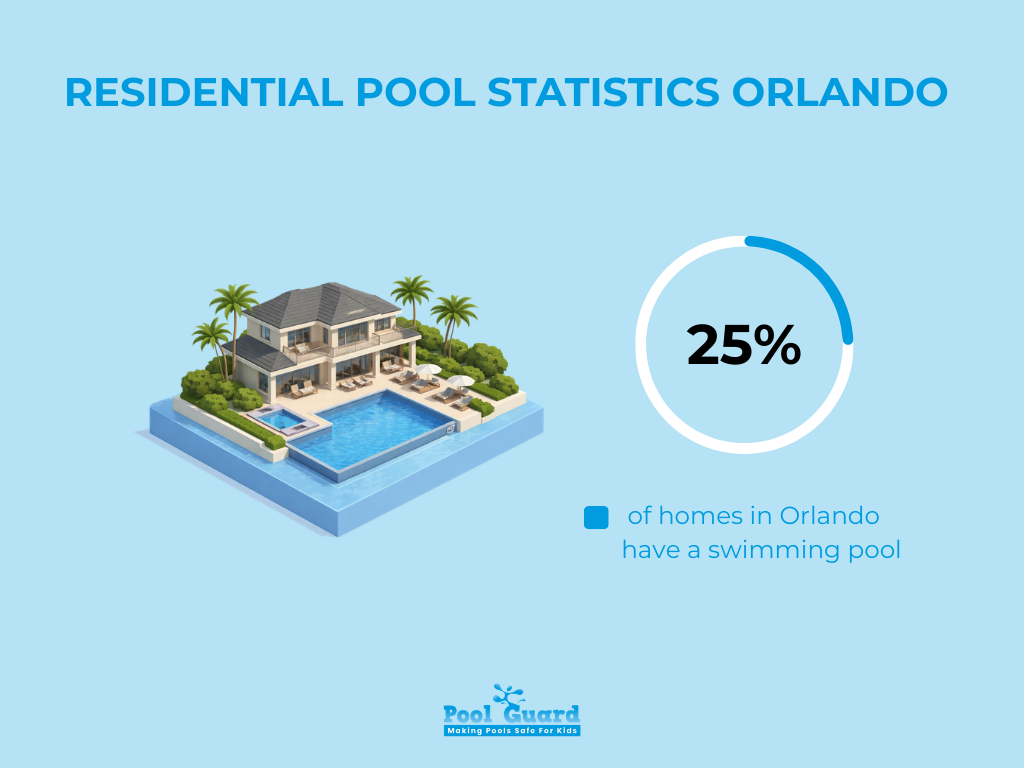
Taken together, these statistics reveal an important reality: in Orlando, pools are not considered luxury add-ons reserved for high-end properties. In many neighborhoods, they are expected amenities that directly influence buyer perception, property value, and competitive positioning in the real estate market.
Understanding pool construction costs in Orlando requires looking beyond a single average number. Pricing varies based on size, material, site conditions, and customization level — but local data provides a strong baseline for homeowners evaluating feasibility.
Based on 2026 data, the cost to build an inground pool in Orlando falls within the following ranges:
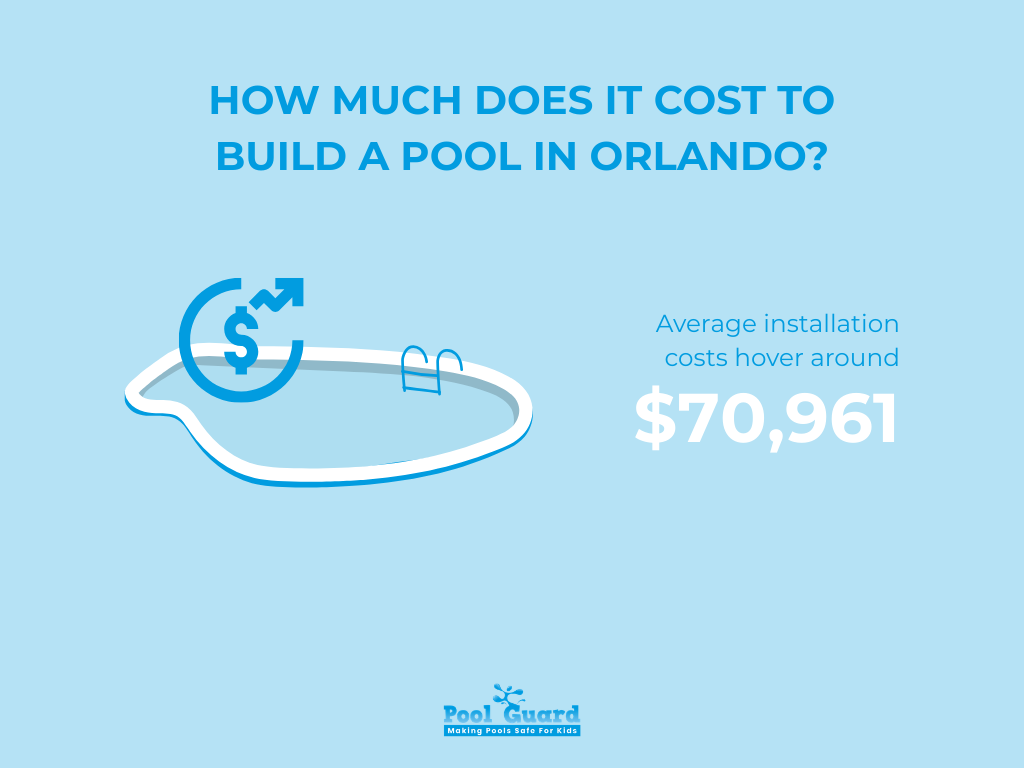
The average homeowner in Orlando spends approximately $70,961 to install an inground pool. However, the final investment depends heavily on pool dimensions, structural complexity, and selected finishes.
Most residential pools in Orlando range from 10×20 to 20×40 feet, reflecting the city’s suburban lot sizes and common backyard layouts.
Pool size is one of the most significant cost drivers because it directly affects excavation, material volume, labor hours, and finishing requirements.
Common size pricing in Orlando includes:
| Pool Size | Average Cost |
|---|---|
| 10×20 | $10,000–$30,000 |
| 15×30 | $22,500–$67,500 |
| 20×40 | $40,000–$120,000 |
Smaller pools reduce excavation and material costs, while larger builds — particularly 20×40 configurations — can exceed $100,000 depending on upgrades and site conditions.
Material choice significantly influences both upfront construction costs and long-term maintenance commitments.
Fiberglass pools tend to dominate the Orlando market because they resist algae growth more effectively in Florida’s humid climate. Their non-porous surface reduces long-term chemical demand and cleaning frequency.
Gunite (concrete) pools offer maximum design flexibility and customization potential but require more ongoing maintenance due to their porous structure. Vinyl pools provide a lower upfront entry point but may require liner replacement over time.
When evaluating Pool Statistics for Orlando, material selection is not just a budget decision — it also determines lifecycle cost, durability, and resale positioning.
Building a pool in Orlando involves more than excavation and materials. Site conditions, labor structure, and local permitting requirements all influence the final investment. Understanding these components provides a more accurate picture of total project economics.
Before construction begins, the property must be cleared, leveled, and prepared for structural installation. In Orlando, site preparation typically includes:
ne of Orlando’s geographic advantages is its sandy soil composition. Compared to clay-heavy or rocky regions in other parts of the United States, sandy soil generally lowers excavation complexity and equipment strain. However, groundwater conditions can still increase costs if stabilization or drainage mitigation is required.
For homeowners evaluating total build feasibility, site prep is often the first meaningful cost variable after pool size.
Labor represents one of the largest portions of pool construction costs in Orlando.
That percentage range highlights how installation complexity can dramatically shift total investment. Custom shapes, upgraded decking, integrated spas, or challenging site conditions can increase labor intensity.
In addition to labor, pool construction in Orlando requires multiple permits:
Total permit costs range from $500–$2,000.
Permitting ensures structural integrity, electrical compliance, and safety standards — and it should be factored into upfront budgeting rather than treated as an afterthought.
Installation is only the beginning. Because Orlando’s swim season is effectively year-round, pool ownership includes continuous operational costs that exceed those in seasonal climates.
| Category | Annual Cost |
|---|---|
| Maintenance | $960–$1,800 |
| Chemicals | $175–$750 |
| Electricity | $800–$1,200 |
| Repairs | $400–$1,000+ |
| Opening & Closing | $650–$1,000 |
| Total | $3,030–$5,995 |
In total, Orlando homeowners can expect to spend between $3,030 and $5,995 per year to maintain a residential pool.
Monthly professional maintenance averages $80–$200, depending on pool size, equipment complexity, and service frequency.
Unlike northern markets where pools are closed for months at a time, Orlando pools often operate year-round. This increases:
In practical terms, pool ownership in Orlando is not seasonal — it is continuous. When evaluating Pool Statistics for Orlando, long-term operational cost is just as important as construction cost.
Maintaining proper water chemistry in Orlando is more demanding than in most U.S. markets. With summer temperatures regularly exceeding 90°F, chlorine dissipates significantly faster under intense heat and UV exposure. This means pool owners in Central Florida must monitor and adjust chemical levels more frequently than homeowners in cooler climates.
When chlorine breaks down quickly, algae growth risk increases — especially in humid environments like Orlando. Add in frequent summer rainstorms, organic debris, and heavy pool usage, and water balance becomes a continuous management priority rather than a seasonal task.
For pools in Orlando and Central Florida, the following ranges are considered optimal:
Total alkalinity between 120–140 PPM helps buffer pH levels, which is particularly important during periods of heavy rainfall. Stabilizer levels between 40–100 PPM help protect chlorine from rapid UV degradation, extending its effectiveness in direct Florida sun.
Heat, UV exposure, and heavy rainfall make Orlando water chemistry management more demanding than in seasonal or temperate markets. In practical terms, consistent testing and chemical balancing are non-negotiable for maintaining safe, clear water year-round.
For homeowners evaluating Pool Statistics for Orlando, water chemistry isn’t just a technical detail — it directly affects maintenance cost, equipment lifespan, and swimmer safety.
Yes — but the impact depends heavily on property tier, neighborhood expectations, and buyer demographics.
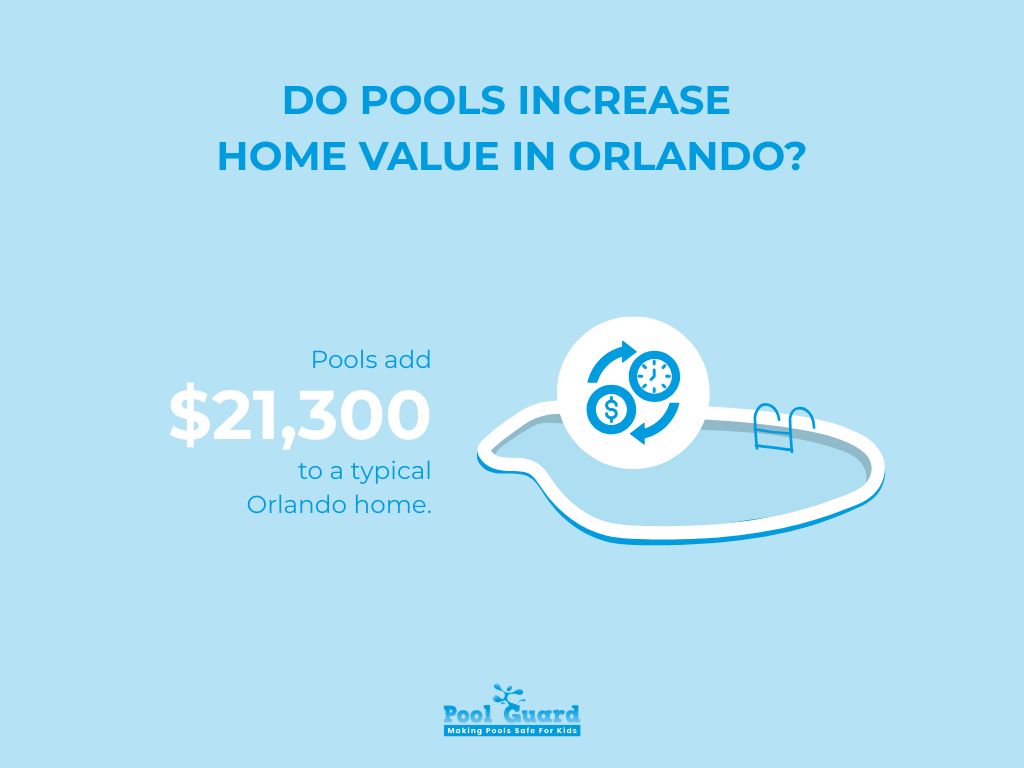
According to metro-level data, pools add $21,300 to a typical Orlando home. Nationally, in-ground pools can increase property value by up to 7%, though recovery of full installation cost is not guaranteed.
Because 25% of Orlando homes already have pools, pool ownership is relatively normalized in many neighborhoods. In mid- to upper-tier communities, a pool may not dramatically increase value — but not having one can create a competitive disadvantage.
In other words, in certain parts of Orlando, a pool isn’t a premium upgrade. It’s an expectation.
However, context matters:
This positioning dynamic makes Orlando distinct. In colder states, pools are optional amenities. In Orlando’s climate and housing ecosystem, they often function as lifestyle infrastructure that supports resale competitiveness.
When analyzing Pool Statistics for Orlando, the value conversation should not focus solely on direct ROI. Instead, it should consider market alignment: in pool-saturated neighborhoods, a property without one may underperform comparable listings.
Orlando’s pool ecosystem extends far beyond private residential backyards. The city’s aquatic footprint includes municipal facilities and large-scale resort water complexes that collectively reinforce its reputation as one of the most pool-centric destinations in the United States.
When analyzing Pool Statistics for Orlando, it’s essential to account for both residential density and public-access infrastructure.
The City of Orlando operates multiple public swimming facilities that serve local communities year-round, reinforcing access beyond private homeownership.
Year-round facilities include:
In addition to these permanent facilities, seasonal pools operate between Memorial Day and Labor Day, expanding capacity during peak summer demand.
This municipal infrastructure ensures that pool access in Orlando is not limited to homeowners. Public facilities contribute to total swim exposure, youth programming, recreational access, and community health.
Orlando’s tourism economy significantly amplifies its aquatic scale. Resort properties feature large-format pools and water amenities that rival standalone water parks.
Notable examples include:
These figures highlight an important dynamic: Orlando’s total water exposure extends well beyond residential installations. Large resort pools operate continuously, often serving thousands of guests weekly.
Hotel pool infrastructure significantly amplifies total aquatic surface area and reinforces Orlando’s identity as a pool-centered city — not just for residents, but for millions of annual visitors.
When combined with residential ownership rates (25% of homes), municipal facilities, and tourism-driven resort complexes, Orlando’s pool footprint becomes structurally embedded into both its housing market and hospitality economy.
Florida averages 1 pool per 14 residents, making it one of the most pool-dense states in the country. Within that statewide concentration, Orlando operates at an even higher level of aquatic activity due to tourism, climate, and residential saturation.
Beyond ownership rates, behavioral metrics provide additional context:
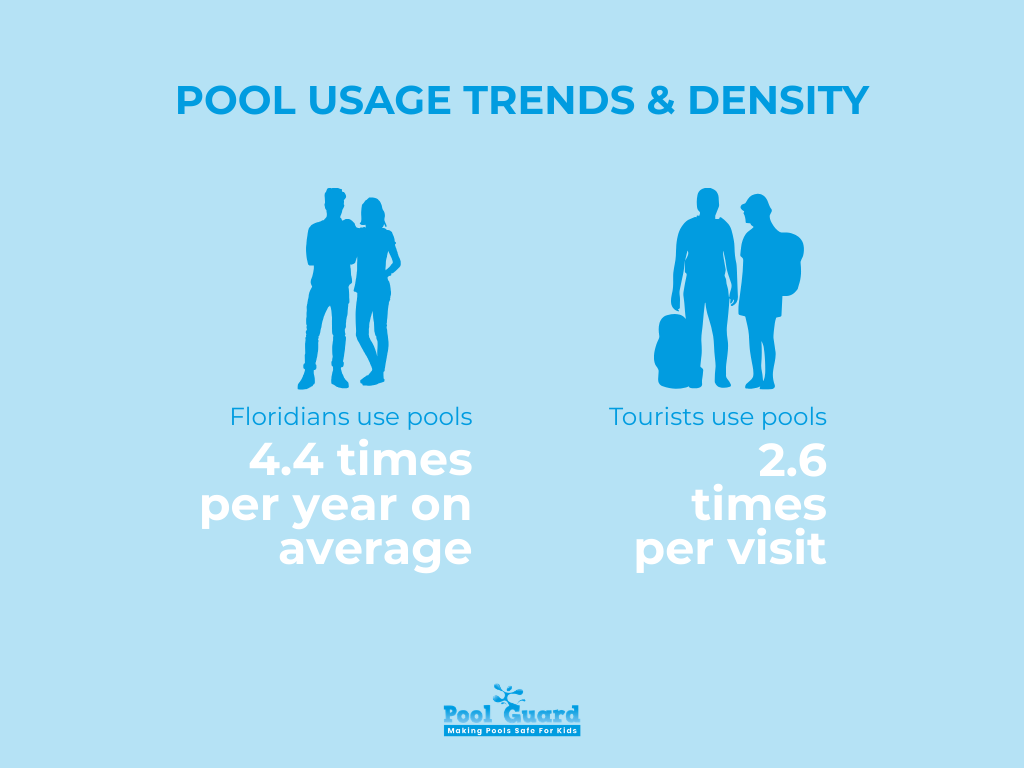
These figures illustrate how heavily pools are integrated into Florida’s recreational culture. However, Orlando’s tourism intensity likely increases real-world usage density beyond the statewide average. With millions of annual visitors and year-round warm weather, pool exposure in Orlando is not seasonal — it is continuous.
When examining pool statistics for Orlando, density matters just as much as installation counts. The higher the exposure rate, the greater the importance of maintenance standards, supervision, and protective infrastructure.
With high density comes heightened responsibility.
National safety data underscores why protective measures are essential:
These statistics highlight a critical reality: the majority of serious incidents occur in residential settings — not commercial water parks or public facilities.
In a city where 25% of homes have pools and resort pools operate year-round, safety infrastructure is not optional. It is foundational.
Fencing is mandatory in Florida. Residential pools must be secured with compliant safety barriers designed to prevent unsupervised access, particularly by young children.
Many homeowners in Orlando opt for screened enclosures, which typically cost $7,000–$18,000. These enclosures serve dual purposes:
In high-density pool markets like Orlando, protective measures should be viewed not just as regulatory compliance — but as essential risk mitigation.
The data is clear — Orlando is not just a city with pools. It is a pool-centric housing and tourism ecosystem shaped by climate, density, and lifestyle demand.
With 25% of homes featuring pools, average installation costs nearing $70,961, annual maintenance reaching up to $5,995, and measurable resale impact of $21,300 per home, pools in Orlando function as long-term residential infrastructure — not seasonal luxuries.
But density changes the equation.
Year-round usage, elevated exposure rates, and strong tourism traffic increase both maintenance demands and safety responsibilities. The same factors that make pools attractive in Orlando — climate, accessibility, and market expectation — also make compliance, water chemistry management, and protective barriers non-negotiable.
Ultimately, these pool statistics for Orlando reveal more than cost and ownership trends — they highlight how deeply pools are embedded in the city’s real estate market, tourism economy, and residential safety landscape.
For homeowners, investors, and real estate professionals, the takeaway is simple:
In Orlando, pool ownership is common. Proper pool management is essential.
If you found this breakdown useful, share it with a homeowner, builder, or real estate professional navigating the Orlando market.

Please fill out the form below with your information. Your local dealer will be notified about your inquiry.
Please fill out the form below with your information. Your local dealer will be notified about your inquiry.