You bought an inflatable pool for a few hundred dollars, pumped it up in the backyard, and filled it with the hose. It’s not a “real” pool—so you probably don’t need a fence, right?
Wrong. In most parts of the United States, if your inflatable pool holds water deeper than 24 inches, the same safety barrier laws that apply to in-ground and above-ground pools apply to your blow-up pool too.
This surprises a lot of homeowners. It also, tragically, catches some of them off guard after a fine—or worse, after an accident.
This guide breaks down exactly what the law says, where the thresholds are, what happens if you ignore the rules, and what your best options are for fast, affordable compliance.
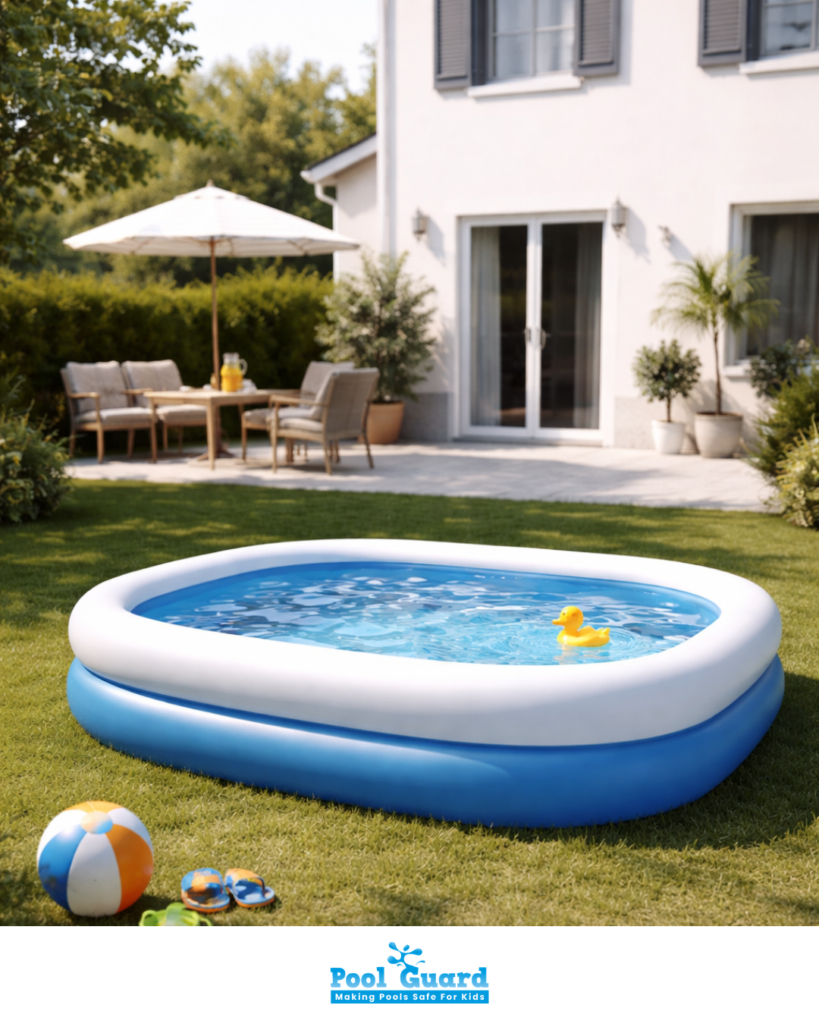
Yes—in most U.S. jurisdictions, you do need pool fence.
The International Residential Code (IRC), which forms the basis for pool safety regulations across most of the U.S., applies barrier requirements to all outdoor pools, hot tubs, and spas with a water depth capacity greater than 24 inches. Inflatable pools that meet this depth threshold fall squarely within that definition.
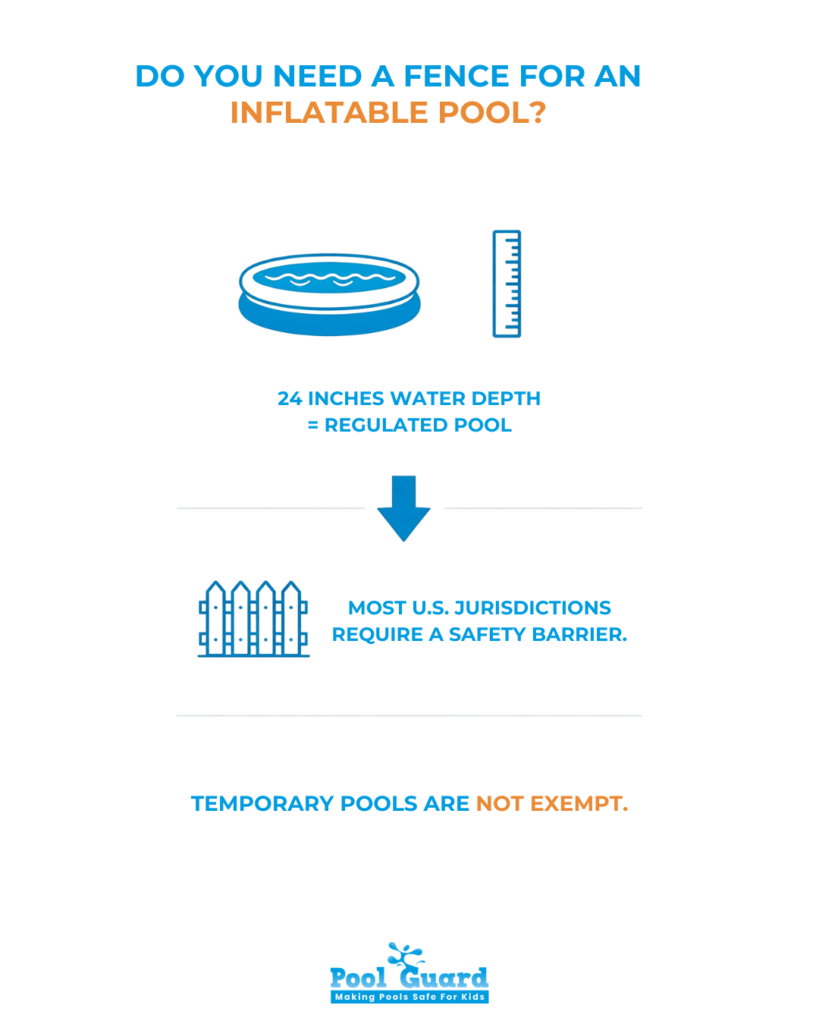
The law doesn’t care what your pool is made of. It cares how deep it is.
Pool safety regulations exist for one reason: to prevent young children from accessing water unsupervised. According to the Centers for Disease Control and Prevention (CDC), drowning is the leading cause of unintentional injury death for children ages 1–4 in the United States. The majority of these drownings happen in residential settings—not public pools or open water.
That risk doesn’t disappear because the pool walls are vinyl instead of concrete.
Most local building codes define a “swimming pool” based on water depth capacity—not construction material, permanence, or price point. When an inflatable pool can hold 24 or more inches of water, it meets the legal definition of a pool in most jurisdictions, and all associated barrier requirements kick in.
This matters because inflatable pools have gotten bigger. Early models were truly small toddler pools—shallow and incapable of holding significant depth. But modern inflatable pools from brands like Intex and Bestway regularly come in 10-foot, 12-foot, and even 18-foot diameters, with sidewall heights well above 24 inches. These are not kiddie pools. They are regulated swimming pools that happen to be made of PVC.
Pool fencing laws in the United States are primarily set and enforced at the state and local level, drawing from two key frameworks:
1. The International Residential Code (IRC)
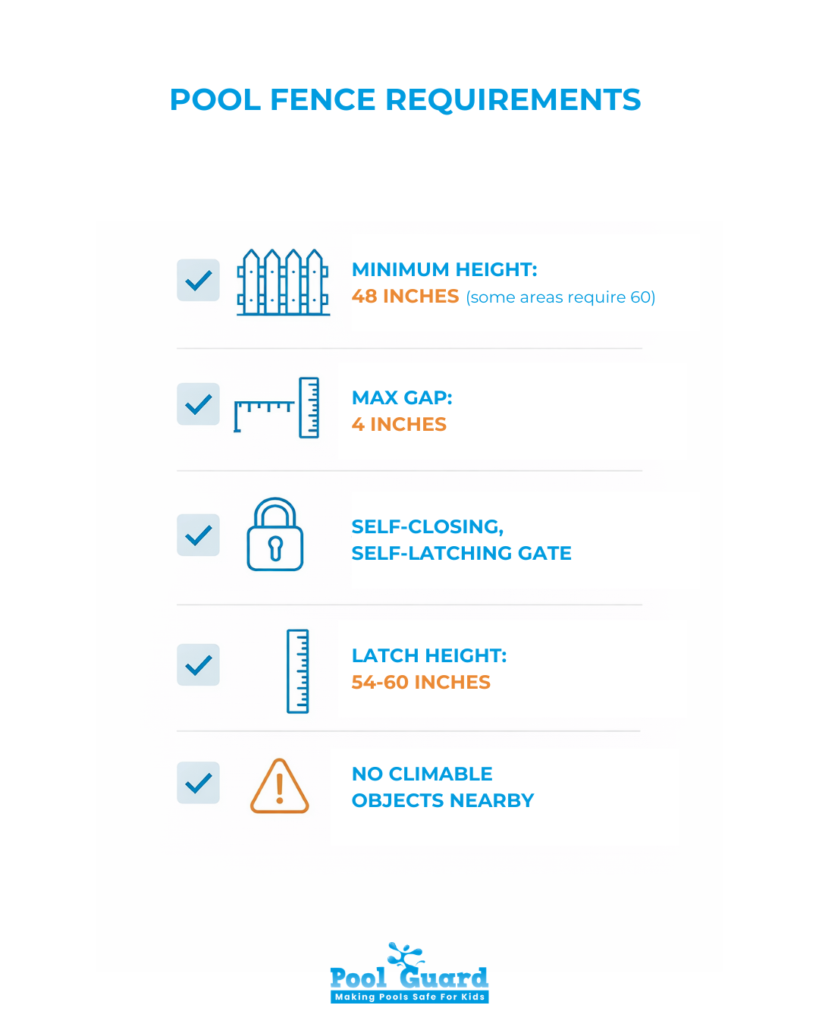
The IRC is a model building code adopted—often with modifications—by most U.S. states. Section R326 covers aquatic facilities and specifies barrier requirements for pools exceeding 24 inches in depth:
2. State-Specific Pool Safety Acts
Always verify with your local building or code enforcement department — city and county rules can be stricter than state minimums.
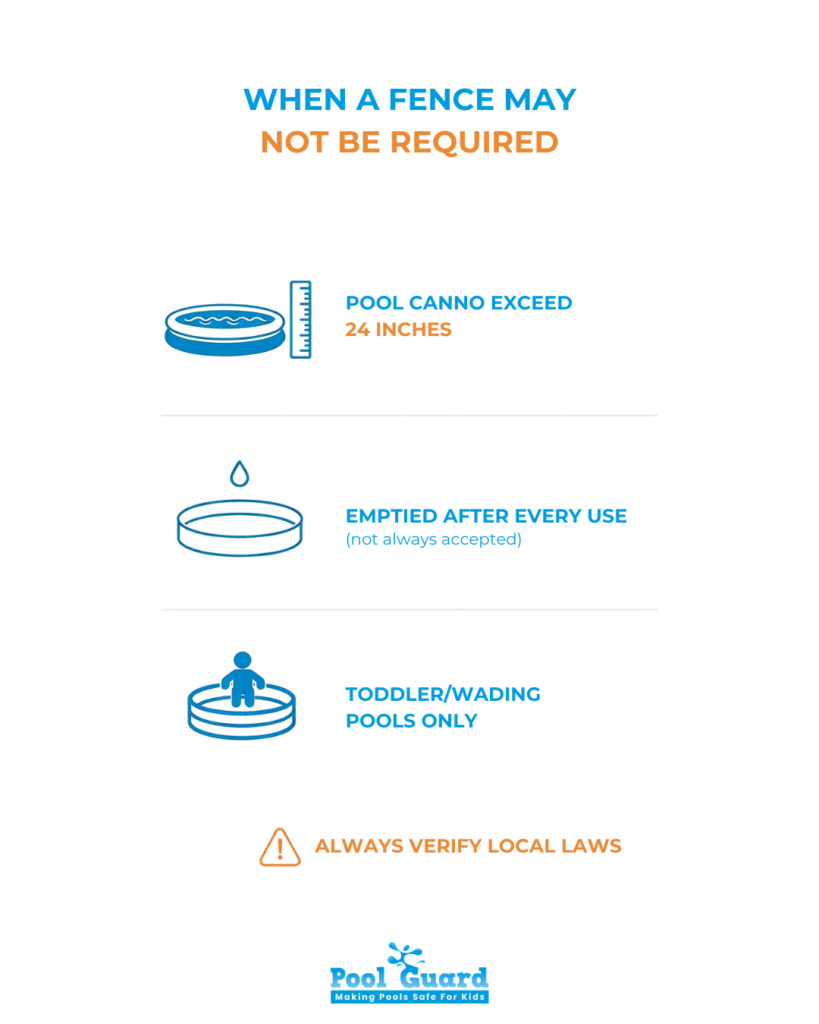
You likely do not need a fence if:
However, tread carefully with the “I empty it every time” exemption. Several states and municipalities do not accept this as a substitute for a compliant barrier. Even an empty inflatable pool left lying in a yard can collect rainwater and pose a drowning risk. Always confirm local rules before relying on this exception.
Above-ground rigid pools (steel, resin, or aluminum-walled) can, in some jurisdictions, use their own sidewalls as part of the barrier — provided the walls meet the minimum height requirement. In these cases, the removable ladder becomes the critical safety point: keeping it locked or removed when the pool is not in use can satisfy local code.
Inflatable pools cannot make this argument. Their soft, flexible walls don’t meet the structural integrity standards for a barrier. Even inflatable pools with 48-inch sidewalls require a separate, compliant fence because those walls are compressible, climbable, and not recognized as a physical barrier under most codes.
This distinction means two families with pools of identical size can face very different compliance requirements — based solely on what the walls are made of.
It’s always a version of the same assumption: “It’s small and temporary — it doesn’t count.”
This is the most dangerous misconception in backyard pool safety.
The CDC reports that approximately 800 children under age 14 drown each year in the United States. The majority of fatal drownings involving young children occur in residential swimming pools — and a significant share involve above-ground, portable, or inflatable pools, not just in-ground ones.
Young children drown silently and quickly. The American Red Cross notes that a child can drown in as little as 20–60 seconds and in as little as two inches of water. There is no reliable warning sound. No splashing. No screaming.
This is why the law doesn’t offer a “small pool” exception based on material or price. The risk is the same. The obligation is the same. Assuming otherwise doesn’t just risk a fine — it risks a tragedy that no family recovers from.
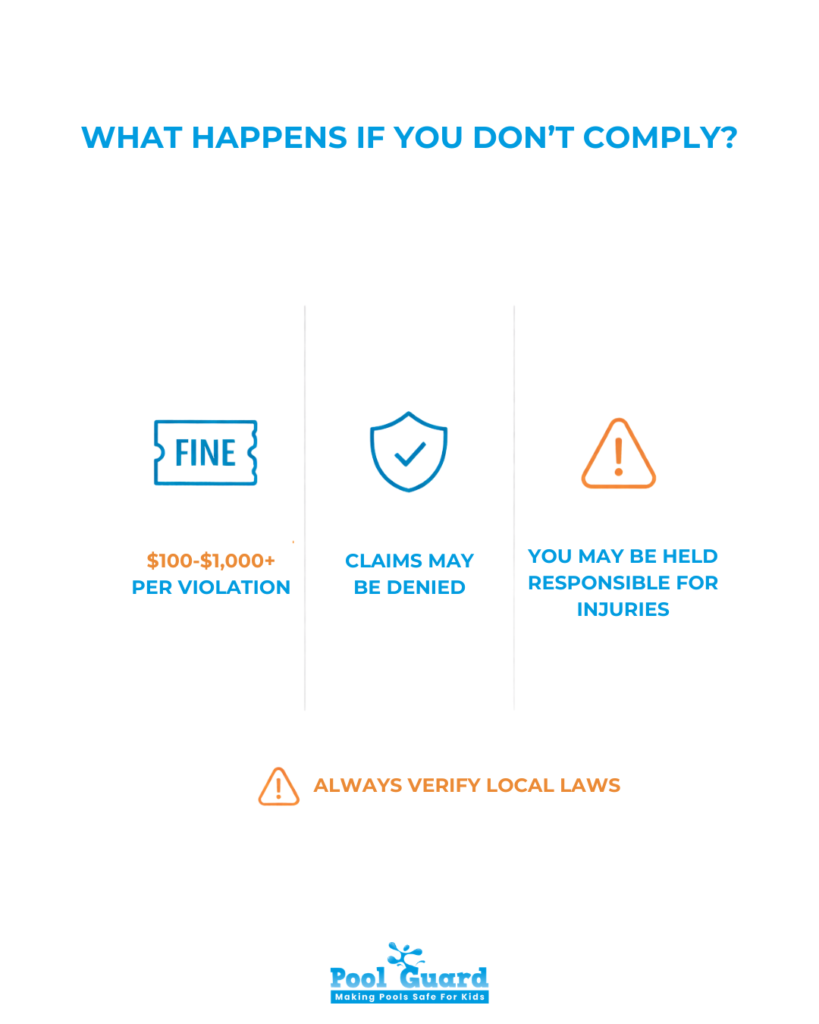
Fines and penalties: Local code enforcement can issue fines ranging from $100 to $1,000+ per violation, with daily accumulation in some jurisdictions until compliance is achieved. In Australia, retailer Decathlon was fined AUD $1.5 million in 2021 for selling inflatable pools without mandatory safety warnings — a signal of how seriously regulators treat this issue globally.
Insurance complications: Many homeowners insurers require proof of code-compliant barriers. If a claim arises from a pool accident and your pool was non-compliant, your insurer may deny coverage entirely.
Legal liability: If a child is injured or drowns in your non-compliant pool — even a neighbor’s child who entered without permission — you may face serious civil exposure. In many states, the attractive nuisance doctrine holds property owners liable for injuries to children caused by hazardous features on their property, regardless of permission.
The cost of a compliant temporary fence is a fraction of any of these outcomes.
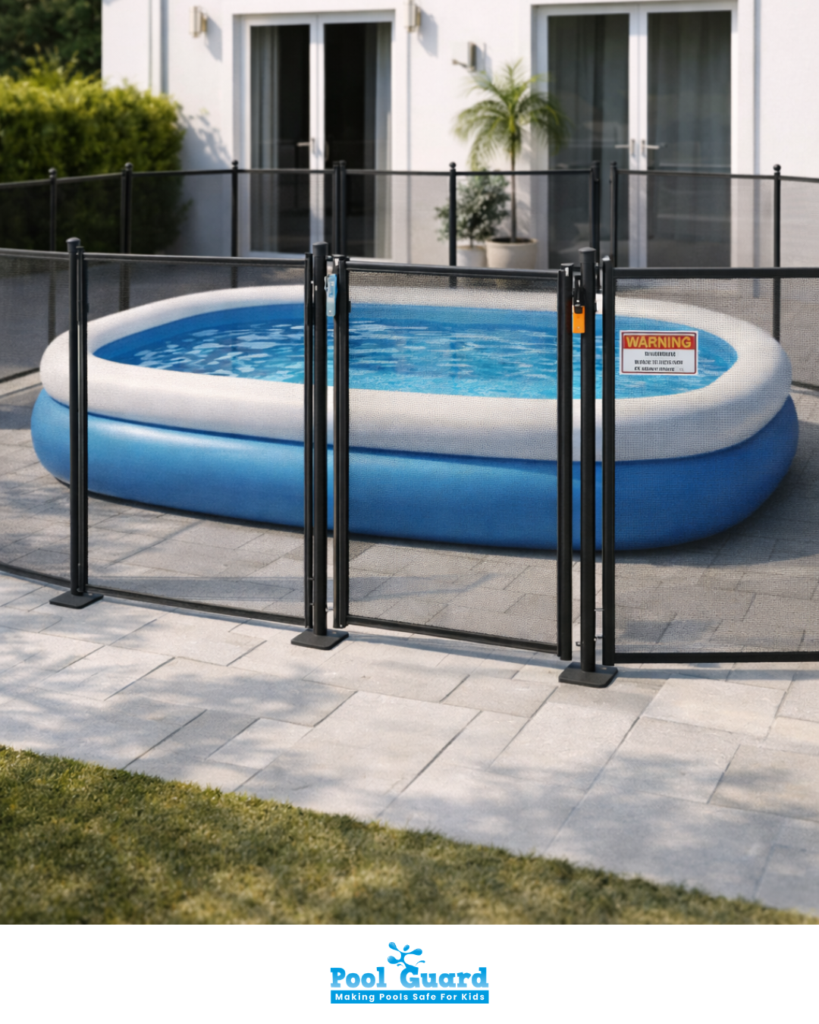
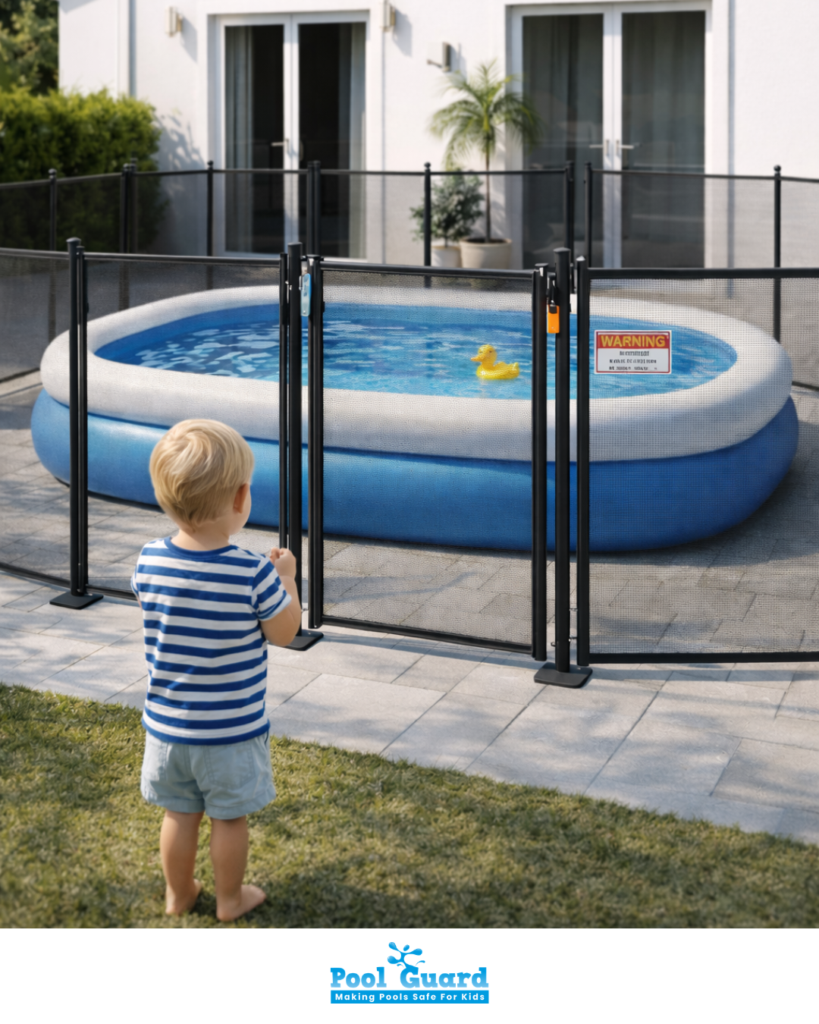
Temporary and removable pool fences are specifically designed for inflatable and above-ground pools. They’re quick to install, easy to reposition, and fully compliant with IRC and most state requirements. Key specifications:
Removable mesh pool fences anchor into grass, soil, or decking, and most systems install in under an hour by one person. At season’s end, they pack into a compact bag.
When purchasing, look for compliance with ASTM F2286 — the U.S. standard for removable mesh pool fencing systems.
An inflatable pool is not a toy. Once it holds 24 inches of water, it is — legally and practically — a swimming pool. It carries the same drowning risks as any other residential pool, and in most parts of the United States, the same legal obligations.
A compliant pool fence is one of the most cost-effective safety investments a homeowner can make. Unlike a fine, an insurance denial, or an unthinkable accident — it’s a problem you can solve in an afternoon.

Please fill out the form below with your information. Your local dealer will be notified about your inquiry.
Please fill out the form below with your information. Your local dealer will be notified about your inquiry.