Most pool owners think about their fence once, when it goes up. After that, it fades into the background, just another part of the yard. But pool fence maintenance is one of those things that quietly matters every single day, especially if you have young children around. A gate that doesn’t latch properly or a sagging mesh panel isn’t a minor inconvenience. It’s a real risk, and it usually develops so gradually that it goes unnoticed until something goes wrong.
The good news is that keeping your fence safe and compliant doesn’t require much, just a little consistency. In this guide, you’ll learn how to inspect, clean, and repair your pool fence throughout every season, and when it’s time for a full replacement.
A pool fence is one of the most important safety investments a homeowner can make. According to the CDC, drowning is the leading cause of unintentional injury death among children aged 1-4, and a properly maintained fence is one of the most effective barriers between a child and an unsupervised pool.
But maintenance isn’t just about safety compliance. It’s about protecting your investment. Here’s what can happen when pool fence maintenance is neglected:
Regular upkeep isn’t a chore. It’s what keeps a safety fence actually safe.
Run this 20-minute inspection monthly, seasonally, and after storms.
Check for any tears or holes
Fix gaps larger than 4 inches
Look for loose or detached mesh sections
Identify and re-tension sagging areas
Replace permanently stretched mesh panels
Open the gate fully and release it
Confirm it closes and latches automatically
Check for proper latch alignment
Adjust tension if the gate swings sluggishly
Repair gates that do not lock consistently
Shake each pole to check for wobble
Inspect deck sleeves for cracks or lifting
Look for pooled water inside sleeves
Straighten leaning or tilting posts
Clear root intrusions near the fence base
Inspect hardware monthly for saltwater pools
Direct sprinkler heads away from the fence hardware
Check for rust pockets on all metal parts
Look for faded or chalky surfaces
Replace components with failing protective coatings
Tighten all visible fasteners with tools
Replace worn or stripped screws completely
Lubricate hinges with silicone-based spray
Avoid dirt-attracting petroleum lubricants
Mesh fences are low-maintenance but not no-maintenance. Dirt, pollen, algae, and mineral deposits from pool water accumulate in the weave over time. Deep clean the mesh every 3-4 months in high-pollen areas, or at least once a year.
Aluminum and powder-coated steel fences are durable, but they’re not self-cleaning.
Fertilizer warning: Rinse your fence after fertilizing nearby garden beds. Many fertilizers contain ammonium sulfate, which can corrode aluminum and cause pitting over time.
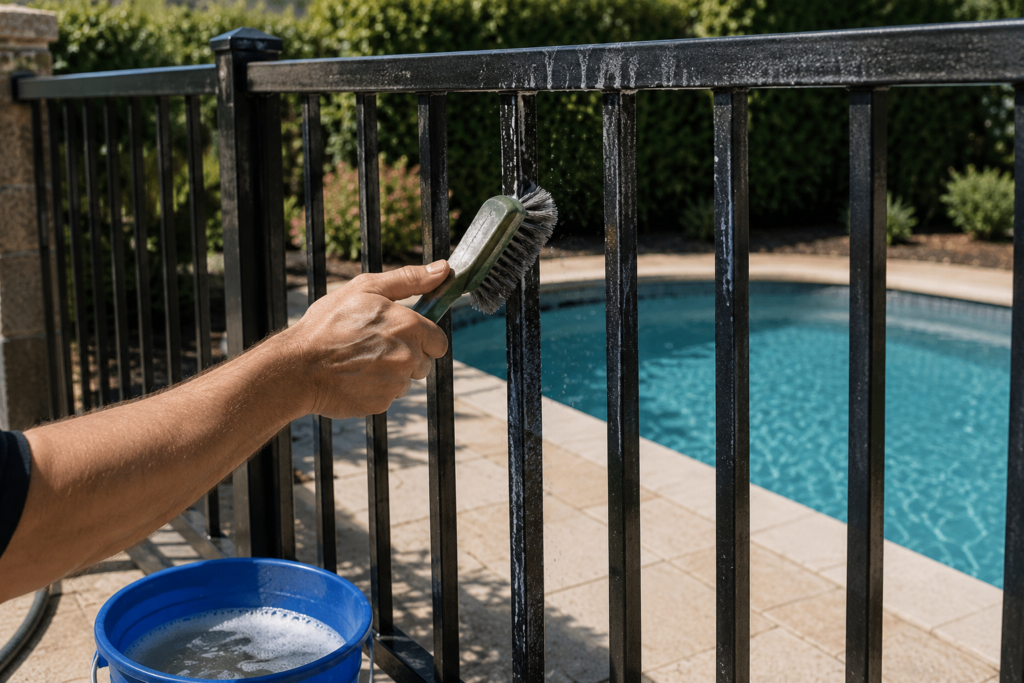
Saltwater chlorination systems produce a salt mist that settles on surfaces and accumulates over time. This mist builds up mineral deposits on glass and mesh, speeds up steel oxidation, and enters powder-coating cracks, causing flaking. To prevent this, rinse metal components weekly and inspect hardware monthly.
UV radiation fades colors and degrades polymers, causing mesh fences with PVC-coated fibers, plastic deck sleeves, and rubberized gate components to lose flexibility. In high-sun climates like Florida, Arizona, and Southern California, UV wear is the main cause of mesh failure. When replacing parts, choose UV-stabilized mesh and hardware to extend your fence’s lifespan with only a minimal increase in upfront cost.
Sprinkler systems create constant wet-and-dry cycles that accelerate rust on metal poles. Redirect sprinkler heads away from the fence and apply a rust-inhibiting coating annually to help protect the metal. Improving ground drainage or adding gravel around posts can also prevent standing water, which can lead to rust, sleeve deterioration, and wood rot.
Removable mesh pool fences offer flexibility, but that removability introduces a maintenance category of its own.
A poorly reinstalled fence is worse than no fence; it creates false confidence.
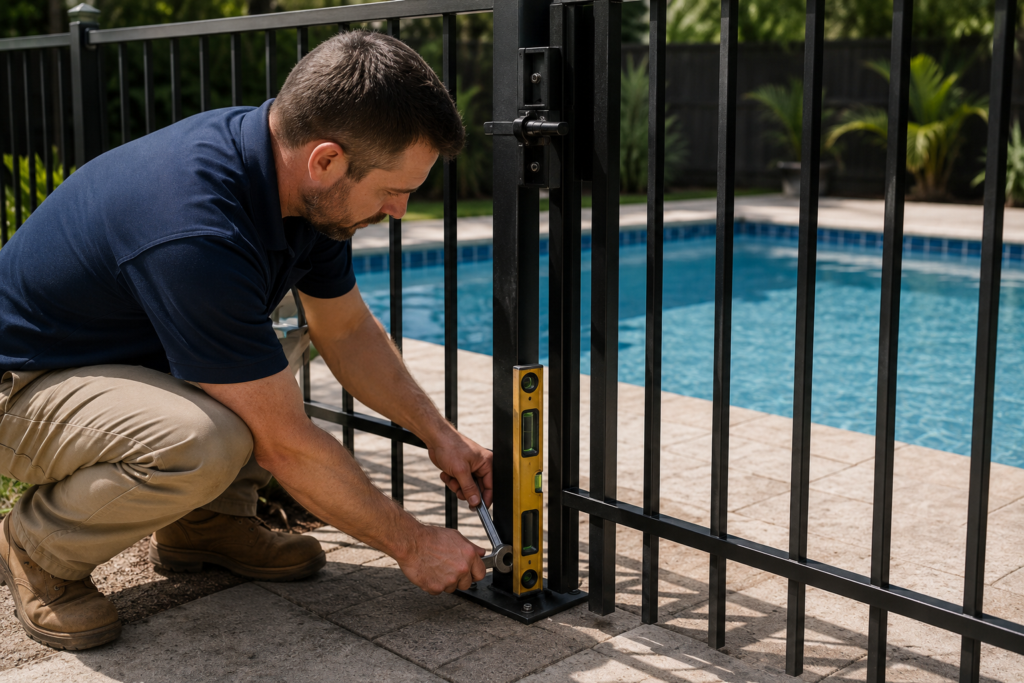
Cause: Worn closing spring, misaligned hinges, or debris in the hinge mechanism.
Fix: Clean and re-lubricate hinges, then adjust spring tension. If the gate still doesn’t close reliably, replace the self-closing hinge assembly. This is not a repair to defer.
Cause: Ground movement, cracked deck sleeves, or poles not fully seated.
Fix: Remove the pole, inspect the sleeve for cracks, clear debris, and reseat the pole. If the sleeve is cracked, replace it – re-inserting a pole into a cracked sleeve won’t hold under load.
Cause: Coating breach from impact, scratch, or UV degradation, exposing bare metal.
Fix: Sand to bare metal, apply rust-inhibiting primer, and touch up with matching paint. Surface rust is cosmetic; deep rust is structural. So, if a pole is compromised internally, replace it.
Cause: Sharp objects, physical impact, pet or child stress on the mesh, or UV-induced brittleness.
Fix: Small holes under an inch can be patched with a mesh repair kit. Larger tears or widespread brittleness warrant full panel replacement. A patched fence is not the same as an intact one.
Cause: Loose poles, stretched mesh, ground shifting, or root intrusion from nearby plants.
Fix: Re-tension the mesh, re-seat loose poles, and trim any encroaching vegetation. If ground movement is the underlying cause, poles may need re-anchoring or concrete stabilization.
| Fence Type | Typical Lifespan (Well-Maintained) | Key Lifespan Factor |
| Mesh (removable) | 8-12 years | UV exposure and storage care |
| Aluminium | 15-20+ years | Coating integrity and moisture control |
| Steel / Wrought Iron | 10-15 years | Rust prevention and climate |
| Glass | 20+ years | Hardware and fitting maintenance |
| Wood | 5-10 years | Staining, sealing, and rot prevention |
Climate plays a major role. In high-humidity, coastal, or high-UV environments, subtract 20-30% from these estimates without diligent maintenance. With it, fences routinely exceed them.
Regular maintenance can extend the life of your pool fence, but eventually, damage, wear, or changing safety requirements may make replacement the better option. If your fence is no longer providing the protection it should, Pool Guard USA offers professional pool fence installation in multiple locations. Browse the service areas below to find a Pool Guard USA location near you and get help creating a safer, more reliable pool area.
A pool fence only protects your family when it’s actually working. With consistent pool fence maintenance, such as routine inspections, timely repairs, and seasonal cleaning, you’re not just preserving a structure; you’re maintaining a genuine safety barrier year after year.
Ultimately, the effort required is small compared to what’s at stake. A quick monthly check, an annual deep clean, and prompt attention to early warning signs are all it takes to keep your fence reliable and compliant. Small habits, done consistently, make all the difference.
Please fill out the form below with your information. Your local dealer will be notified about your inquiry.
Please fill out the form below with your information. Your local dealer will be notified about your inquiry.