Fresno has a pool problem – and most residents don’t know it.
With nearly 1 in 3 Fresno homes owning a swimming pool or spa, and drowning standing as the leading cause of preventable death for children under 5 in the region, the stakes around water safety in California’s Central Valley have never been higher. Whether you’re a pool owner, a parent, or a public health advocate, understanding Fresno’s pool landscape – from drowning statistics to inspection violations to local swim programs – could be the difference between a safe summer and a tragedy.
This data-driven guide compiles the most complete picture of Fresno pool statistics available, drawing from Fresno County Department of Public Health records, Valley Children’s Hospital data, city aquatics programs, and local nonprofit swim organizations. Read on to find out what the numbers actually say – and what they mean for you.
Fresno sits in the heart of the San Joaquin Valley, where summer temperatures routinely climb above 100°F. It’s no surprise, then, that pool ownership in the area is exceptionally high.
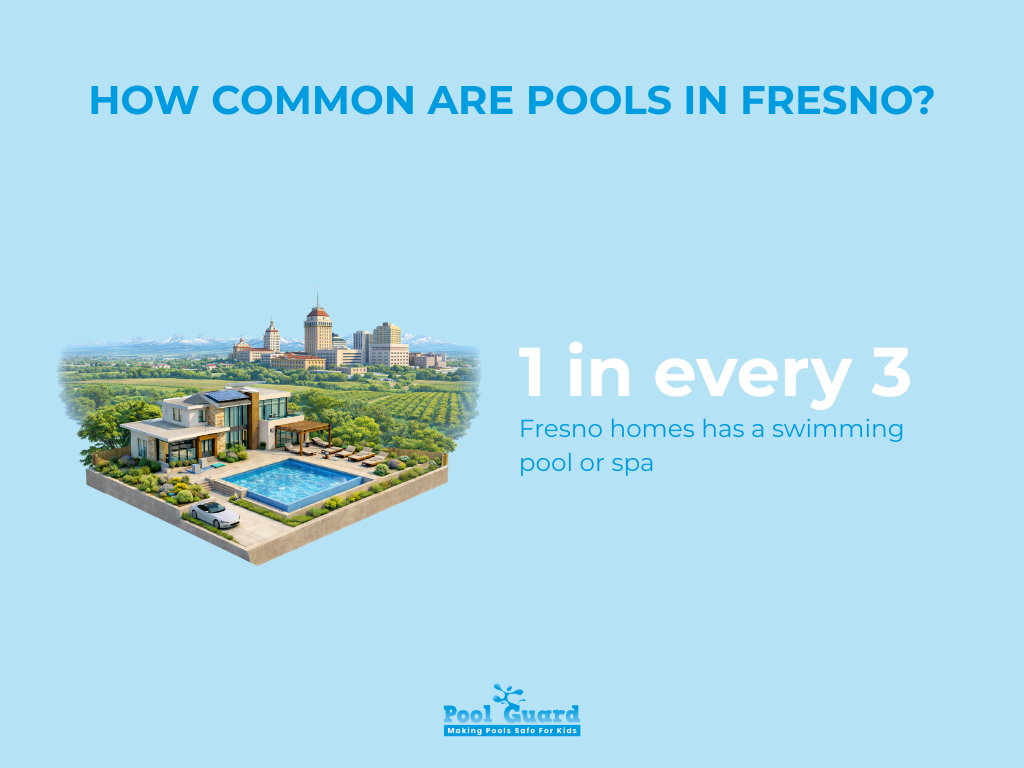
An estimated 1 in every 3 Fresno homes has a swimming pool or spa. That’s a significantly higher rate of swimming pools per capita than the national average, and it comes with an underappreciated layer of risk. According to surveys conducted by Dr. Mark M. Simonian, MD FAAP – drawing from local pediatric practices – 1 out of 4 families with a pool report a close call where a child nearly drowned or was seriously injured before being rescued.
That’s not a rare edge case. That’s a pattern.
The data on drowning deaths in Fresno County is sobering – and consistent. According to the Water Safety Council of Fresno County, which analyzed hospitalization data from Valley Children’s Hospital spanning 1999 to 2012:
These numbers reflect a local pattern of a much larger national issue. Explore U.S. pool drowning statistics to see how Fresno compares across the country.
In the 1980s and 1990s, 30 to 40 children were hospitalized annually at Valley Children’s Hospital due to non-fatal drownings in Fresno County. Since 1999, those numbers have declined – a trend the Water Safety Council attributes to improved safety awareness, wider CPR adoption, and increased use of pool barriers and fencing.
Even during the COVID-19 pandemic, when drowning rates rose nationally in 2020, Fresno County managed to hold the line, recording lower numbers than in prior years. That’s a meaningful public health success – but not a reason for complacency.
Fresno County’s Department of Public Health oversees more than 1,300 public pools, each inspected twice a year by a team of 23 environmental health inspectors – the same staff who handle restaurant inspections and consumer complaints.
The definition of “public pool” is broad: it includes pools at apartment complexes, condominiums, mobile home parks, hotels, schools, health clubs, water parks, and city parks – essentially any pool that isn’t a private single-family backyard.
In 2019, the data revealed a troubling picture:
According to Maryjane Day, a supervising environmental health specialist with Fresno County, the most common closure trigger is chemical imbalance – specifically no chlorine or dangerously high pH levels.
Other closure causes include:
“A pool is like a baby,” Day noted. “Once you neglect the chlorine, it’s a problem to get things back in balance.”
The county’s longest-running closure in 2019 was at the Dorado Apartments on West Belmont Avenue in southeast Fresno, where a non-functioning safety fence was flagged in January, with additional gate and drain cover violations discovered during a follow-up inspection in April.
Wayne Fox, director of the environmental health division, put the human cost of lax fencing standards in stark terms, recalling a case where a child broke through a plywood-covered gap in a closed pool’s fence – and drowned.
“If there’s a problem with the gate or the fencing is bad, close the pool,” Fox said.
It’s an uncomfortable fact, but a scientifically documented one. A 2012 research survey found that roughly 1 in 5 adults admitted to urinating in a swimming pool. Canadian and Chinese researchers later developed a method to measure urine levels in pools using chemical byproducts of an artificial sweetener excreted in human urine:
There is currently no legal threshold for urine levels that would trigger a pool closure – but it’s one more reason to keep chemical balances dialed in.
The City of Fresno operates a tiered system of public aquatic facilities, all opening on June 16, 2025, running 7 days a week from 1–5pm, with free admission at all locations.
Full-Sized Municipal Pools:
Learner Pools (2.5–5 feet deep, for ages 5–12):
Wader Pools (1 foot deep, no age restriction – perfect for toddlers):
Splash Parks (free, open 10am–8pm daily from May 24th): Nine locations across Fresno, including Dickey Playground, Figarden Loop Park, Todd Beamer Park, and Melody Park, among others.
The City of Fresno PARCs department partners with Fresno Unified to provide free and low-cost swim lessons at 6 high school pools, one community pool, Fresno State, and Break the Barriers. Classes span all skill levels – from parent-child water familiarity sessions to advanced stroke development for swimmers who can already cover 25 meters.
For families wanting more than a municipal pool, Fresno’s private waterpark options include:
Beyond public pools, Fresno’s competitive and recreational swim community is supported by 16 swimming leagues and clubs in the greater metro area. Together, they:
Key organizations include:
The statistics above aren’t just numbers – they point directly to what works and what doesn’t. Here’s what Fresno’s own data supports:
Research cited by the Water Safety Council indicates that installation of four-sided isolation fencing could prevent 50 to 90 percent of childhood residential pool drownings. Yet broken or inadequate fencing remains one of the most cited violations in Fresno County pool inspections. The gap between what we know works and what’s actually installed is costing children their lives.
California – alongside Arizona, Florida, and Oregon – has enacted safety laws requiring some type of fencing around residential pools, but enforcement at the individual home level remains inconsistent.
Most children who drown in swimming pools were last seen napping inside the home and had been missing for less than five minutes – often while in the care of one or both parents. No fence, alarm, or flotation device substitutes for direct adult supervision.
“They can have all the safety equipment, all the fences up, all the chemistry balanced, but if you’re not watching your kid, someone can drown,” said Wayne Fox of the Fresno County Health Department.
Fresno pool statistics are giving a thought of a community doing some things right – drowning hospitalizations are down since the 1990s, free swim education is expanding, and public inspection programs are active – but with significant gaps that still cost lives every summer.
The core takeaways:
If you’re a pool owner in Fresno, this data is your checklist. If you’re a parent, it’s your wake-up call. And if you’re a public health advocate or journalist, it’s your roadmap for where the work still needs to happen.
Protect your pool. Protect your family. Explore Poolguard USA’s full range of pool fences and other safety barrier solutions – built specifically for the risks that Fresno’s statistics make impossible to ignore.
Please fill out the form below with your information. Your local dealer will be notified about your inquiry.
Please fill out the form below with your information. Your local dealer will be notified about your inquiry.