If your pool water level keeps dropping, evaporation—not leaks—is almost always the reason. The problem? Most pool owners drastically underestimate how much water evaporates, how fast it happens, and how expensive it becomes over a year.
This guide delivers what competitors don’t: a clear, data-driven pool water evaporation chart, real benchmarks for what’s normal, and the exact variables that cause water loss to spike—sometimes overnight.
By the end, you’ll know precisely how much pool water evaporates daily, when evaporation becomes excessive, and how to cut losses by up to 95%.
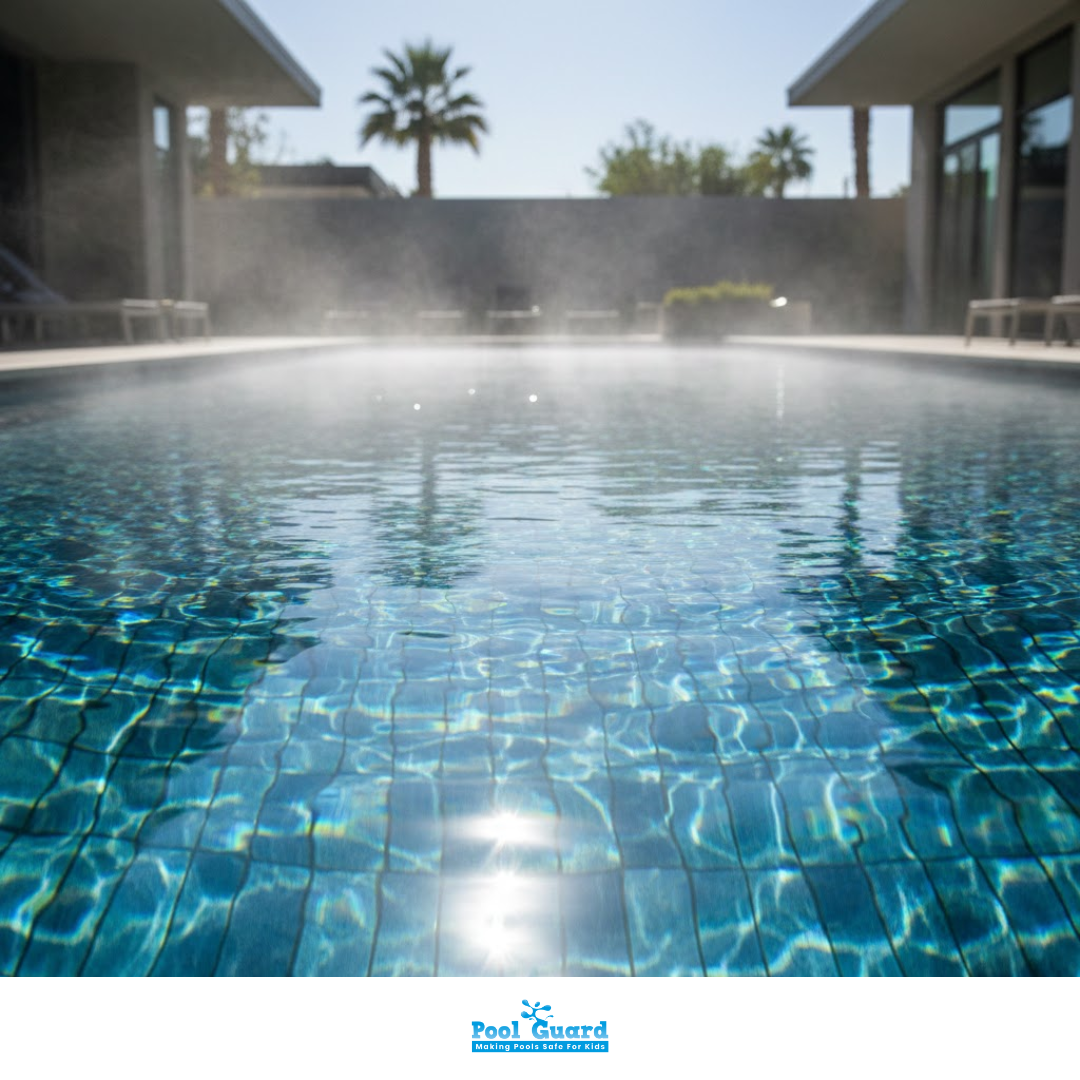
Pool water evaporation happens every day, whether you notice it or not. While the exact rate varies based on climate, weather conditions, pool temperature, and exposure, decades of field measurements and engineering models show that evaporation follows predictable, measurable patterns. Understanding these baseline numbers is critical—because once you know what normal evaporation looks like, it becomes much easier to identify excessive water loss, estimate long-term costs, and decide whether prevention measures (like covers or wind protection) are worth the investment.
The following figures represent real-world averages for residential swimming pools and are widely used by pool professionals, builders, and inspectors as practical benchmarks. They reflect evaporation modeling and observational data published by the U.S. Geological Survey, the U.S. Environmental Protection Agency, and established pool engineering standards.
Quick facts every pool owner should know:
These numbers are consistent with evaporation modeling published by the U.S. Geological Survey, the U.S. Environmental Protection Agency, and pool engineering standards.
Pool water evaporation is driven by a combination of temperature, humidity, and air movement—not temperature alone. The chart below shows how these variables interact to affect daily and monthly water loss for a typical 400-square-foot residential swimming pool. Rather than presenting a single “average,” this table illustrates realistic scenarios pool owners commonly experience during warm weather, from calm, humid days to hot, dry, windy conditions that cause evaporation to spike.
Use this chart to estimate how much water your pool is likely losing under current conditions, compare normal versus excessive evaporation, and understand why two pools in the same neighborhood can experience very different water loss rates.
| Water Temp | Air Temp | Humidity | Wind | Daily Loss (in) | Daily Gallons | Monthly Gallons |
|---|---|---|---|---|---|---|
| 78°F | 80°F | 60% | 0 mph | 0.15 | ~37 | ~1,100 |
| 82°F | 90°F | 40% | 5 mph | 0.30 | ~75 | ~2,250 |
| 85°F | 95°F | 30% | 10 mph | 0.60 | ~150 | ~4,500 |
| 88°F | 100°F | 20% | 15 mph | 1.00+ | 250+ | 7,500+ |
Key takeaway: Wind and humidity matter more than temperature alone. Most charts ignore this—yours shouldn’t.
When pool water evaporates, most owners think in terms of inches—but water bills, chemical costs, and heating losses are measured in gallons. This conversion gap is where evaporation quietly becomes expensive. The calculator below translates water level drop into real volume, making it easier to estimate daily losses, monthly costs, and the true impact of evaporation on pools of different sizes.
Use this section whenever you measure water loss with a ruler, bucket test, or skimmer mark and want to understand how much water actually disappeared, not just how far the level dropped.
| Pool Size | Gallons per Inch |
|---|---|
| 10,000 gal | ~620 gallons |
| 15,000 gal | ~930 gallons |
| 20,000 gal | ~1,240 gallons |
| 25,000 gal | ~1,550 gallons |
| 30,000 gal | ~1,860 gallons |
How to use this table:
Measure how many inches your pool water level dropped, then multiply by the value in the right column. For example, a 20,000-gallon pool that drops 0.5 inches loses roughly 620 gallons of water.
For pools that don’t match standard sizes—or for more precise calculations—use the engineering formula below:
Gallons Lost = Surface Area (sq ft) × 0.62 × Inches Lost
This equation is based on water volume conversion standards used in pool engineering and evaporation modeling developed under ASHRAE guidelines.
This pool evaporation calculator estimates water loss based on surface area and inches lost for residential pools of all sizes.
One of the most common—and most misunderstood—questions pool owners ask is: how much evaporation is normal for a pool? The short answer is that there is no single universal number. Normal evaporation depends heavily on regional climate, seasonal weather patterns, and local air conditions, which is why two pools of the same size can lose water at very different rates.
Rather than relying on generic averages, it’s far more accurate to evaluate pool evaporation using climate-based benchmarks. The ranges below reflect real-world observations used by pool professionals and inspectors to distinguish normal evaporation from excessive or abnormal water loss.
In dry, desert climates, evaporation rates are the highest in the country due to consistently low humidity, high solar exposure, and frequent wind. Even properly functioning pools can lose substantial amounts of water without any leaks present.
In these regions, it is normal for pools to lose ⅜ to ½ inch of water per day during warm months. Over the course of a week, that adds up to 2–3 inches, and annually it often totals 15,000 to 25,000 gallons for an uncovered residential pool. These losses are considered typical—not excessive—given the environmental conditions.
Humid regions experience noticeably lower evaporation rates because moist air slows the evaporation process. While temperatures may be high, the air’s ability to hold additional moisture is limited, which naturally suppresses water loss.
In these climates, daily evaporation typically falls between ⅛ and ¼ inch, with weekly losses closer to 1–1.5 inches. On an annual basis, most uncovered pools lose approximately 7,000 to 12,000 gallons to evaporation—often less than half the losses seen in arid regions.
Pools in coastal and northeastern climates experience the widest seasonal variation. During summer, evaporation rates commonly reach ¼ inch per day, similar to other temperate regions. In spring and fall, losses usually decline to ⅛–¼ inch per day as temperatures moderate.
Winter evaporation is often overlooked but can be surprisingly significant. Cold air holds less moisture, which increases the vapor pressure difference between the pool water and the surrounding air. As a result, uncovered pools can still lose water during cold, dry winter spells—even when temperatures are low and the pool is not in use.
Evaporation accelerates as the temperature gap (ΔT) between water and air increases.
It speeds up when the physical conditions around the pool make it easier for water molecules to escape into the air. The most important driver is the temperature difference between the water and the surrounding air, which increases vapor pressure and accelerates moisture loss. Humidity and wind then determine how quickly that vapor is carried away, turning small temperature gaps into significant daily water loss.
| ΔT (Water vs Air) | Evaporation Rate |
|---|---|
| 5°F | ~0.15 in/day |
| 10°F | ~0.25 in/day |
| 20°F | ~0.40 in/day |
Humidity is the most underestimated evaporation driver.
Wind is one of the most powerful—and most underestimated—drivers of pool water evaporation. As air moves across the water surface, it continuously removes moisture-saturated air and replaces it with drier air, allowing evaporation to accelerate far beyond what temperature alone would suggest. Even moderate wind speeds can double or triple daily water loss, which is why two pools at the same temperature can evaporate at drastically different rates.
| Wind Speed | Evaporation |
|---|---|
| 0 mph | 0.1–0.2 in/day |
| 5 mph | 0.3–0.6 |
| 10 mph | 0.6–1.0 |
| 15 mph | 1.0–1.4 |
| 20 mph | 1.4–1.8 |
Sun exposure accelerates pool water evaporation by continuously adding energy to the water surface throughout the day. Pools in full, direct sunlight absorb more heat, increasing surface temperature and driving faster moisture loss—an effect that is especially pronounced in dry or windy climates. Even partial shade can meaningfully reduce evaporation by limiting this constant thermal input.
Heated pools evaporate significantly faster because warm water holds more energy and creates a larger vapor pressure difference with the surrounding air. As a result, heated pools can lose water 2–4 times faster than unheated pools under the same conditions. Every gallon that evaporates also removes heat (measured in BTUs), forcing reheating and compounding both water loss and energy cost.
Pool evaporation follows predictable seasonal patterns, but the magnitude of water loss varies significantly by climate. Warmer months drive the highest evaporation rates due to increased temperatures and sun exposure, while winter losses are often underestimated—especially in dry or coastal regions where cold, low-humidity air continues to pull moisture from the water surface. The table below compares typical monthly evaporation ranges across major climate zones to help distinguish normal seasonal loss from abnormal behavior.
| Season | Dry Climate | Humid Climate | Coastal |
|---|---|---|---|
| Spring | 7–9 in | 5–6 in | 4–5 in |
| Summer | 10–12 in | 6–8 in | 6–7 in |
| Fall | 5–7 in | 4–5 in | 4–6 in |
| Winter | 2–4 in | 2–3 in | 3–4 in |
Pool covers are the single most effective way to reduce pool water evaporation, because they physically block moisture from escaping the water surface. While all covers provide some benefit, the degree of evaporation reduction varies significantly by pool cover type, material, and how completely the pool surface is sealed. The table below compares realistic evaporation savings based on real-world performance rather than manufacturer claims.
| Cover Type | Evaporation Reduction |
|---|---|
| Solar Cover | 90–95% |
| Automatic Safety Cover | 85–95% |
| Mesh Cover | 50–80% |
| Liquid Pool Cover | 15–40% |
Covers are by far the most effective control lever—nothing else is close. Understanding pool net vs cover differences can help clarify why some options reduce evaporation more effectively than others.
One of the most important distinctions for pool owners to make is whether water loss is caused by normal evaporation or an underlying leak. Evaporation occurs gradually and follows predictable environmental patterns, while leaks typically cause accelerated or inconsistent water loss that exceeds normal benchmarks. The table below provides a quick reference to help determine when water loss falls within normal evaporation ranges and when further investigation is warranted.
| Loss Rate | Interpretation |
|---|---|
| ¼–½ in/day | Normal |
| >1 in/day | Abnormal |
| >2 in/day | Likely leak |
The bucket test is one of the simplest and most reliable methods for determining whether pool water loss is caused by normal evaporation or a leak. However, the test is only useful when it’s performed carefully and interpreted correctly, since environmental factors like wind and circulation can significantly affect results.
To improve accuracy, the test should be run using a covered versus uncovered comparison, ensuring the bucket water and pool water experience identical exposure. It’s also important to run the test during both pump-on and pump-off cycles, as some leaks only occur when the system is pressurized. Whenever possible, avoid performing the test on windy days, or adjust expectations upward to account for increased evaporation caused by air movement.
Key bucket test considerations:
If the pool water level drops more than the bucket water under identical conditions, evaporation alone is unlikely to be the cause and a leak should be suspected.
While the bucket test helps confirm whether a leak may be present, it does not identify where the water is escaping. In practice, leaks often reveal themselves through a combination of physical, chemical, and operational warning signs that develop gradually.
One of the earliest indicators is rapid chemical imbalance, as leaking water carries sanitizers and dissolved minerals out of the pool faster than normal evaporation would. Persistent wet or mushy soil around the pool shell, equipment pad, or plumbing runs can signal underground leakage. Structural issues—such as visible cracks in the pool shell, deck, or tile line—may also indicate that water is escaping below the surface.
Common leak warning signs include:
Water loss that occurs only while the pump is operating often points to pressure-side plumbing issues or leaks in auxiliary features such as spas or waterfalls.
Pool design plays a major role in how much water is lost to evaporation. Differences in surface area, elevation, water movement, and exposure mean that certain pool types lose water far faster than others—even in the same climate.
Inground pools typically experience the highest absolute evaporation loss because they have the largest exposed surface area. While the evaporation rate per square foot may be similar to other pools, the total volume lost adds up quickly.
Above-ground pools generally contain less water, but they are often more exposed to wind due to their elevated profile. This increased air movement can accelerate evaporation, especially in open yards or elevated locations.
Infinity-edge pools experience extreme evaporation because water is constantly flowing over the edge, dramatically increasing surface exposure. Continuous overflow creates ideal conditions for rapid vapor loss, making these pools some of the most evaporation-intensive designs.
Pools with waterfalls, fountains, or spa spillovers lose water significantly faster than static pools. These features increase evaporation by 20–60% almost immediately, as flowing water continuously replaces moisture-saturated air with dry air.
Reducing pool evaporation isn’t just about conserving water—it’s about return on investment. Some strategies dramatically reduce water loss with minimal effort, while others provide smaller gains but still make sense when combined strategically. The table below compares the most effective evaporation-reduction methods, showing both their typical reduction range and their real-world ROI based on water savings, energy reduction, and long-term operating costs.
This comparison helps prioritize which solutions deliver the largest impact per dollar spent, rather than treating all evaporation controls as equal. Long-term performance also depends on maintaining a pool cover properly, since poor upkeep can reduce effectiveness over time.
| Method | Reduction | ROI |
|---|---|---|
| Automatic cover | 85–95% | Very high |
| Solar cover | 90–95% | High |
| Windbreaks | 20–40% | Moderate |
| Lower temp | 10–25% | High |
| Automation | Variable | High |
Evaporation doesn’t just lower water levels—it quietly increases the total cost of pool ownership. Every gallon of water lost must be replaced, reheated, and chemically rebalanced, which compounds expenses over time. Many pool owners significantly underestimate these secondary costs because they’re spread across utility bills and maintenance purchases.
The table below estimates the annual financial impact of evaporation for a typical 400-square-foot residential pool, breaking costs into water replacement, heating energy, and chemical loss. Together, these figures illustrate why even “normal” evaporation can become a four-figure annual expense if left unmanaged.
| Category | Estimated Cost |
|---|---|
| Water | $200–600 |
| Heating | $300–1,200 |
| Chemicals | $150–400 |
| Total | $650–2,200/year |
Get a printable, climate-based pool water evaporation chart you can reference anytime. It includes daily and seasonal benchmarks, gallon-loss conversions, and cost estimates to help you quickly determine what’s normal and when action is needed.
Pool water evaporation is a normal, predictable process driven by temperature, humidity, wind, and exposure—but the water loss is often far greater than most pool owners expect. Left unmanaged, even “normal” evaporation can add up to thousands of gallons and significant annual costs.
By using this pool water evaporation chart, you can quickly determine whether your pool’s water loss is within normal limits for your climate, identify when evaporation becomes excessive, and rule out potential leaks with confidence. In many cases, simple measures—especially installing a properly fitted pool cover—can reduce evaporation by up to 95%.
Evaporation may be unavoidable, but unnecessary water loss isn’t. This chart gives you the data you need to manage your pool efficiently, accurately, and without guesswork—or you can explore pool safety and efficiency solutions for a more comprehensive approach.
Evaporation is normal — excessive loss isn’t!

Find your local dealer by entering your zip code above.
Please fill out the form below with your information. Your local dealer will be notified about your inquiry.
Please fill out the form below with your information. Your local dealer will be notified about your inquiry.