If ducks are using your pool, you don’t have a wildlife “nuisance.” You have a behavior and hygiene problem that will escalate unless it’s solved correctly. Ducks don’t wander into pools by accident. They evaluate water sources, test safety, and once they succeed, they adopt the location.
Ongoing contamination from wildlife can quickly turn into broader pool hazards if not addressed properly. That’s why homeowners keep asking how to keep ducks out of pool (and why quick fixes almost always fail).
This guide explains why ducks are attracted to swimming pools, the real health risks of duck poop in pool water, why most deterrents stop working, and the how to keep ducks away from pool for good—without harming wildlife or relying on gimmicks.
Ducks are not impulsive animals. They are cautious, pattern-driven, and highly responsive to environmental cues. Unfortunately, a residential pool sends all the wrong signals.
Swimming pools closely mimic calm, predator-free freshwater environments. There is no current, no vegetation obscuring vision, and no natural predators lurking beneath the surface. For a duck flying overhead, this looks safer than most ponds.
Still water plays a critical role. Ducks avoid choppy or turbulent surfaces because movement interferes with their ability to detect predators and land safely. A glassy pool surface is an open invitation.
Reflective water compounds the problem. Smooth pool water reflects light in a way that visually signals depth and safety from above. That reflective surface is one of the strongest attractors for waterfowl.
Pools located near lawns make matters worse. Grass attracts insects and provides feeding opportunities, while nearby landscaping offers resting areas. This creates a feeding–resting loop, encouraging repeated visits.
Once ducks land safely, habit formation begins. Ducks have strong spatial memory. If a location proves safe, they return—often daily and often at the same times.
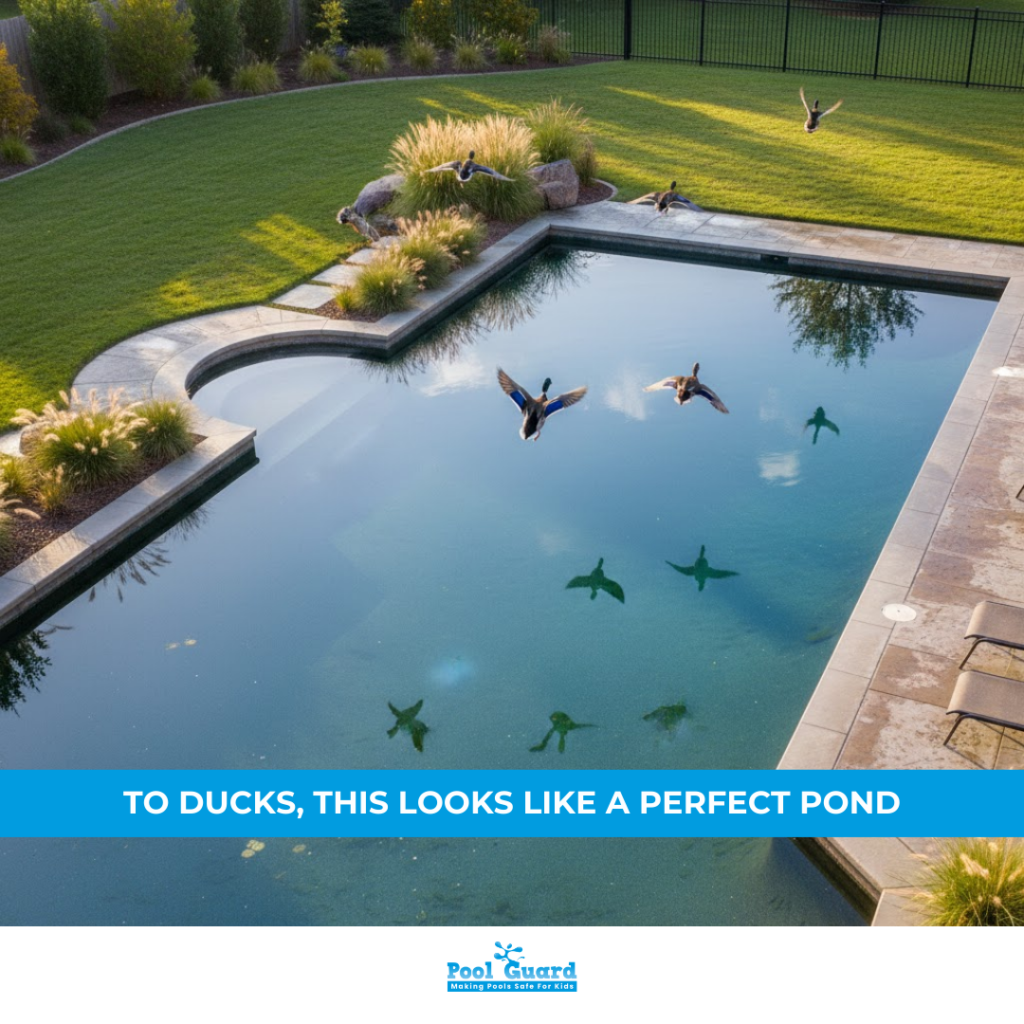
Key takeaway: Ducks don’t “visit” pools. Once they succeed, they adopt them.
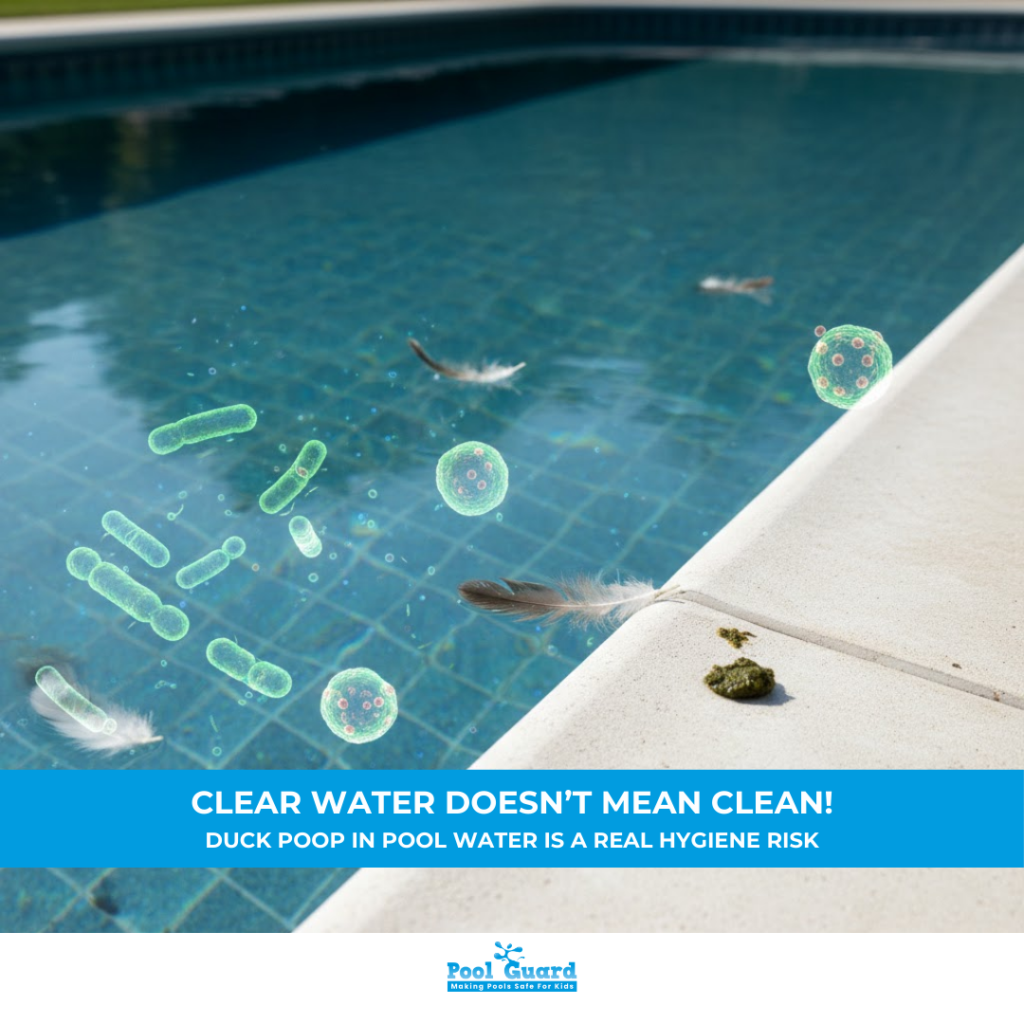
Duck droppings are not just unsightly—they are a documented public health concern. Contaminated water raises the same concerns covered in whether pool water can make you sick.
Wild ducks and geese commonly carry harmful pathogens, including E. coli, Salmonella, Campylobacter, and Cryptosporidium. Cryptosporidium is especially problematic because it is highly resistant to chlorine.
According to the Centers for Disease Control and Prevention, Cryptosporidium can survive up to seven days in properly chlorinated pool water. That means a single contamination event can pose a risk long after the pool appears clean.
Standard chlorination does not instantly neutralize the problem. Duck feces increases organic load, causing chlorine levels to drop rapidly and forcing repeated shocking. Filtration systems strain under the load, and contamination often reoccurs with each return visit.
Guidance from the Environmental Protection Agency confirms that organic waste significantly increases disinfectant demand and reduces treatment effectiveness.
Children, elderly swimmers, and immunocompromised individuals face the highest risk. A clear pool is not necessarily a safe pool.
Most advice about how to deter ducks from a pool ignores one critical factor: habituation.
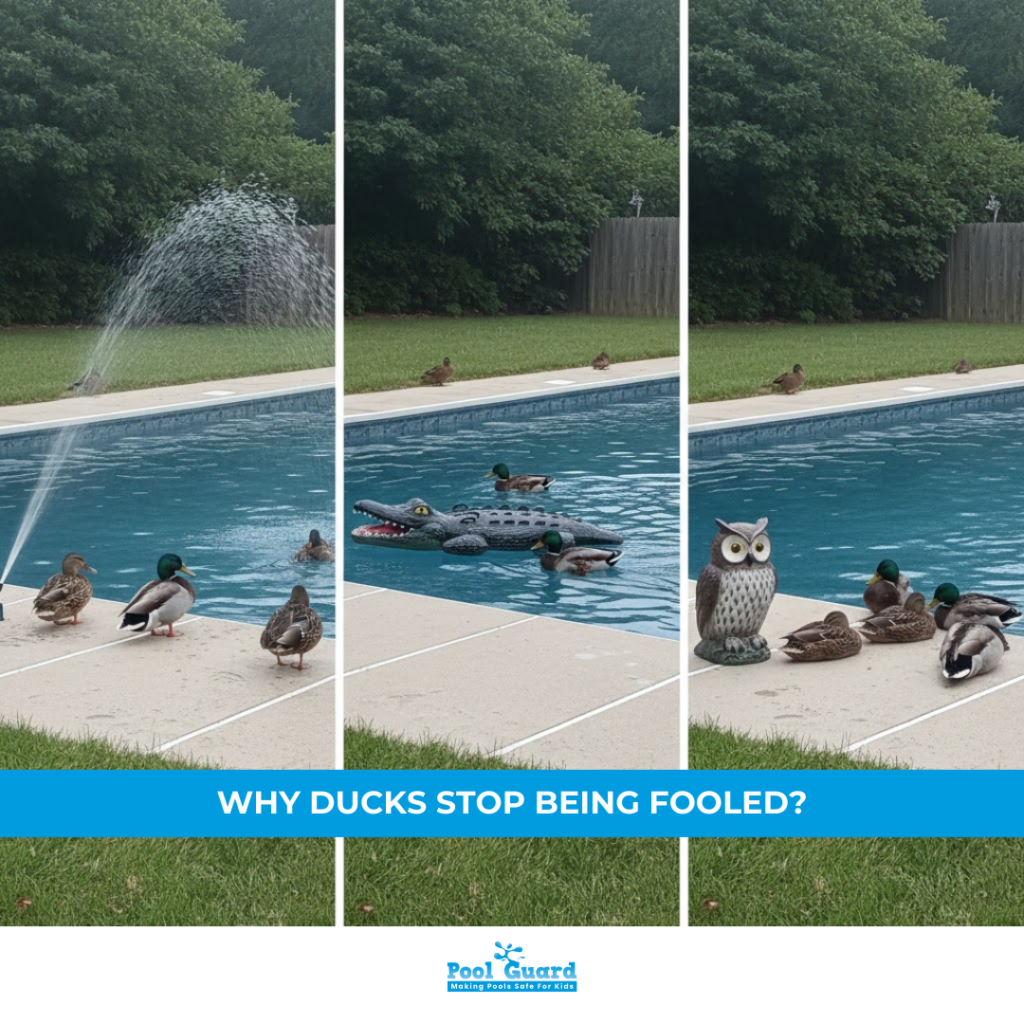
Ducks quickly learn which threats are real and which are harmless. Noise deterrents, sprinklers, and visual decoys work briefly, then fail once ducks recognize the pattern.
Motion deterrents only work when active. If a sprinkler isn’t triggered at the moment a duck lands, it’s irrelevant. Floating toys and decoys lose effectiveness within days, becoming background objects.
Timing makes the problem worse. Ducks most often land at dawn and dusk, when:
Nighttime behavior is rarely addressed by DIY solutions, yet it’s when most re-contamination occurs.
Some measures can disrupt behavior temporarily, but none should be mistaken for prevention.
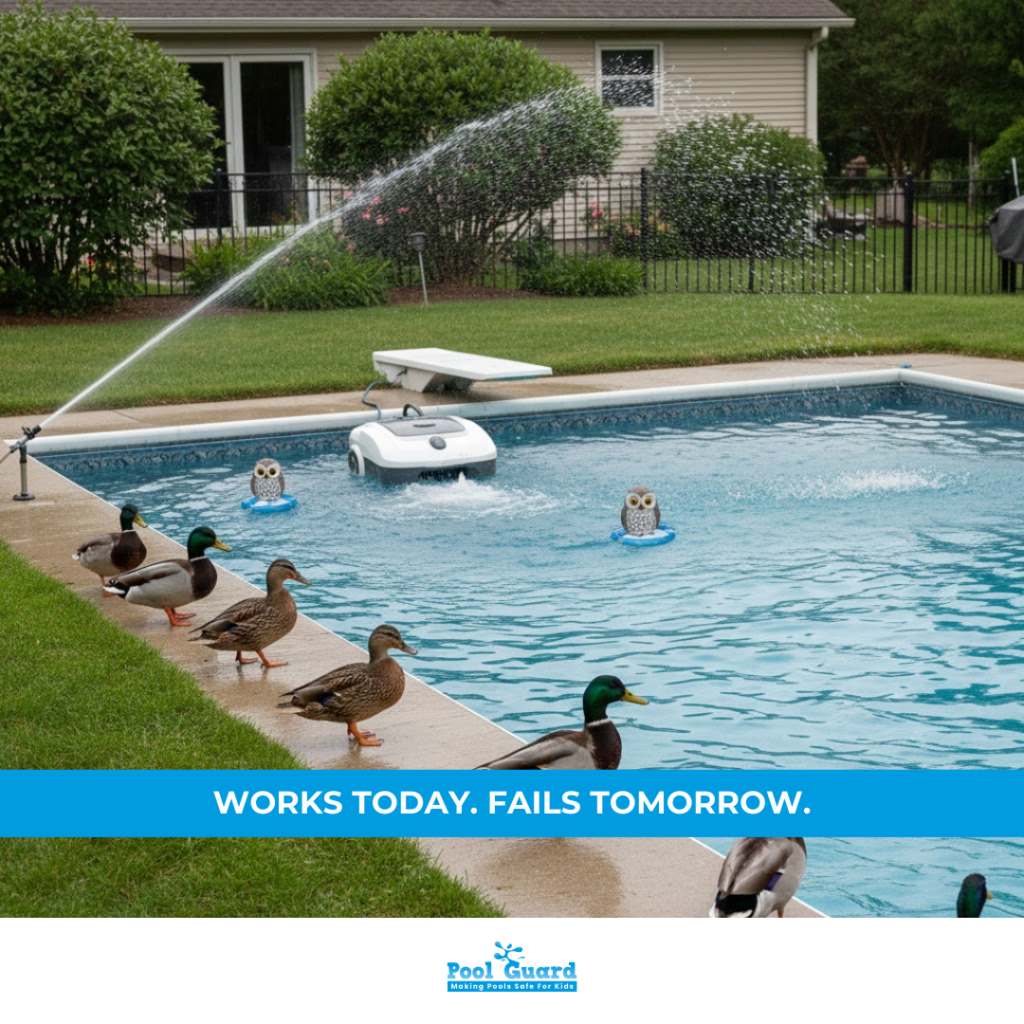
Motion-activated sprinklers can startle ducks initially and may reduce daytime landings. However, effectiveness typically drops after one to two weeks, and they are unreliable at dawn, dusk, and night.
Predator decoys and large pool floats work by triggering visual caution. Ducks quickly learn that static threats pose no danger. Rotating decoys slows habituation slightly but does not eliminate it.
Pool cleaners and water movement reduce calm landing conditions and can discourage initial touchdown. Once the water is still again, ducks return.
These methods are behavior interrupters, not solutions.
The only consistently reliable strategy is physical access prevention.
The principle is simple:
If ducks can’t land, they stop returning.
No landing means no habit loop.
You don’t chase ducks away—you remove the ability to use the pool.
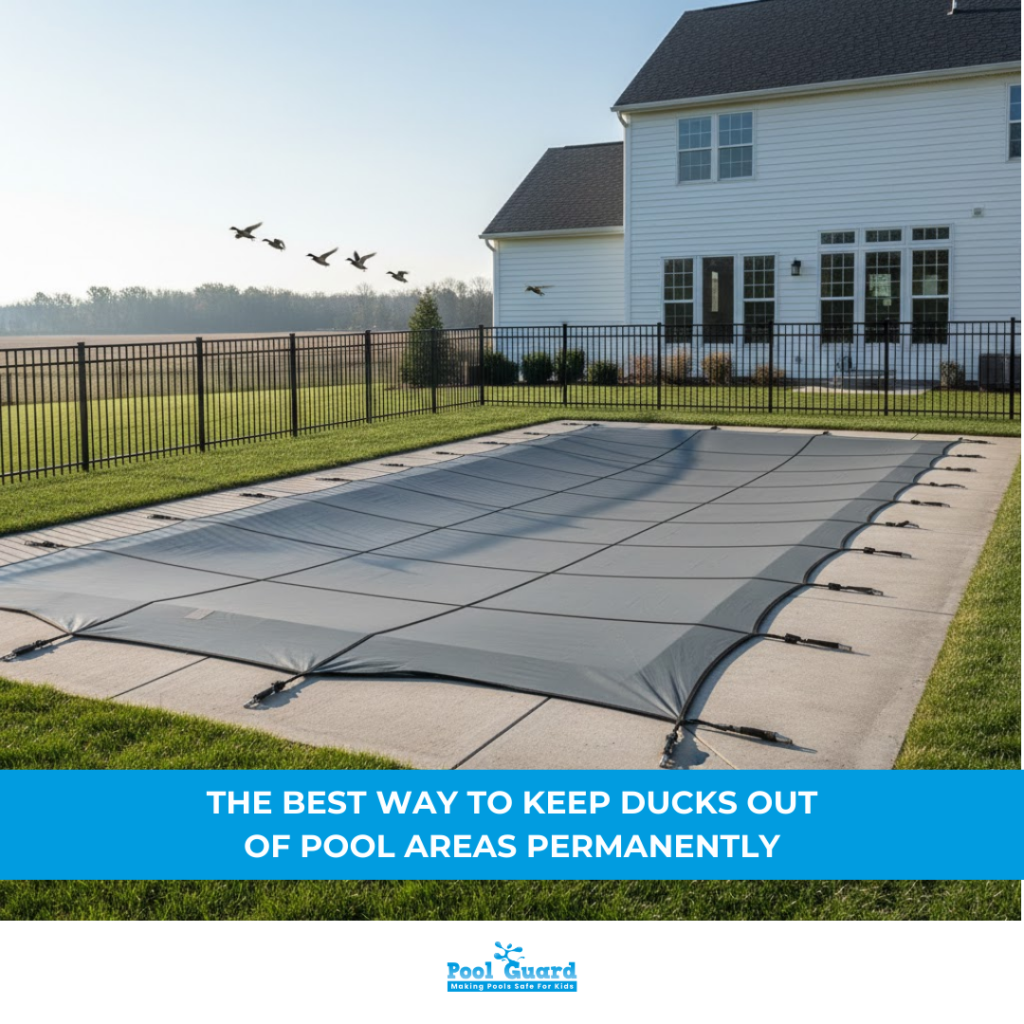
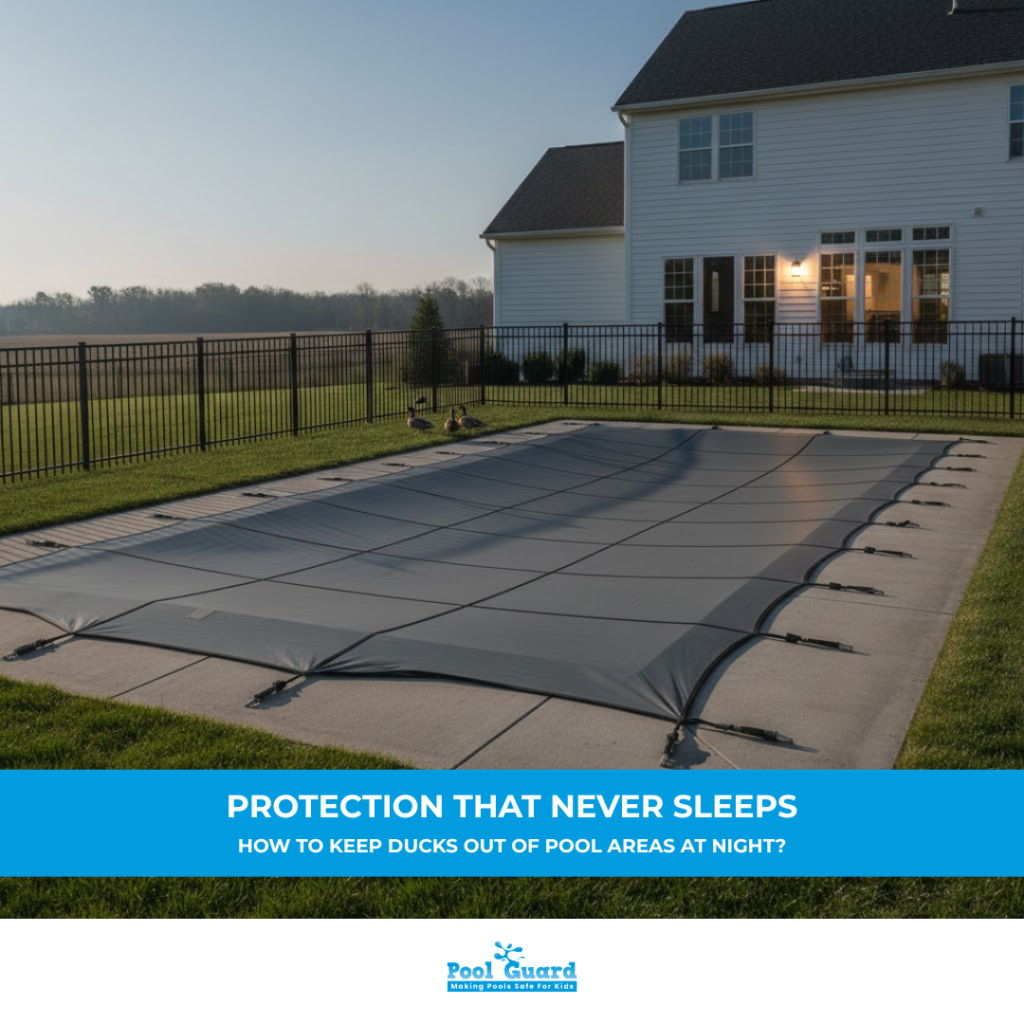
Pool covers eliminate reflective water cues and prevent landing entirely. Ducks will not attempt to land on covered surfaces. Covers are especially effective at night and during early morning hours when other deterrents fail. Pool covers eliminate reflective water cues and prevent landing entirely, making them one of the most effective long-term solutions.
Additional benefits include reduced debris, lower evaporation, and improved chemical stability. Choosing between different options depends on your setup, which is why comparing pool net vs pool cover solutions is important.
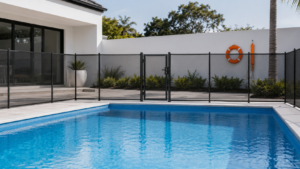
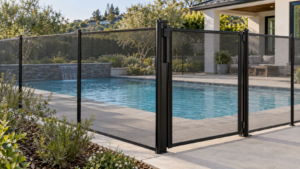
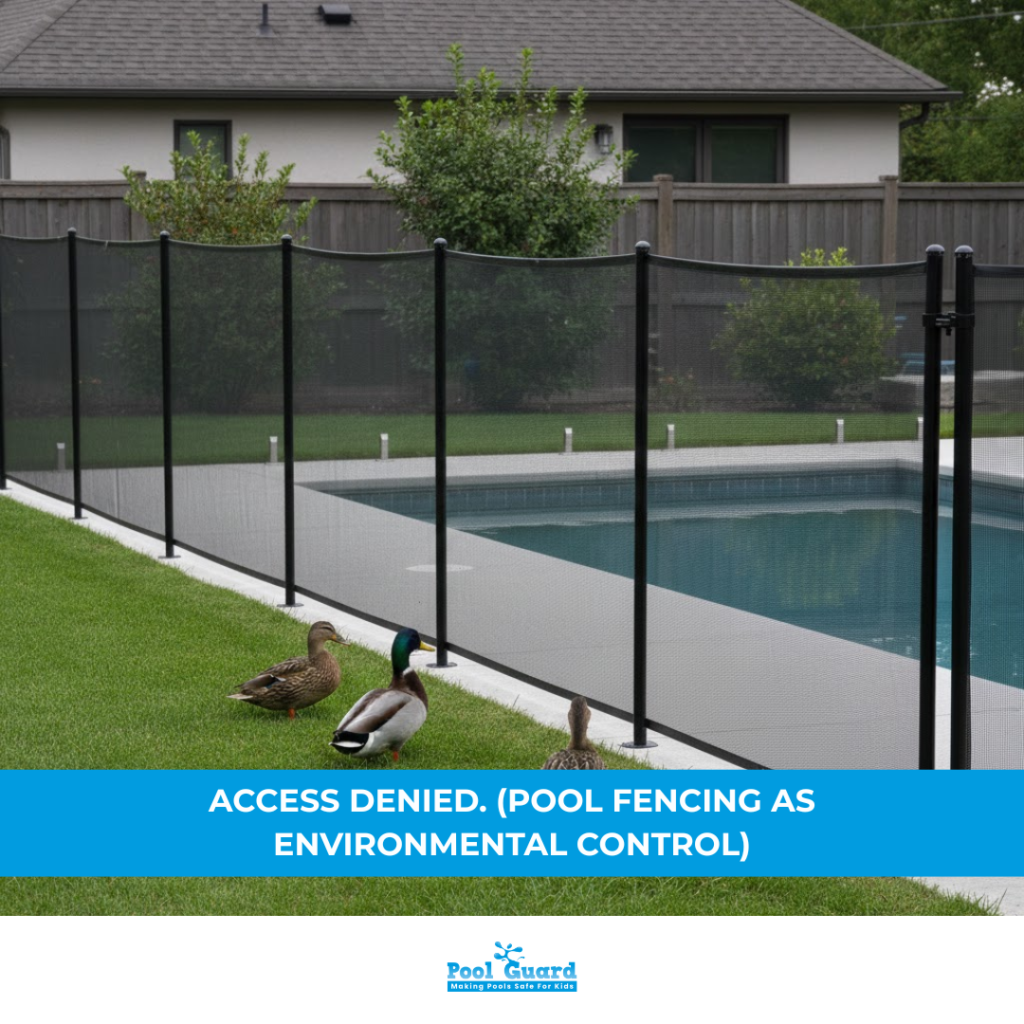
Pool fencing prevents entry and exit access, stopping waddling, nesting, and loitering around the pool area. Unlike deterrents, fencing works regardless of time of day or animal behavior.
This is passive, always-on protection. Think of it as access control, not wildlife control.
Nighttime is when most contamination happens.
Ducks prefer dawn and dusk because predator visibility is low and human activity is minimal. Motion-based deterrents struggle in low light and often fail to activate consistently.
Covers and fencing outperform all other methods after dark because they do not rely on sensors, sound, or learning curves. No access means no landing—day or night.
Some commonly suggested tactics are dangerous or illegal.
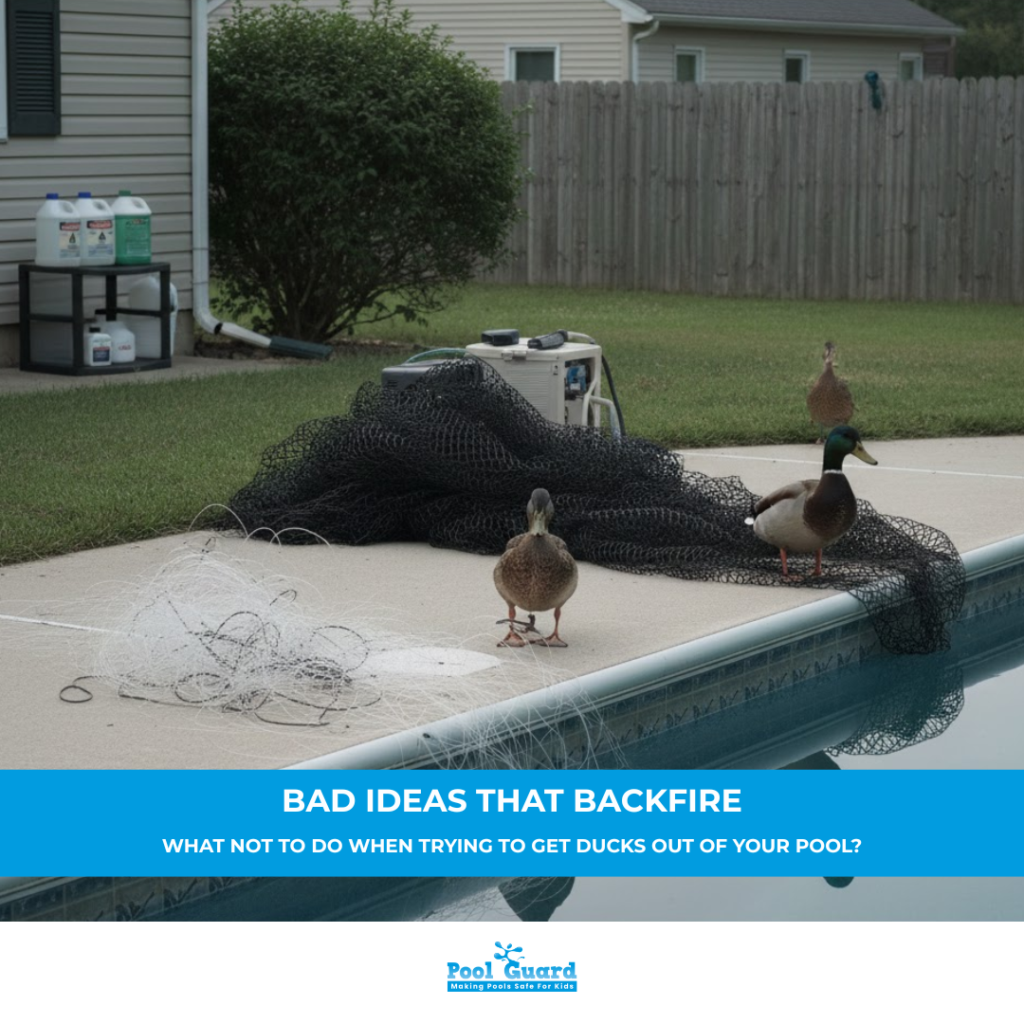
Fishing line, loose bird netting, and makeshift barriers can seriously injure wildlife. Chemical deterrents that alter water chemistry create safety risks for swimmers and animals alike.
Harassing or harming ducks is illegal in many cases. Guidance from the U.S. Fish and Wildlife Service notes that many waterfowl are protected under the Migratory Bird Treaty Act, which restricts harassment, injury, or destruction of nests.
Humane, passive exclusion is the safest and most responsible approach.
Sprinklers, decoys, and pool cleaners can work immediately but fail long-term and offer little nighttime protection. Pool covers and fencing work immediately and permanently, remain humane, and are effective around the clock.
Permanent access control is especially important if:
This is also where pool safety inspections become valuable, ensuring barriers are properly installed and compliant while protecting both people and wildlife.
Ducks don’t choose pools out of stubbornness or curiosity—they choose them because pools offer exactly what they’re looking for: calm water, clear sightlines, and an easy, safe landing zone. Most deterrents only interrupt that behavior temporarily. Sprinklers, decoys, noise, and movement may cause hesitation, but they don’t remove the underlying incentive. As long as ducks can land, they will keep coming back.
The most effective solution is combining physical barriers like pool fences and covers for long-term protection. When you physically remove access to the water surface, you eliminate the behavior entirely. No landing means no lingering, no contamination, and no need for constant intervention.
By preventing access instead of reacting to visits, you get long-term results:
In the end, the strategy is simple and durable. Ducks move on when a pool is no longer usable to them. If they can’t land, they don’t stay—and that’s the only solution that consistently holds up over time.
Stop Ducks by Removing Access, Not Chasing Them Away!
Find your local dealer by entering your zip code above.
Please fill out the form below with your information. Your local dealer will be notified about your inquiry.
Please fill out the form below with your information. Your local dealer will be notified about your inquiry.