If you own a pool, you already know the truth most marketing glosses over: water is both a luxury and a liability. For families with children or pets, pool safety isn’t theoretical—it’s a daily, emotional concern.
That’s why the debate around pool net vs pool cover keeps coming up. On paper, both promise protection. In reality, they work very differently, fail in different ways, and demand different levels of effort from homeowners.
For many homeowners, the real concern behind this comparison comes down to broader pool hazards that are often underestimated. These risks are reflected in overall drowning statistics that continue to show residential pools as a leading source of incidents.
This guide cuts through marketing claims and explains what actually happens in real backyards, not brochures. We’ll break down how each system works, where each excels, where each falls short, and how to decide which one fits your life—not just your pool.
A pool safety net is a tensioned mesh system that sits securely over the surface of a swimming pool. It is custom-fitted to the pool’s exact shape and anchored into the surrounding deck to create a strong, load-bearing barrier. Unlike covers that seal the pool entirely, a safety net is designed to intercept a fall and prevent a person—especially a child or pet—from entering the water.
Pool safety nets are commonly used as a secondary layer of protection in residential backyards, particularly where homeowners want safety without permanently altering the look or accessibility of the pool area.
Pool safety nets rely on tension and structural anchoring to perform their function effectively:
In short, a pool safety net is designed to stop someone after they fall toward the water, not before they access the pool area.
Pool safety nets are most often chosen in situations where flexibility and aesthetics matter:
This makes pool safety nets a popular option for homeowners seeking a balance between safety, convenience, and appearance—while understanding their limitations compared to other pool safety solutions.
Pool safety nets are built to reduce the risk of serious pool accidents by acting as a physical barrier over open water. Their primary role is to interrupt a fall before full water entry occurs.
Specifically, pool safety nets are designed to prevent:
By catching the body above the waterline, the net buys critical time for supervision and intervention.
It’s equally important to understand the limitations of pool safety nets. They are not a complete safety solution and should never be treated as one.
Pool safety nets are not designed to:
A pool safety net is a risk-mitigation tool, not a removal of the hazard itself. Effective pool safety requires layered protection, supervision, and clear boundaries—not reliance on a single measure.
A pool safety cover is a reinforced fabric or vinyl system that spans the entire pool opening, creating a continuous physical barrier between people and the water. Unlike nets, which respond after a fall occurs, a safety cover is designed to prevent access altogether by sealing off the pool surface when it is not in use.
Pool safety covers are commonly used as a primary safety measure in residential settings and are often paired with other protections for layered risk reduction. Many homeowners compare different types of covers before choosing, especially when reviewing the best pool cover options available.
Pool safety covers function by fully covering the pool and securing tightly to the surrounding structure:
This approach prevents contact with the water rather than reacting after someone has already fallen toward it.
There are several common types of pool safety covers, each serving different needs and preferences:
Each type varies in cost, convenience, maintenance, and level of protection, making it essential to choose based on how the pool is used and the level of safety required.
Pool safety covers are engineered to create a firm, continuous barrier over the pool, stopping access before an accident can occur. Their design focuses on prevention rather than mitigation.
Specifically, pool safety covers help prevent:
By sealing off the pool when it’s not in use, safety covers significantly reduce the risk of unintended water exposure.
In addition to accident prevention, pool safety covers offer practical operational advantages that improve efficiency and reduce upkeep:
These secondary benefits make pool safety covers appealing not only from a safety standpoint, but also for homeowners looking to lower ongoing maintenance costs and preserve water quality over time.
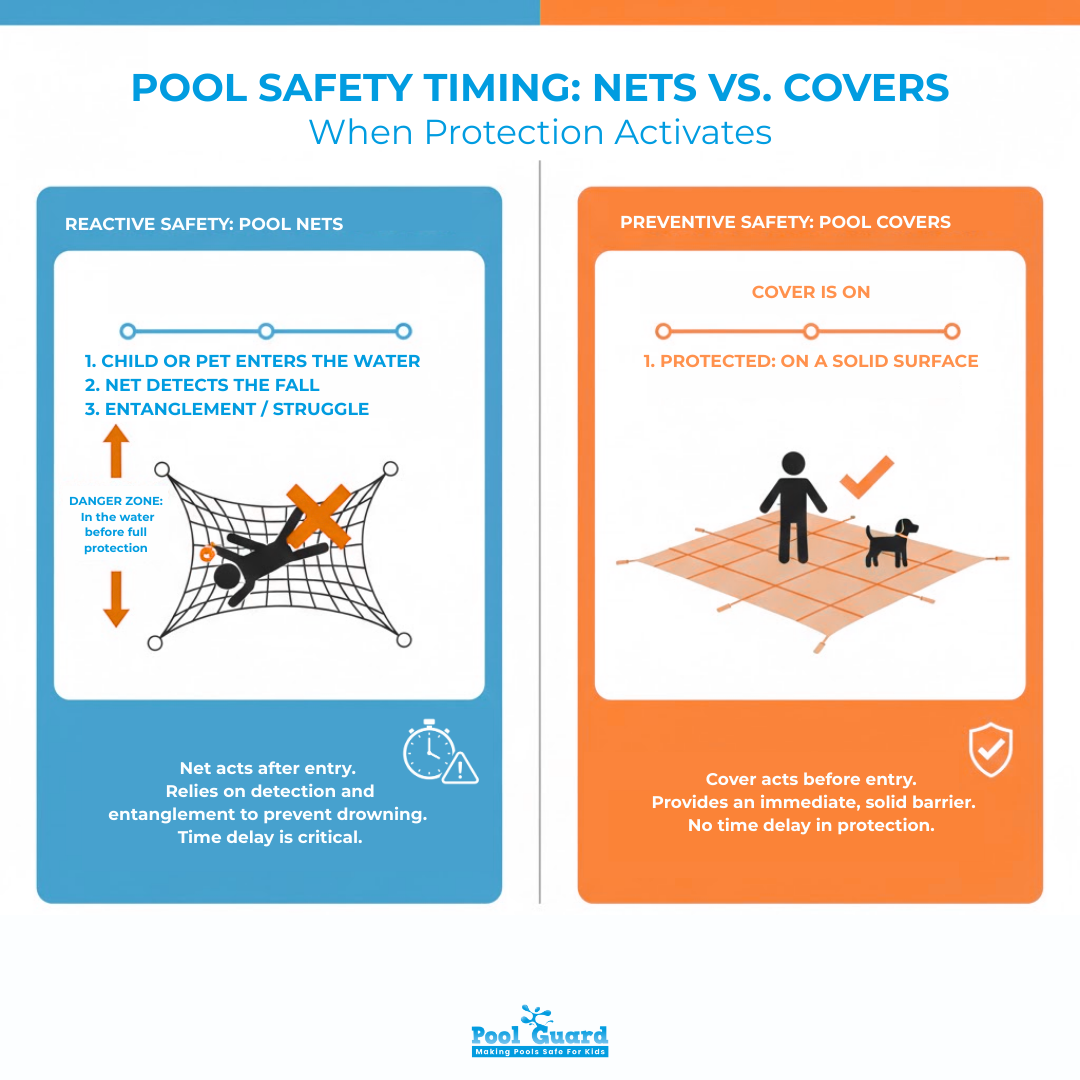
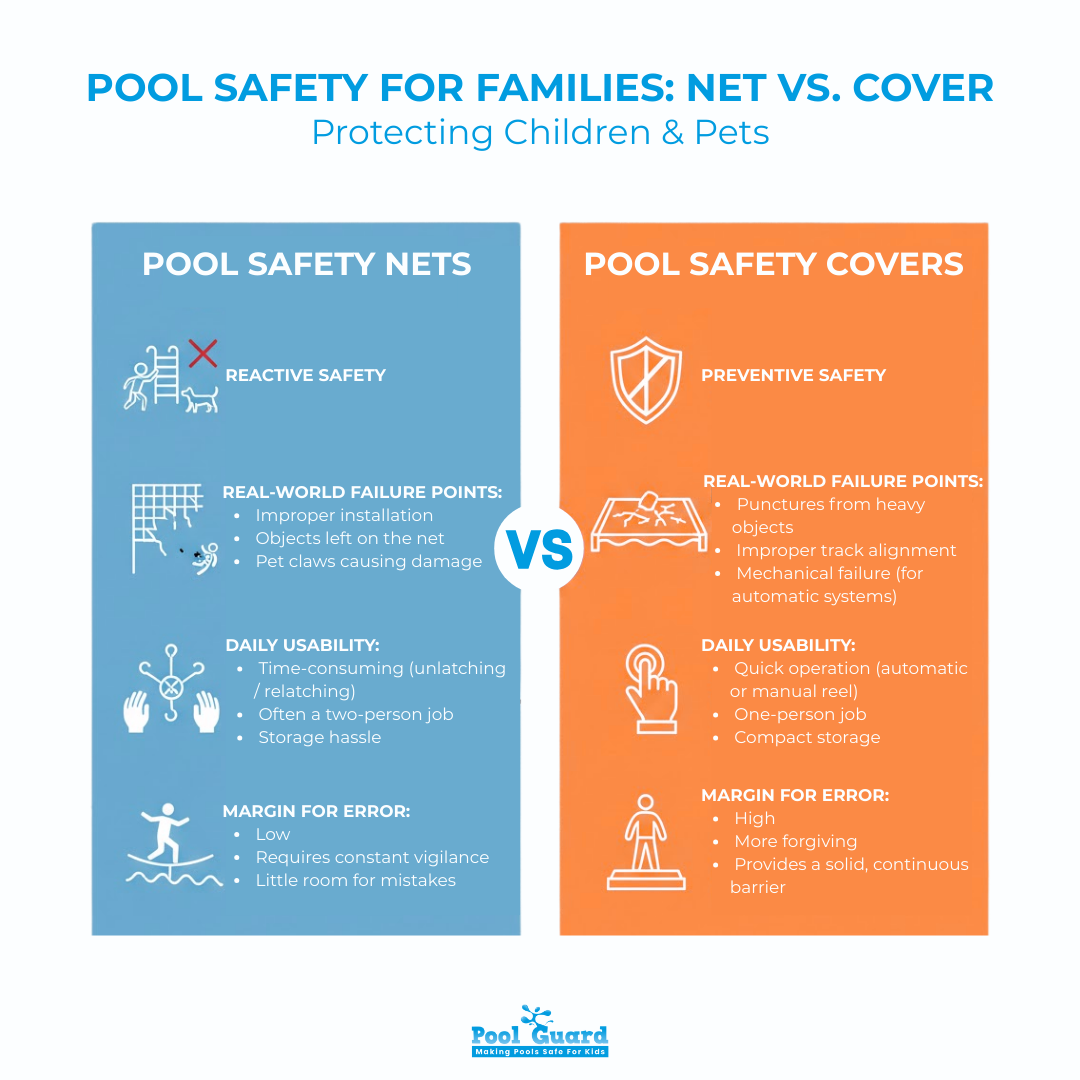
While pool safety nets and pool safety covers are both designed to reduce drowning risk, they approach safety in fundamentally different ways. Understanding these differences is critical when choosing the right solution for your property.
The core distinction lies in how each system handles risk:
If the goal is to stop accidents before they occur, covers provide a more proactive layer of protection.
Day-to-day usability varies significantly between the two options:
For households with frequent pool use, convenience can be a deciding factor.
Aesthetics matter for many homeowners:
This often comes down to personal preference and backyard design priorities.
Both systems require upkeep, but the type of maintenance differs:
Performance in managing debris and water also differs:
The right choice depends on whether safety alone is the priority—or if maintenance, cleanliness, and efficiency also matter.
Choosing between a pool safety net and a pool safety cover comes down to how much prevention, convenience, and margin for error you’re willing to accept. Below is a clear breakdown of the strengths and limitations of pool safety nets.
Pool safety nets are often selected for their simplicity and lower initial investment:
These factors make pool nets appealing for homeowners who prioritize aesthetics and flexibility.
However, pool safety nets come with important trade-offs that should not be overlooked:
Because pool nets are reactive rather than preventive, they require consistent diligence to remain effective.
Pool safety covers are often considered the most comprehensive single-layer pool safety solution. They focus on prevention, efficiency, and long-term practicality—but they also come with trade-offs.
Pool safety covers offer several advantages beyond basic accident prevention:
These benefits make safety covers especially appealing for households seeking both safety and reduced pool upkeep.
Despite their effectiveness, pool safety covers are not without limitations:
For many homeowners, the decision comes down to whether the higher initial investment is justified by the added convenience, prevention, and peace of mind.
Upfront price alone doesn’t tell the full story. Pool safety nets and pool safety covers differ significantly in installation complexity, long-term value, and ongoing cost savings.
At the initial purchase level, the difference is straightforward:
This is often where homeowners stop comparing—but it’s also where many decisions go wrong.
Both systems require professional precision, but for different reasons:
Improper installation in either case reduces effectiveness and shortens lifespan.
Over time, the financial gap often narrows—or reverses:
Covers tend to offset their higher upfront cost through operational efficiency.
A pool net may cost less initially, but if it’s used inconsistently due to inconvenience—or requires frequent adjustment—the real value drops quickly. Pool safety covers, by contrast, reward consistent use and typically deliver stronger long-term return despite the higher initial investment.
Bottom line: if cost is the only filter you’re using, you’re likely underestimating the long-term trade-offs.
There’s no universal “best” option—but there is a better choice depending on how your pool is used, who’s around it, and how much margin for error you’re willing to tolerate.
When young children are involved, prevention matters more than aesthetics:
If a system fails when someone forgets one step, it’s not child-proof.
Pet-related risks are often underestimated, as shown in real pet drowning statistics. Animal behavior introduces unpredictable risk:
For households with dogs or other pets, covers typically offer a safer margin.
Usage frequency changes priorities:
The less often a pool is used, the more valuable full coverage becomes.
This is often the real deciding factor:
Be honest about which trade-offs you’re willing to live with. The wrong choice isn’t the “inferior” product—it’s choosing a system that doesn’t match how your household actually behaves.
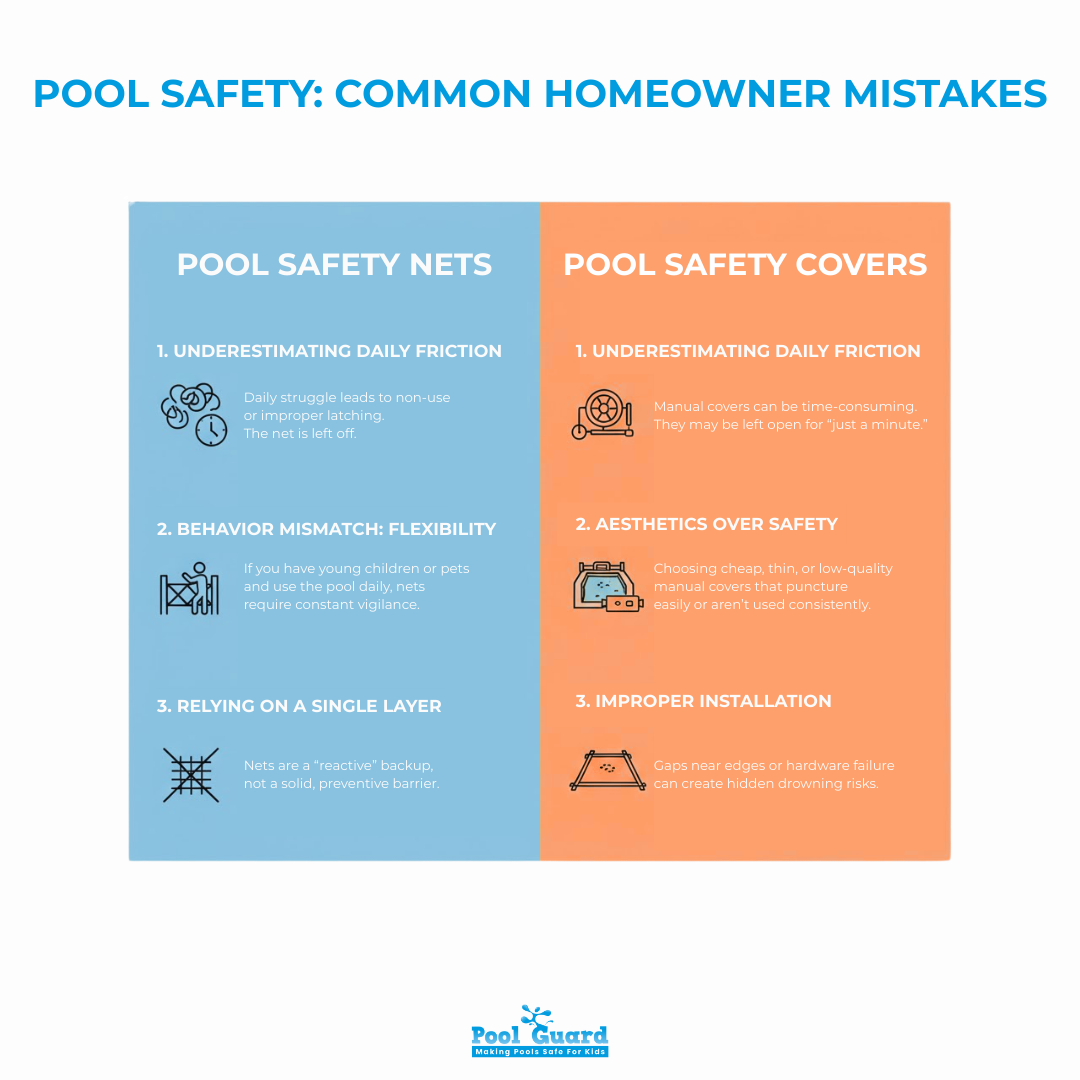
The pool net vs pool cover decision isn’t about which product sounds safer—it’s about which one will be used correctly, consistently, and realistically in your home.
No barrier replaces supervision. The most effective pool safety strategy is layered: physical protection, responsible habits, and informed decision-making.
Choose based on real-life behavior, not marketing promises. The best solution is the one that fits your household’s routines, energy level, and risk tolerance—not just your budget. Compare your options carefully, review pool fence solutions, and explore additional pool safety resources before making a final decision.
If this guide helped clarify your decision, consider sharing it with another pool owner who’s asking the same questions.
Find your local dealer by entering your zip code above.
Please fill out the form below with your information. Your local dealer will be notified about your inquiry.