What is near drowning? Near drowning is a commonly used term for surviving a drowning incident—but here’s the truth most people miss: survival does not mean safety.
In everyday language, people use “near drowning” to describe a situation where someone almost drowned but lived. In modern medicine and public health, however, the preferred term is non-fatal drowning, a definition adopted by organizations such as the World Health Organization. Many of these incidents are reflected in broader drowning statistics, which highlight how common non-fatal drowning events actually are.
Why the change matters:
The phrase “near drowning” falsely implies a close call with no lasting risk. In reality, non-fatal drowning can cause delayed, serious, and sometimes permanent medical complications, even when a person appears fine immediately afterward.
If you take one thing from this guide, let it be this:
Any drowning event is a medical emergency—regardless of outcome..
A near drowning, medically referred to as non-fatal drowning, occurs when a person is submerged in water long enough to impair breathing and oxygen delivery to the body, but survives the incident. Although the person lives, the event can still cause serious and sometimes delayed medical complications.
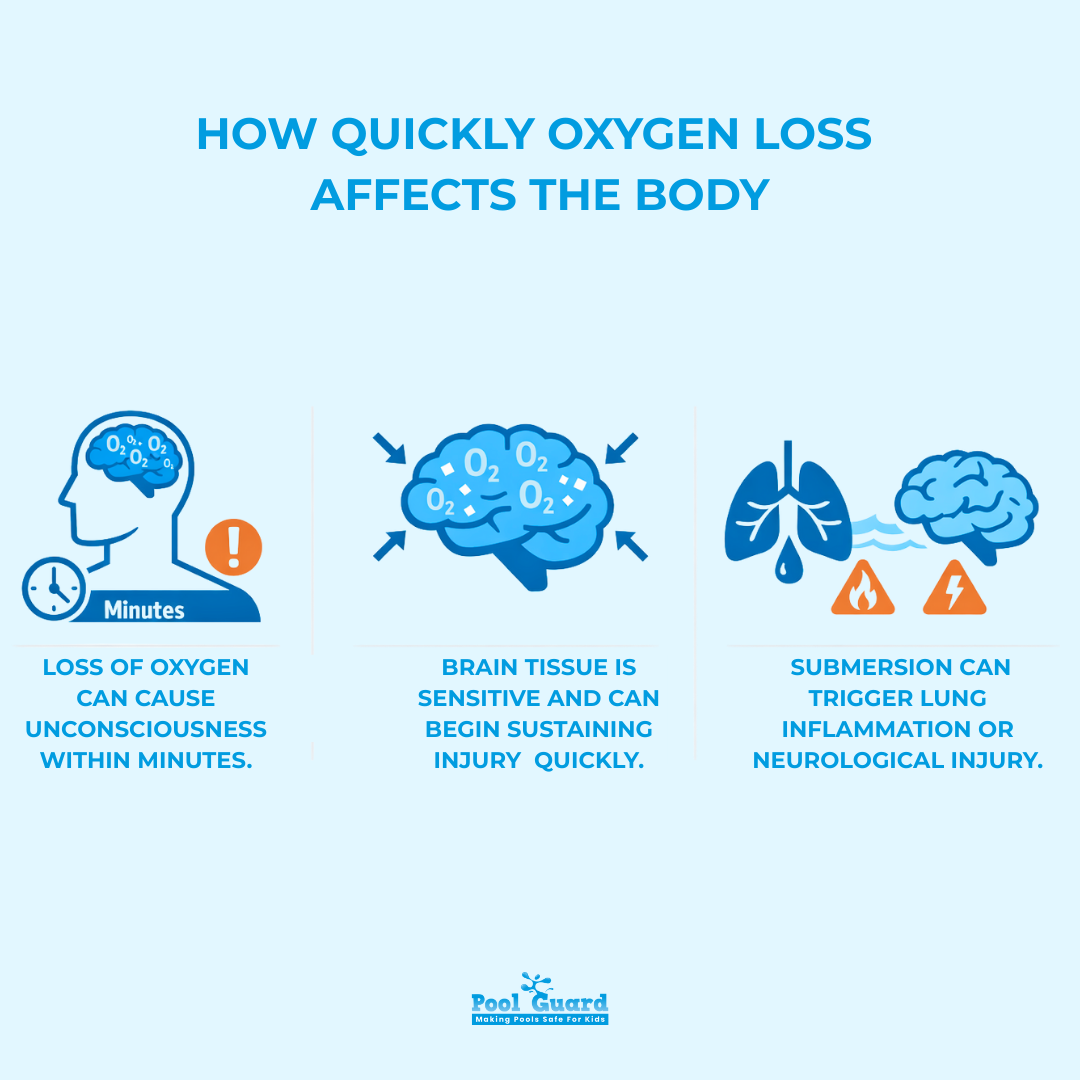
When water is inhaled into the airway or the airway spasms shut in response to submersion, the body is quickly deprived of oxygen. Understanding how quickly oxygen deprivation occurs also helps explain why even brief submersion times can be dangerous, as outlined in how long it takes to drown. This sets off a dangerous chain reaction:
The human body is extremely sensitive to interruptions in oxygen supply, and damage can occur faster than many people realize:
Children face a higher risk of severe injury during near drowning incidents for several physiological and behavioral reasons:
Symptoms of near drowning can appear immediately after the incident or be delayed for several hours. Both early and delayed symptoms are serious and require medical attention.
Some symptoms occur right away and indicate that the body is struggling to recover from oxygen deprivation or water inhalation. These may include:
In many cases, symptoms do not appear until hours after the drowning event. These delayed symptoms can be just as dangerous and should never be ignored:
Delayed respiratory distress is common after non-fatal drowning. Never assume the danger has passed simply because symptoms improve or appear mild. Any breathing changes or unusual behavior after a water incident should be treated as a medical emergency.
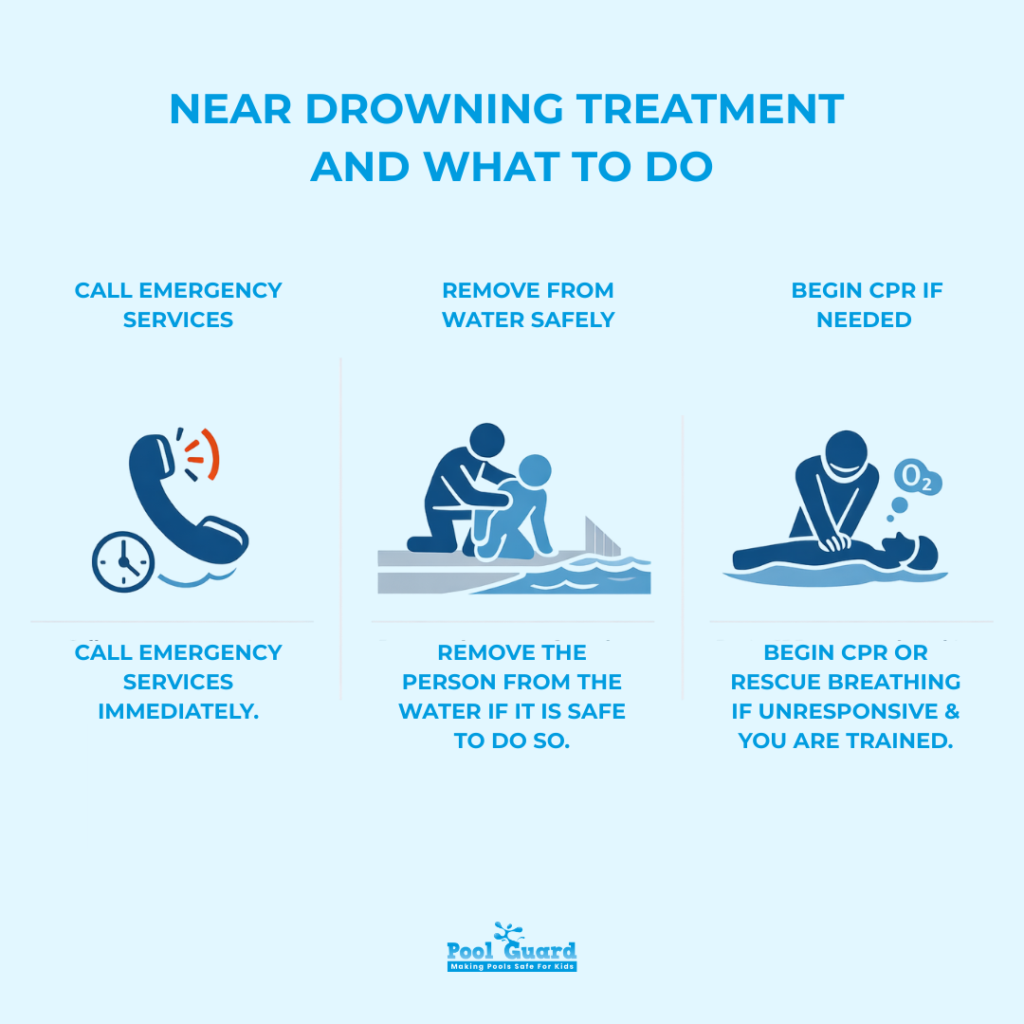
Prompt and appropriate treatment after a near drowning incident can be lifesaving. Because drowning primarily deprives the body of oxygen, early action is critical, even before symptoms appear severe.
If a near drowning occurs, the following steps should be taken without delay:
Organizations such as the American Red Cross emphasize that rescue breathing is especially important in drowning-related emergencies, because oxygen deprivation—not sudden cardiac arrest—is typically the primary threat.
Medical evaluation is required after every near drowning incident, even if the person appears alert and stable.
A person may seem reassuringly normal at first. For example, they may:
Despite this, internal injury can still be developing. Water inhalation can trigger lung inflammation, fluid buildup, or delayed respiratory distress. Oxygen deprivation may also cause subtle neurological effects that are not immediately obvious.
Because of these risks, near drowning victims typically require medical observation for 6 to 24 hours to monitor for lung injury, breathing complications, or neurological changes.
There is no safe “wait and see” approach after a drowning event. If someone has been submerged and breathing was impaired — even briefly — professional medical care is essential.
Non-fatal drowning can lead to lasting health consequences, depending on how long oxygen delivery was impaired and how quickly effective rescue and treatment occurred. While some individuals recover fully, others may experience long-term or permanent complications affecting the lungs, brain, or overall quality of life.
Damage to the lungs is common after near drowning because inhaled water irritates lung tissue and interferes with oxygen exchange. Potential long-term lung effects include:
The brain is especially sensitive to oxygen deprivation, and even short interruptions can cause injury. Possible neurological effects include:
The severity and likelihood of long-term effects after near drowning depend on several key factors, including:
Drowning is one of the leading causes of unintentional injury-related death in young children, and non-fatal drowning occurs far more frequently than fatal incidents. While many children survive these events, the medical and neurological risks can be severe and long-lasting. Because drowning often happens silently, assigning a dedicated water watcher can help reduce the risk during active pool use.
Research from Royal Life Saving Australia highlights the scale of the problem:
Near drowning is especially dangerous for children because it often unfolds quickly and without obvious warning signs:
Because children may be unable to call for help or show clear signs of distress, drowning incidents are often detected too late. This is why prevention strategies must focus not only on supervision, but also on physical safety barriers and layered protections around water.
Supervision is essential—but supervision alone fails predictably. Distractions are a normal part of daily life. Phones ring. Doors open. Children move quickly and quietly. Even attentive adults can miss a critical moment.
Because of this reality, water safety experts emphasize the importance of layers of protection, especially in residential pool environments. Effective prevention does not rely on a single safeguard, but on multiple overlapping measures that reduce risk when human attention lapses. In addition to fencing, many homeowners follow a complete pool safety checklist to ensure all layers of protection are in place.
The most effective strategies for preventing near drowning around pools include a combination of physical barriers, monitoring systems, and clear safety expectations:
Physical barriers significantly reduce reliance on perfect human behavior. They are designed to work even when adults are distracted, which is precisely when most drowning incidents occur.
This layered approach is why modern pool safety standards increasingly prioritize environmental controls, not just awareness or supervision. When multiple protections are in place, the risk of near drowning drops dramatically.
Emergency medical care should be sought immediately if any of the following symptoms occur after a water incident. These signs may appear right away or develop hours later, and all should be treated seriously:
If in doubt, go. Early medical evaluation can save lives and significantly reduce the risk of long-term complications.
Surviving a drowning event does not mean the danger has passed.
Delayed symptoms are real and can become life-threatening.
Children are uniquely vulnerable to both immediate and long-term effects.
Understanding what is near drowning — and what it really means in medical terms — is essential to recognizing how serious these incidents can be. Non-fatal drowning is not a harmless close call; it is a medical emergency that demands prompt attention, even when someone appears fine at first.
The most effective solution is prevention.
Strong barriers, layered protection, and informed action save lives.
If this guide helped clarify the risks, explore pool safety fence options or review additional pool safety resources to create a safer environment around your pool.

Find your local dealer by entering your zip code above.
Please fill out the form below with your information. Your local dealer will be notified about your inquiry.
Please fill out the form below with your information. Your local dealer will be notified about your inquiry.