
We're the #1 Pool Safety Barrier Provider in the U.S.

Pool Statistics for Miami

Miami has one of the highest concentrations of residential swimming pools in the United States, driven by a tropical climate, year-round warm temperatures, and a housing market where outdoor living is a central feature. Pools are common across many Miami neighborhoods, from inland suburbs to coastal and luxury residential areas.

This page presents local, data-based statistics on residential swimming pools in the Miami metro area. The focus is on measurable factors such as pool ownership rates, average pool sizes, usage throughout the year, construction and maintenance costs, and how pools relate to home values. The information is intended to describe how pools exist and are used locally, without offering recommendations or purchasing guidance.

Residential Pool Statistics for Miami: The Big Picture

Miami consistently ranks among the top cities in the United States for residential swimming pool ownership, reflecting a long-established pattern in the local housing market rather than a short-term surge in demand.

According to national survey data:
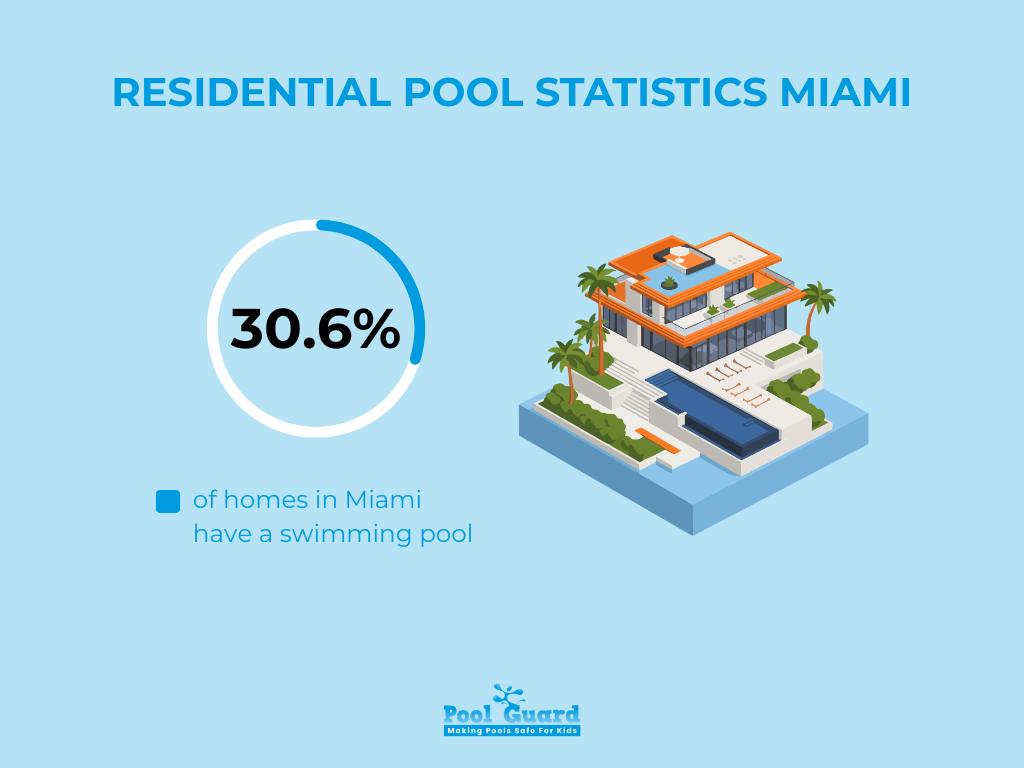
  • 30.6% of homes in Miami have a swimming pool, meaning that nearly one out of every three residential properties in the city includes a private pool as a permanent feature of the home.
  • Miami ranks #2 in the United States for percentage of residential pool ownership, placing it among the most pool-dense major metropolitan areas in the country.
  • Ownership levels have remained consistent over the last five years, indicating that this level of penetration is stable and structurally embedded in the housing market rather than influenced by temporary economic or lifestyle shifts.
Residential Pool Statistics Miami

In other words, nearly 1 in 3 homes in Miami includes a swimming pool as part of the property’s standard configuration.

This is not seasonal demand. It is not a short-lived trend. It reflects a structural characteristic of Miami’s residential real estate landscape.

Why Miami Leads

Several key factors help explain the sustained strength behind these residential pool statistics for Miami trends and why the city continues to rank so highly on a national level:

  • Year-round warm climate, which makes outdoor living viable and attractive in every season, increasing the practical value and daily usability of private swimming pools.
  • Strong luxury real estate market, where pools are frequently considered a standard feature rather than an optional upgrade, particularly in mid- to high-end residential segments.
  • High tourism influence, which drives demand for short-term rental properties and vacation homes that often include pools to remain competitive in a hospitality-oriented market.
  • Lifestyle-driven buyer expectations, as many residents relocate specifically for outdoor living, entertainment space, and resort-style amenities that align with Miami’s coastal identity.
  • Migration-driven housing growth, where new developments frequently incorporate pools into residential design plans from the outset, reinforcing long-term ownership patterns.

In Miami, swimming pools are not positioned as an upgrade or a niche luxury feature. In many neighborhoods and price brackets, they represent a baseline expectation within the residential market — a structural element of property design rather than a discretionary addition.

Miami Pool Construction Permits: Growth Data

Building permit data provides one of the clearest indicators of real market momentum, offering measurable insight into actual construction activity rather than speculative projections or sentiment-based analysis.
Miami-Dade County Pool Permits (2025)

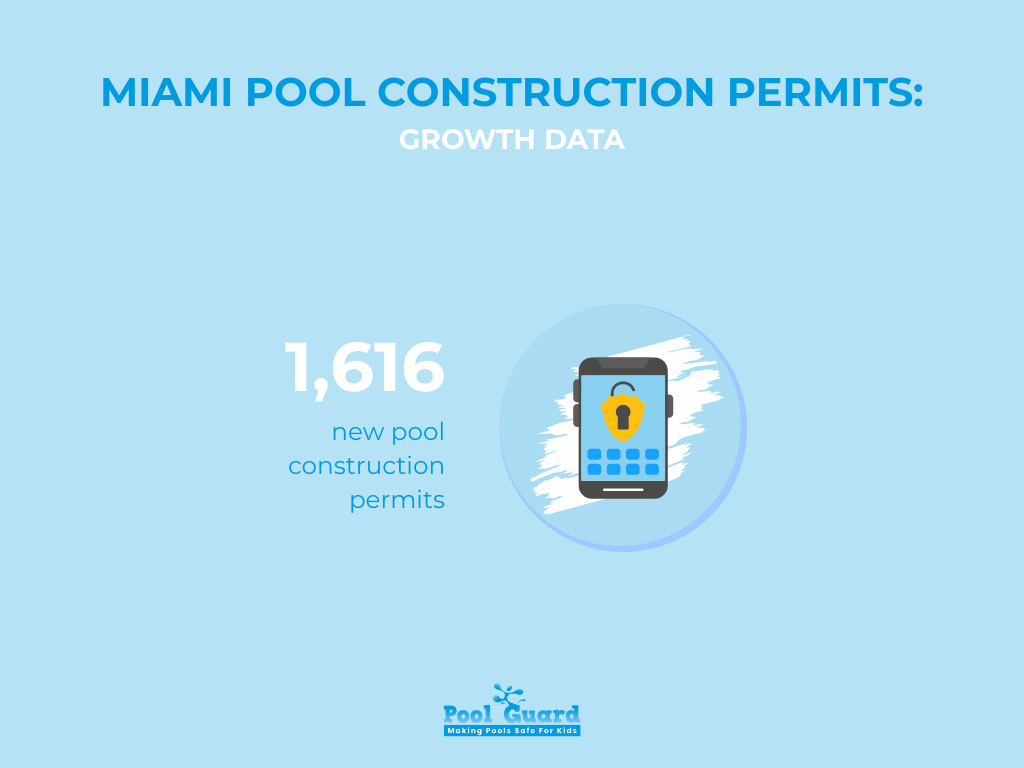
  • 1,616 new pool construction permits were issued in Miami-Dade County, reflecting substantial residential investment in private pool installations across the region.
  • +36% year-over-year growth, marking a strong rebound in construction activity compared to the previous year and signaling renewed expansion in the local pool market.
  • Previously declined:
    • –33% in 2023, representing a significant pullback following peak pandemic-era expansion.
    • –21% in 2022, indicating the beginning of a broader market correction driven by macroeconomic pressures and interest rate adjustments.
Residential Pool Statistics for Miami - Miami Pool Construction Permits

This 36% rebound is not marginal or incremental. It represents one of the strongest county-level growth rates in Florida, suggesting that Miami-Dade’s pool construction sector has regained forward momentum after a two-year contraction phase.

In separate year-to-date data (January–September 2025), Miami-Dade reported approximately:

  • +22% year-over-year increase in permits, further reinforcing the narrative of sustained recovery and renewed construction demand through the majority of the current calendar year.

This performance places Miami among Florida’s most resilient high-end pool construction markets, alongside Palm Beach, Sarasota, Lee, and Collier counties — all of which are known for strong luxury residential activity and consistent outdoor lifestyle demand.

What This Means

Following the period of pandemic-driven over-expansion and subsequent interest-rate correction, Miami’s residential pool market did not experience structural collapse. Instead, it underwent a recalibration phase, adjusting to new economic conditions before returning to measured growth.

This indicates:

  • Stable luxury demand, suggesting that higher-income homeowners continue to invest in long-term property enhancements despite broader economic fluctuations.
  • Continued investment in outdoor living, reflecting Miami’s enduring cultural emphasis on exterior residential amenities and lifestyle-driven property improvements.
  • Confidence in long-term property value, as pool construction remains a capital-intensive upgrade that homeowners typically pursue when they believe in sustained real estate appreciation.

Overall, the data points toward a market that has absorbed volatility, corrected excesses, and re-established growth on more sustainable footing.

Pools and Property Value in Miami: The Resale Advantage

If you’re evaluating residential pool statistics for Miami through the lens of return on investment, the resale data provides some of the most compelling insights. Pool ownership in Miami is not just a lifestyle preference — in many segments of the market, it directly correlates with property value, buyer demand, and competitive positioning.

In high-demand submarkets, buyers increasingly expect pools to include compliant safety barriers, making a properly installed pool fence in Miami an important component of long-term asset protection.

Miami Beach Sales Data (Past 12 Months)

  • 55% of all single-family homes sold had pools, meaning that more than half of the residential transactions in this market involved properties with private swimming pools already in place.
  • 87% of luxury homes ($2M–$3M) sold had pools, demonstrating that in the upper-tier segment, pool presence is overwhelmingly standard rather than optional.
  • Only 13% of $500K–$750K homes had pools, highlighting a clear distinction between entry-level pricing brackets and higher-end inventory.
  • 41% of $750K–$1M homes had pools, showing a transitional segment where pool inclusion begins to meaningfully influence buyer expectations and property desirability.

As price increases, pool presence increases dramatically. The data reveals a strong positive correlation between home value and the likelihood that a property includes a swimming pool, particularly in coastal and high-demand submarkets.
Coconut Grove & Coral Gables

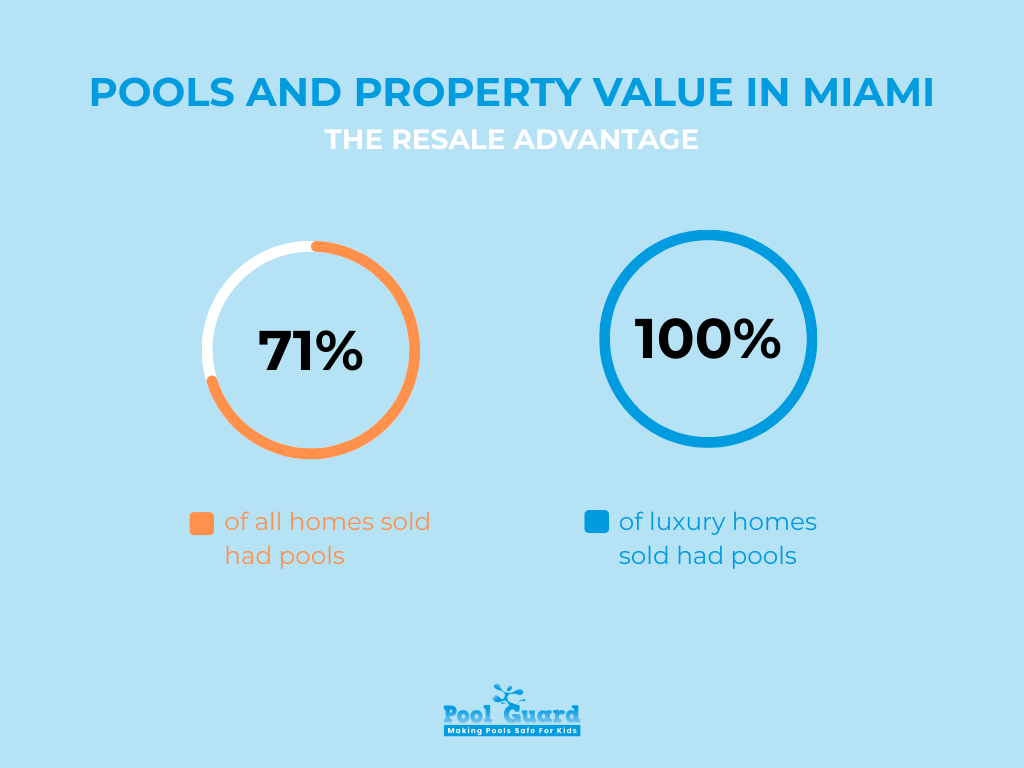
  • 71% of all homes sold had pools, reflecting a market environment where pool ownership is well above the citywide average and deeply integrated into neighborhood norms.
  • 100% of luxury homes sold had pools, indicating that in the high-end tier of these submarkets, pool inclusion is effectively a baseline requirement rather than a differentiator.
Residential Pool Statistics for Miami - Pools & Property Value in Miami

If you’re selling high-end real estate in these areas without a pool, you are not simply missing an amenity — you are operating at a structural disadvantage. In competitive luxury segments, buyer expectations are already calibrated toward properties that deliver complete outdoor living experiences, and pool presence plays a central role in that equation.

Pool Premium: How Much Value Do Pools Add to a Home in Miami?

National Realtor.com analysis (2025) shows:

  • Homes with pools carry a 54% price premium
  • Peak premium reached 61% in January 2022
  • Median price-per-square-foot:
    • $247 (with pool)
    • $204 (without pool)

While the pandemic-driven premium has softened, pools still command a significant pricing advantage.

For Florida specifically:

  • Estimated 11% return on investment
  • On a $500,000 home, that’s approximately $55,000 in added value
  • Conservative pool build cost estimate: $25,000

In Miami’s high-demand submarkets, ROI may exceed that statewide estimate.

Miami Leads in Commercial Pool Development

Residential pool statistics for Miami don’t exist in isolation.

Miami also leads Florida in commercial pool installations, driven by:

  • Hospitality sector growth
  • Resort-style amenity competition
  • Tourism economy

The hospitality sector accounted for a significant portion of pool construction growth in 2024.

Why does this matter for homeowners?

Commercial development normalizes luxury expectations. Buyers begin to expect private pools when surrounded by resort-style living.

Florida Context: Why Miami Outperforms

Statewide pool permit activity in Florida was down roughly 2.9% year-to-date in 2025.

Miami-Dade, however, posted positive growth.

That divergence signals something critical:

Miami’s pool demand is less cyclical and more lifestyle-driven.

While other counties experienced double-digit declines, Miami’s high-end segment showed resilience and rebound.

Market Psychology: Why Pools Remain Essential in Miami

Even in a buyer-sensitive market:

  • 15% of homes across Florida have pools
  • Miami’s percentage is more than double that
  • Luxury buyers expect pools as standard

Today’s buyer may negotiate price harder than in 2022, but they still prioritize:

  • Outdoor entertainment space
  • Resort-style living
  • Privacy amenities
  • Property differentiation

The demand has shifted from impulsive to intentional — not disappeared.

What These Residential Pool Statistics Miami Mean for Homeowners

If You Own a Pool

  • You are positioned in a premium resale bracket.
  • You align with dominant buyer expectations.
  • You likely outperform non-pool comps in upper-tier neighborhoods.

If You Don’t Have a Pool

  • In luxury neighborhoods, you may face buyer resistance.
  • Value perception could decline relative to competitors.
  • In mid-tier pricing, pool addition ROI should be evaluated carefully.

If You’re Building in 2026

Interest rates may moderate. Migration remains strong. Permit growth has stabilized.

That combination suggests:

Measured growth — not frenzy — but sustained demand.

Conclusion: Miami’s Pool Market Isn’t a Trend — It’s Infrastructure

The residential pool statistics for Miami data tells a clear story:

  • 30.6% of homes have pools
  • Miami ranks #2 nationally
  • 1,616 permits issued in 2025 (+36% YoY)
  • 87–100% of luxury homes sold include pools
  • Strong commercial and residential alignment

Pools in Miami are not indulgences. They are economic drivers, lifestyle anchors, and competitive assets.

If you operate in Miami real estate, construction, or home improvement, ignoring this data means ignoring market reality.

Explore related safety and pool protection resources at Poolguard USA to ensure your investment is protected long-term.

Sources

Recent Articles

Contact Dealer

Please fill out the form below with your information. Your local dealer will be notified about your inquiry.

Contact Dealer

Please fill out the form below with your information. Your local dealer will be notified about your inquiry.