Most pool owners spend time thinking about water chemistry, cleaning schedules, and equipment upkeep. Very few think critically about their pool ladder – yet for above-ground pool owners, the ladder is the single most consequential safety decision they’ll make. It’s the only way in and out of the pool, and if it’s accessible when it shouldn’t be, it becomes an open invitation to tragedy.
This guide cuts through vague checklists and gives you the specific, evidence-based information you need to make your ladder – and your entire pool area – genuinely safe.
4,523 ER visits from pool equipment injuries (CPSC) #1 cause of unintentional injury death in children ages 1–4 is drowning (CDC) <30 seconds – the time it can take for a toddler to drown in unsupervised water
According to the U.S. Consumer Product Safety Commission (CPSC), over 4,500 people visit the emergency room each year with injuries tied to pool equipment – including covers, drains, and ladders. Injuries range from lacerations and contusions to broken bones. But the more dangerous risk isn’t the ladder structure itself.
The more dangerous risk is access. A ladder left in place on an above-ground pool is effectively an unlocked gate. The Centers for Disease Control and Prevention (CDC) reports drowning is the leading cause of unintentional injury death among children ages 1–4. In the vast majority of these incidents, the child gained unsupervised access to the water.
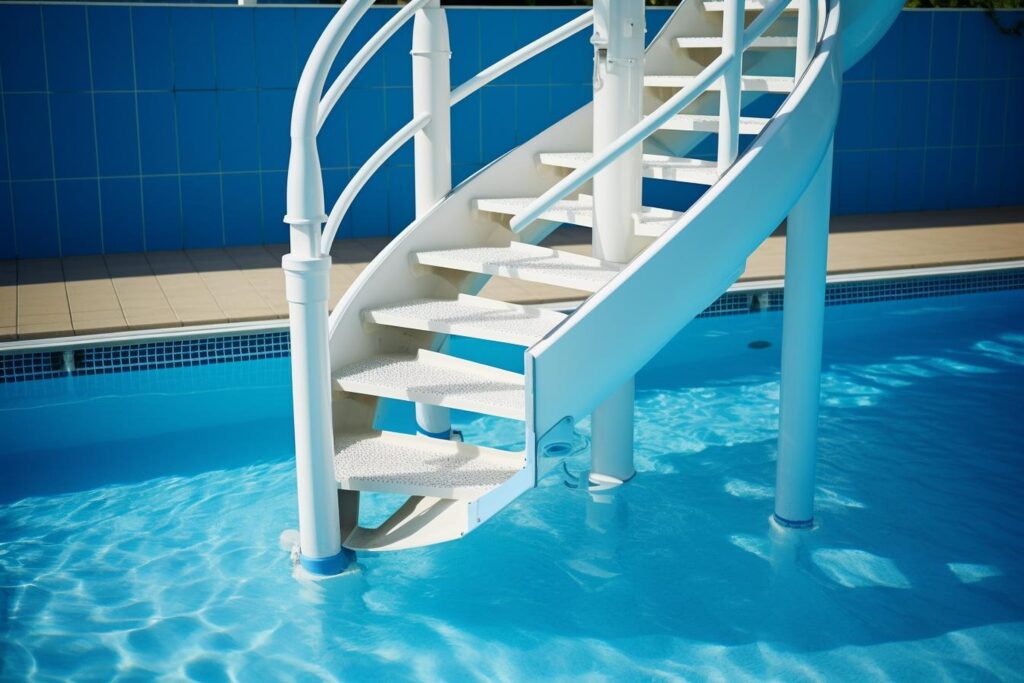
In-ground pools typically have permanent barriers – fencing, gates, and alarms – installed at the perimeter. Above-ground pools often don’t, because the pool wall itself is assumed to be a barrier. That assumption breaks down the moment a ladder is left in place.
“Barriers such as four-sided fencing have been shown to reduce the risk of drowning by up to 83% in young children. A pool ladder with no secondary barrier offers essentially no protection against unsupervised access.” – Safe Kids Worldwide, Pool Safety Research Summary
An above-ground pool creates a false sense of safety. Because the water isn’t at ground level, many families assume toddlers can’t reach it. But a curious 2-year-old can climb a pool ladder faster than most adults realize – especially one that’s low-profile, A-frame style, or doesn’t require significant strength to ascend.
A child 18–36 months old follows older siblings to the pool area. No adult is watching. The ladder is in place. The child drowns within minutes.
After swimming, the ladder is left to “pop back in later.” A phone call happens. A neighbor stops by. The window of unsupervised access opens without anyone noticing.
A lock or removable outer step is put in place. An older child – old enough to problem-solve, too young to understand consequences – repositions it to let younger siblings into the pool.
These aren’t hypothetical edge cases. They reflect documented drowning incident patterns investigated by the CPSC and corroborated by child drowning prevention organizations. The common thread: access was possible because the ladder was accessible.
Above-ground pool ladder safety operates under fundamentally different conditions than in-ground pools. Understanding why matters for every decision you make.
Common structural failure modes to watch for in any above-ground pool ladder:
Check the CPSC Recalls database regularly and inspect your ladder at the start and end of each swim season.
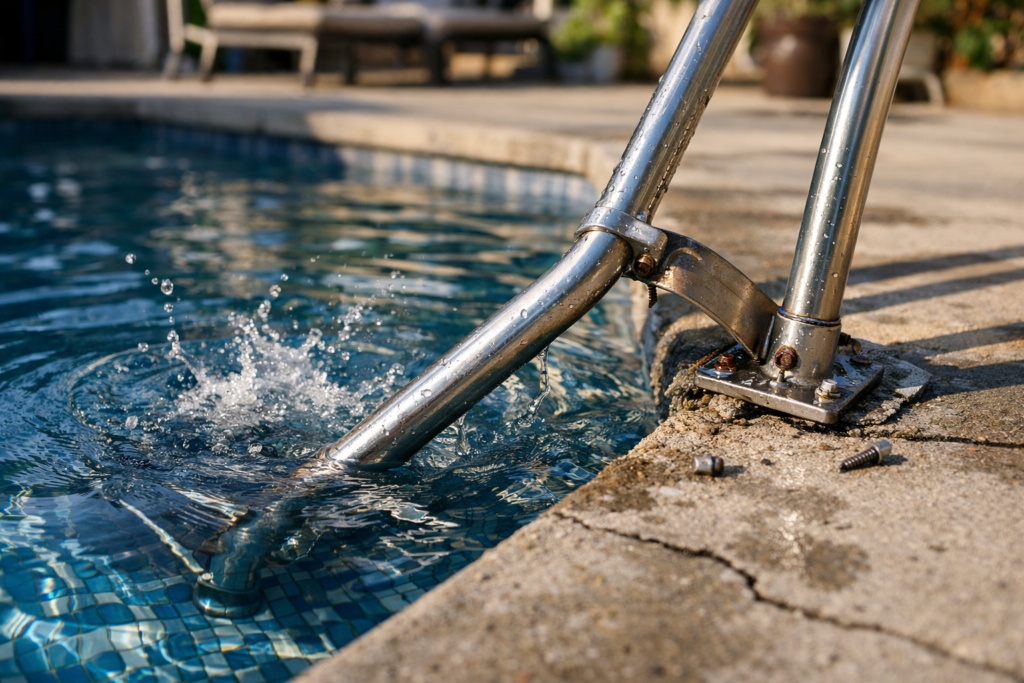
Above-ground pool ladders have no mandatory federal safety regulations in the U.S. The CPSC publishes voluntary safety standards that manufacturers and consumers can follow — but there’s no enforcement mechanism if they don’t.
Key CPSC voluntary guidelines, translated into what they actually mean for your family:
What it does: Prevents casual or unauthorized access with a keyed or combination lock mechanism. Where it breaks: Locks left unlocked “just this once.” Keys accessible to children. Lock mechanisms corroding in outdoor environments.
What it does: When removed, completely eliminates the access point. Best physical control option. Where it breaks: Only works if you consistently remove it. Inconvenient removal = rarely done. Storage location near pool reintroduces risk.
What it does: Creates a physical cage or wrap around the outer rungs, stopping children from climbing even when the ladder is in place. Where it breaks: Barriers that aren’t secured to a fixed structure can be moved by older children. Must meet height and latch requirements to be effective.
What it does: Raises the first rung out of reach of toddlers when the pool is not in use. Where it breaks: Older children (4+) can often reach or climb anyway. Steps that flip up can be pulled back down. Not reliable as a sole measure.
What it does: Prevents the ladder from being relocated by guests, children, or wind, reducing repositioning risk. Where it breaks: Doesn’t prevent climbing – it only prevents the ladder from being moved to the wrong spot.
What it does: Reduces slip-and-fall injuries during normal entry and exit. Critical for elderly users and young children. Where it breaks: Anti-slip coatings wear off over time. Must be inspected and replaced seasonally. Provides zero access control benefit.
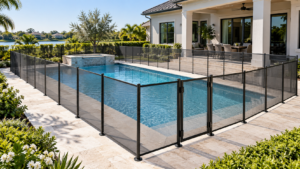
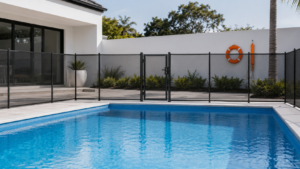
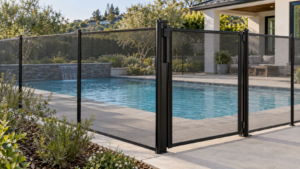
What it does: Creates a continuous perimeter barrier around the pool, independent of the ladder. The only measure that works passively. Where it breaks: Gates left propped open. Pool fences without self-closing, self-latching mechanisms. Inadequate height (min. 48 inches recommended).
Every ladder-based safety measure shares one fatal flaw: it depends on human consistency. People get busy. They get interrupted. They assume someone else handled it. Research on child injury prevention consistently shows that passive protective systems – those that work without requiring a human action – dramatically outperform active ones.
Removing a ladder after every swim is an active measure. Forgetting once is all it takes. A pool fence with a self-closing, self-latching gate is a passive measure – it protects even when you forget.
This is why leading drowning prevention organizations, including the American Red Cross and Safe Kids Worldwide, emphasize layers of protection rather than any single intervention.
Ladder Control:
Pool Fence + Gate:
ASTM F2286 is the standard for safety covers and barriers for above-ground pools. A fence meeting this standard, combined with a self-closing, self-latching gate, provides a continuous barrier layer that pool ladder control alone cannot replicate.
Layer 01 — Ladder Control: Remove, lock, or block after every swim. First line – weakest link.
Layer 02 — Pool Fence + Gate: Four-sided, 48″+ with self-latch. The only fully passive barrier.
Layer 03 — Pool Cover: Approved safety cover (not solar cover) rated to bear weight. Backup layer only.
Layer 04 — Pool Alarm: Surface or subsurface motion sensor. Alerts when water is disturbed.
No single layer is sufficient. Each has limitations. The fence doesn’t alert you if defeated. The alarm can’t prevent entry. The cover isn’t always in place. But all four together create a system where multiple failures must occur simultaneously before a child reaches the water – dramatically reducing risk.
Toddlers (Ages 1–4): Highest drowning risk group. Fast, quiet, and drawn to water. Cannot assess risk.
Pets: Dogs can fall into pools and struggle to find the exit. A ladder inside the pool aids escape; one outside is irrelevant to their safety.
Elderly Users: Slip-and-fall risk is highest on wet ladder steps. Handrail grip and step width are critical.
Distracted Households: Work-from-home parents, large gatherings, visitors – anytime normal supervision gaps occur, risk increases sharply.

There are no mandatory federal regulations specifically for above-ground pool ladder design in the U.S. The CPSC issues voluntary standards. However, many states and municipalities have their own pool safety codes – check with your local building department. Some homeowner’s insurance policies also have pool safety requirements.
There’s no universal standard, but for child safety purposes, the first accessible rung should ideally be high enough that a toddler (under 36 inches tall) cannot reach it unaided. For most designs, this means using a flip-up or removable outer step when the pool is not in use, rather than relying on rung height alone.
No. Ladder control is an active safety measure – it only works when someone remembers to apply it. A pool fence is a passive barrier that works continuously. Drowning prevention research consistently recommends using both together as part of a multi-layer approach.
The most reliable options, in order of effectiveness: (1) Remove the ladder entirely and store it away from the pool area, (2) use a lockable ladder with a keyed mechanism, (3) install a barrier enclosure around the ladder base with a self-latching gate. Flipping up outer steps alone is not sufficient for households with children over age 3.
At minimum, at the start and end of each swim season, and after any heavy use, severe weather, or impact. Pay specific attention to bolted joints, non-slip step surfaces, and footpads. Check the CPSC recall database annually for your ladder’s model.
Pool ladder safety isn’t just about buying a ladder with good grip and solid rails – though both matter. It’s about understanding that your ladder is an access control device first and a climbing aid second. For above-ground pool owners especially, the discipline of removing or locking that ladder after every single swim is the difference between a well-managed risk and a preventable tragedy.
Pair that discipline with a proper pool fence, a self-latching gate, and a pool alarm, and you’ve built the kind of layered protection system that gives families real safety – not just the feeling of it.
Share this guide – it could save a life. Explore pool safety resources at Pool Guard USA.

Find your local dealer by entering your zip code above.
Please fill out the form below with your information. Your local dealer will be notified about your inquiry.