A child can drown in the time it takes to answer a text message. Silently. In a familiar backyard pool. With adults nearby.
That’s not a hypothetical; it’s what the data repeatedly show across decades of research. Swimming pool accidents are one of the most preventable causes of death in the United States, yet they claim thousands of lives every year and send tens of thousands more to the emergency room.
This guide compiles the most comprehensive, up-to-date swimming pool accidents statistics from trusted sources such as the CDC, CPSC, WHO, and NDPA. It gives pool owners, parents, and caregivers a clear picture of the risks and the specific measures that actually reduce them.
Before diving into the details, here are the numbers that matter most:
Every year in the United States, according to the CDC, there are an estimated 4,000 fatal unintentional drownings; that works out to 11 drowning deaths every single day.
But fatal drownings are only part of the picture. For every person who dies, approximately two more experience a nonfatal drowning that requires emergency care, bringing the daily nonfatal total to 22 incidents per day. Nearly 40% of those nonfatal drowning victims require hospitalization or transfer to another facility for further care, compared to just 10% for all other unintentional injuries combined.
The long-term consequences of nonfatal drowning are often severe. Oxygen deprivation during a drowning incident can cause hypoxic brain injury, leading to memory problems, learning disabilities, and permanent disability.
Not all drownings happen in pools – natural water, bathtubs, and other water sources account for a significant share. But swimming pools represent a disproportionately deadly environment, particularly for young children.
The CPSC’s most recent annual drowning report found that between 2019 and 2021, an average of 358 children under age 15 fatally drowned in pools or spas each year. In 2021 alone, that number rose to 380 deaths, a 12% single-year increase that CPSC Chair Alex Hoehn-Saric called “a sobering reminder of how prevalent these tragedies are”.
The CDC also tracks drowning rates by state. During 2018-2021, the national annual age-adjusted drowning death rate was 1.31 deaths per 100,000 people, though rates vary significantly by geography, with warmer-climate and water-access states showing higher rates.
The scale of drowning as a global public health crisis is staggering. According to the World Health Organization:
The United States, with its comparatively strong infrastructure, still accounts for a substantial share of preventable drowning deaths, a fact that makes domestic prevention all the more achievable and all the more urgent.
Drowning is the leading cause of death for children ages one to four in the United States, surpassing motor vehicle accidents, falls, and illnesses. Toddlers are uniquely vulnerable because they are naturally drawn to water but lack the physical coordination to save themselves. Because drowning is rapid, silent, and lacks obvious distress signals like splashing or screaming, a child can slip beneath the surface completely unnoticed by nearby adults.
Data highlights the critical nature of this threat, with 75% of fatal child drownings and 77% of nonfatal pool injuries involving children under age five. Furthermore, nearly 70% of these incidents occur during non-swim time when adults don’t expect the child to be near the water. Proving how quickly a tragedy can unfold, 77% of child drowning victims had been missing for five minutes or less when they were discovered in the pool.
Contrary to popular belief, backyard pools are statistically far more dangerous than public facilities. Data shows that 81% of fatal drownings involving children under 15 occur in residential settings, including a child’s own home or a neighbor’s property. Among pool-specific fatalities in this age bracket, 75% occur in private residential pools, with 17% of those deaths involving above-ground pools.
Several distinct factors make residential pools uniquely dangerous for young children. Familiarity often breeds complacency, leading families to lower their guard, leave gates propped open, or let a momentary distraction turn fatal. Unlike public facilities, home pools lack trained lifeguards and rely entirely on adults who are easily distracted by phones, guests, or food. Finally, residential pools provide much easier unsupervised access, often sitting just a few steps away from the back door.
Drowning remains the second leading cause of unintentional injury death for children ages five to 14, trailing only motor vehicle crashes. As youth age into adolescence, fatal incidents shift from swimming pools to natural bodies of water. This transition is largely driven by increased independence and risk-taking.
Demographics and alcohol significantly elevate adult drowning statistics. By age 15, the male drowning rate nearly triples, with males ultimately accounting for 80% of all drowning deaths. Furthermore, alcohol is a contributing factor in up to 70% of teen and adult water recreation deaths because it severely impairs judgment and coordination.
Specific medical and developmental conditions also dramatically heighten vulnerability. Drowning is the most common cause of unintentional injury death for individuals with seizure disorders, occurring most frequently in bathtubs. Additionally, individuals with autism spectrum disorder face a drowning risk approximately 40 times higher than the general population.
Drowning, defined by the WHO as “the process of experiencing respiratory impairment from submersion or immersion in liquid”, is the dominant cause of pool-related death. But nonfatal drowning (sometimes called near-drowning) carries its own severe consequences, including brain damage, permanent disability, and psychological trauma.
For every child under 18 who dies from drowning, seven more receive emergency department care for nonfatal drowning. That ratio underscores the extent of harm occurring below the fatal threshold.
Not all pool accidents involve water. Wet surfaces around pools, such as decking, pool steps, ladders, and walkways, pose significant slip-and-fall hazards. The CPSC estimates that approximately 4,900 people per year receive emergency care for swimming pool and spa-related injuries, with falls accounting for a substantial portion of those visits. Proper pool deck surfaces, anti-slip coatings, and adequate lighting substantially reduce this risk.
Diving into shallow water, whether a pool, lake, or river, causes a disproportionate share of catastrophic spinal cord injuries. Cervical spine fractures resulting from striking the bottom of a shallow pool can cause permanent paralysis. Proper depth markings, “No Diving” signage in shallow areas, and enforcement of safe diving rules prevent these tragedies.
Drain entrapment, or suction entrapment, occurs when a pool, spa, or hot tub drain traps a swimmer’s hair, clothing, limb, or body. Young children are highly vulnerable because they lack the physical strength to break free from these powerful suction forces. Between 2009 and 2013, the CPSC documented 33 entrapment incidents, with 85% resulting in injury and the vast majority involving victims aged 15 or younger.
To combat this danger, federal law under the Virginia Graeme Baker Pool and Spa Safety Act requires all public facilities to install compliant anti-entrapment drain covers. Residential pool owners should also verify that their systems feature these certified drain covers and replace any cracked or damaged components immediately.
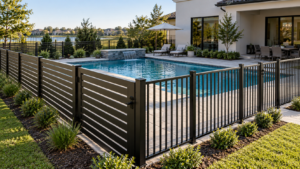
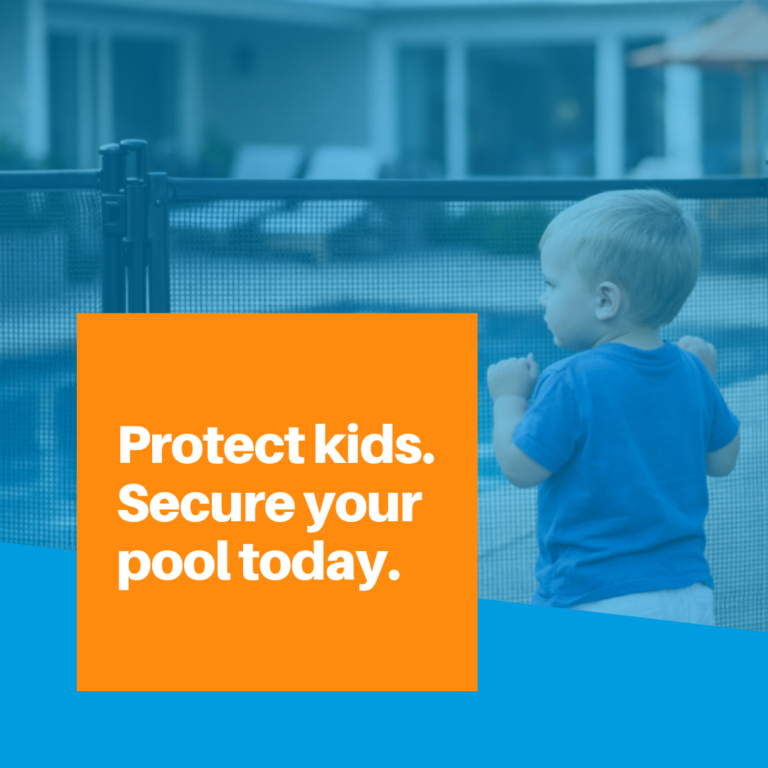
The single most effective structural intervention in drowning prevention is four-sided isolation pool fencing. Completely enclosing the water separates the pool from both the yard and the house.
This specific structural barrier reduces a child’s risk of drowning by 83% compared to having no fence or only three-sided perimeter fencing. It eliminates unsupervised access by ensuring a toddler cannot reach the water without an adult actively operating the gate.
Conversely, three-sided fencing is significantly less effective. When the house forms the fourth side of the barrier, a child only needs to open the back door to slide into the pool area completely unnoticed.
The “just a minute” problem is at the heart of most child drowning deaths. Research shows that 77% of child drowning victims were missing for five minutes or less when found, and 70% were not expected to be near water. This means the danger is rarely negligent parenting; it is the extreme speed at which a tragedy unfolds during ordinary distractions like a phone call, conversation, or bathroom trip.
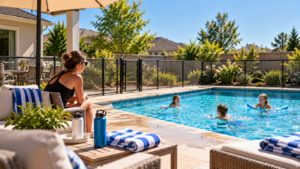
To combat this, safety organizations such as the CPSC, the American Red Cross, and the Pool Safely campaign strongly recommend designating a “Water Watcher“. This specific adult assumes primary responsibility for actively supervising children without phone use or other distractions, rotating the role regularly during gatherings. Data from Safe Kids Worldwide shows that 88% of children who drown had an adult present at the scene, proving that mere presence is not a substitute for active, undistracted supervision.
A significant share of child pool drownings involves unanticipated access pathways. These dangerous gaps commonly include gates left propped open or broken, climbable fences with horizontal rails or nearby furniture, partially secure pool covers, and above-ground ladders left in place.
To prevent these vulnerabilities, pool owners must conduct regular audits of their access barriers. Inspections should occur seasonally and after every gathering to ensure all physical layers of protection function perfectly.
The evidence for four-sided isolation fencing is among the strongest in the entire drowning prevention literature:
No single safety measure is sufficient on its own. The drowning prevention community emphasizes a layered approach, where multiple independent safeguards must fail simultaneously for a tragedy to occur.
Effective layers include:
Formal swimming instruction significantly reduces the risk of drowning. The American Academy of Pediatrics recommends lessons for children starting at the age of one to build critical water competency skills early.
However, stark disparities in swimming ability exist, with 64% of African Americans, 45% of Hispanic/Latino, and 40% of White children possessing little to no swimming skills. This gap heavily mirrors parental abilities; children are dramatically less likely to swim if their parents cannot.
Costs, geographic limitations, and historical exclusion from public facilities drive these skill gaps, making equitable access to swim lessons both a drowning-prevention and a health equity imperative.
The figures throughout this guide are not abstract data points; each represents a family facing a devastating tragedy. Reviewing these swimming pool accidents statistics proves one reality: these incidents are entirely preventable. Proven interventions, like four-sided fencing, layered barriers, swim education, and bystander CPR, are consistent and immediately actionable.
Children under five face the highest risk, primarily in residential backyard pools. Because attention lapses last only seconds, physical barriers must remain flawless. If you own a pool, audit your gates today; if you supervise children, learn CPR and designate an undistracted Water Watcher every single time.
Please fill out the form below with your information. Your local dealer will be notified about your inquiry.
Please fill out the form below with your information. Your local dealer will be notified about your inquiry.