
If you’re asking, do you need a fence around an above ground pool? the honest answer in most cases is yes. The assumption that “above ground” automatically means safer or legally exempt is one of the most common — and dangerous — misunderstandings among pool owners.
Across the United States, pool barrier laws are designed around one core principle: preventing unsupervised access, especially by young children. Depth, accessibility, and surrounding structures matter far more than whether the pool is installed in the ground or sits above it.
According to the Centers for Disease Control and Prevention, drowning remains a leading cause of unintentional injury death for children ages 1–4. Residential pools, including above-ground models — are frequently involved, which is why understanding how long it takes to drown is critical for homeowners. That reality shapes building codes, inspection standards, and insurance underwriting decisions nationwide.
In most jurisdictions, a fence is legally required when a pool exceeds a certain water depth. The trigger is commonly:
This means that even temporary or seasonal above-ground pools can fall under full barrier requirements.
Many homeowners believe that because the pool wall itself stands 48 inches tall, it serves as a built-in safety barrier. Sometimes that is true. Often it is not. The presence of ladders, decks, platforms, pumps, or climbable landscaping can instantly invalidate that assumption.
Insurance requirements complicate the issue further. Even if local enforcement is minimal, many insurers require a compliant fence as a condition of coverage. Legal compliance and insurance compliance are not always identical — but both matter.
The Virginia Graeme Baker Pool & Spa Safety Act primarily addresses drain safety and anti-entrapment systems, but it reinforces a broader national approach to layered pool protection. That approach emphasizes multiple safeguards working together:
Fencing remains the first and most critical layer.
While specific language varies, many states adopt barrier standards aligned with the International Code Council and the International Swimming Pool and Spa Code (ISPSC).
In practical terms, inspectors often look for the following:
These measurements are not arbitrary. They are engineered to prevent small children from squeezing through, climbing over, or reaching latch hardware.
One of the most misunderstood parts of above ground pool fence requirements involves 48-inch pool walls.
In certain jurisdictions, a 48-inch above-ground pool can serve as its own barrier if very specific conditions are met. Those conditions typically include:
The moment you install a permanent ladder or attach a deck, the wall usually no longer qualifies as a standalone barrier.
This is one of the most searched variations of the topic — including misspelled queries like “do 48 inch above ground pool requires pool fence.”
The answer depends on configuration, not just height.
A 48-inch wall may qualify as a compliant barrier only if access is fully controlled. However, it does not qualify if:
Many homeowners fail inspection because they assume height alone determines compliance. Inspectors evaluate access points, climbable surfaces, and gate hardware just as closely as wall measurements. Many of these misunderstandings are similar to questions like how deep a pool can be without a fence, where access matters more than depth alone.
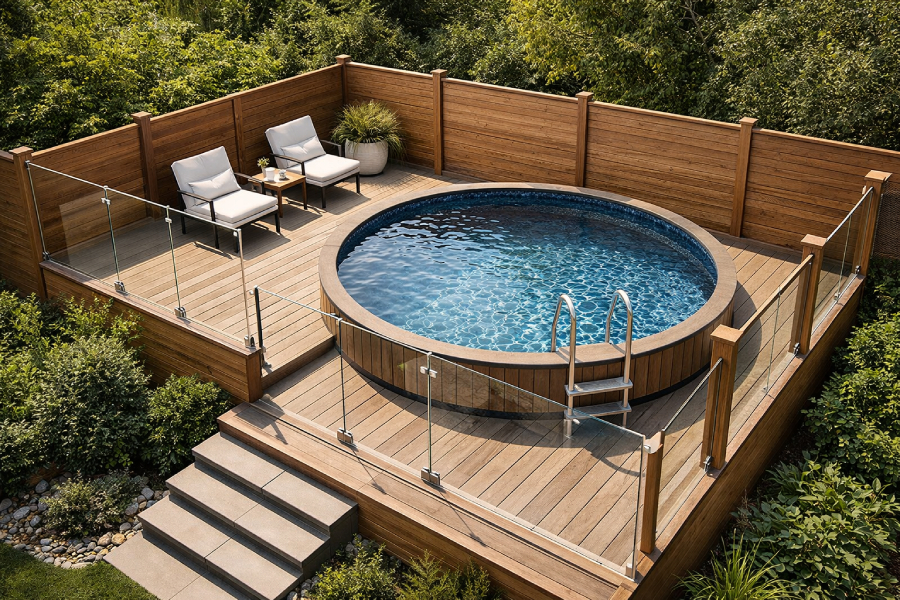
Adding a deck to an above-ground pool dramatically alters the compliance landscape.
A deck effectively creates a raised platform that can bypass the protective function of the pool wall. Railing systems installed around decks often do not meet barrier standards because they may:
In most cases, once a deck is attached, full isolation fencing with a self-closing gate becomes mandatory.
This is one of the most common compliance mistakes made by well-intentioned homeowners.
Even when local enforcement appears relaxed, insurance carriers frequently require fencing as a condition of homeowner’s coverage.
Residential pools are considered attractive nuisances. If a foreseeable hazard exists, property owners have a duty to take reasonable steps to prevent harm.
Failure to install a compliant barrier can result in:
Meeting minimum code is important. Meeting insurance underwriting standards protects your financial future, especially when considering pool fence insurance requirements. Costs can vary significantly depending on layout and materials, so understanding typical pool fence installation cost ranges can help you plan accordingly.
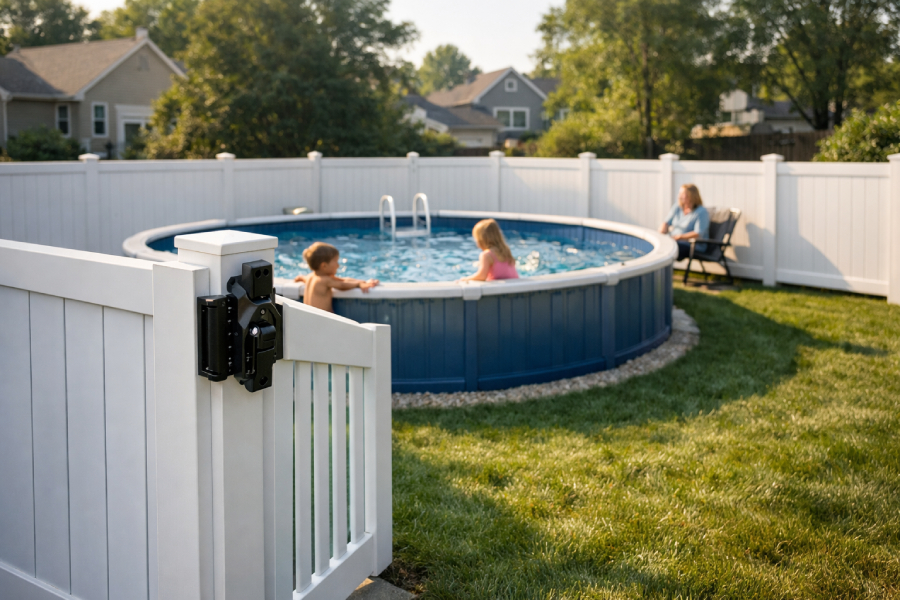
This is not theoretical. Consequences are real and often severe. Many of these risks tie directly into real-world drowning statistics, which show how quickly incidents occur in residential pools.
Homeowners who fail to comply may face:
In court, the central question becomes simple: Did you take reasonable safety measures? If a barrier was required and absent, liability exposure increases significantly.
A fence costs far less than litigation.
Selecting the right fencing solution depends on your property layout, permanence needs, and compliance requirements.
Mesh safety fencing is popular for its transparency, it provides strong protection while maintaining visibility and can be engineered to meet code when paired with compliant gate systems.
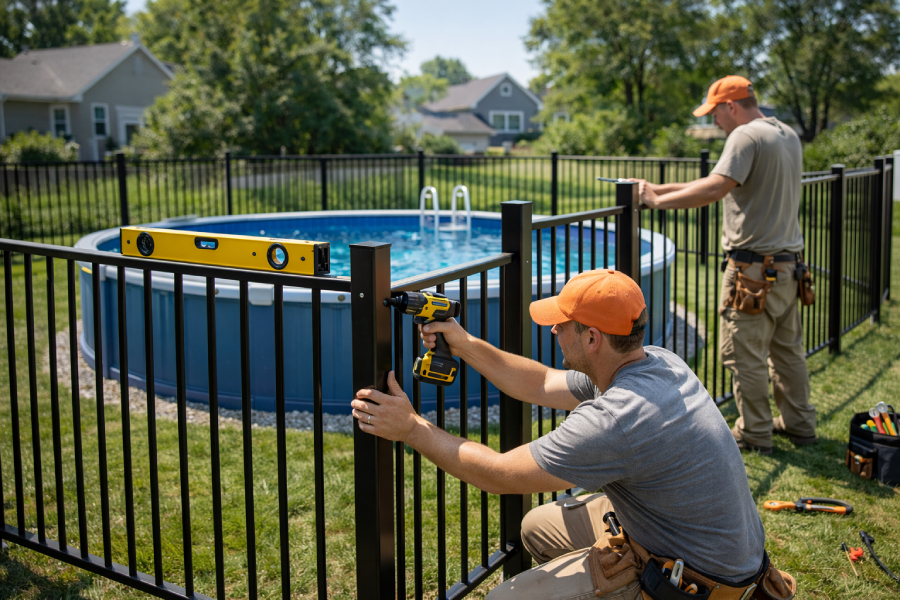
Permanent aluminum fencing offers durability, corrosion resistance, and precise picket spacing that aligns with inspection standards.
Removable pool fencing provides flexibility for seasonal pools or properties requiring adaptable solutions.
Secure ladder systems and gate hardware are equally critical. Self-closing hinges and high-mounted latches are often the most scrutinized elements during inspection.
The goal is not simply installing a fence — it is installing a compliant barrier fence system.
While laws vary, here is a simplified comparison of common standards:
Always verify requirements with your local municipality. City and county amendments frequently override state-level baselines.
Before scheduling inspection or activating your insurance policy, confirm the following:
Using a structured pool safety checklist can help ensure nothing is missed before inspection. This checklist alone can prevent costly inspection failures.
Legally? In most cases, yes.
Practically? Absolutely.
Financially? It is far cheaper than liability exposure, insurance denial, or civil litigation.
The real question is not simply do you need a fence around an above ground pool? It is whether you are willing to accept the risk of not having one.
A compliant fence protects children, protects guests, protects your assets, and protects your peace of mind. A fence works best when combined with supervision strategies like assigning a water watcher during pool use.
If this guide clarified your next steps, share it with another pool owner or explore additional pool safety resources to ensure your setup meets modern compliance standards.
Please fill out the form below with your information. Your local dealer will be notified about your inquiry.
Please fill out the form below with your information. Your local dealer will be notified about your inquiry.