
A self-closing pool gate is only protective if it works every single time.
Many homeowners assume that because the gate swings shut, it must be secure. But self-closing does not automatically mean self-latching. And even self-latching does not guarantee reliability if the mechanism fails under certain conditions. Gates drift, hinges loosen, posts shift after storms, and latches fall out of alignment. These changes are gradual and often invisible until the gate stops securing properly.
This guide explains how to test a self closing pool gate step by step. It is not an adjustment tutorial. It is a verification process designed to help you confirm that your gate performs consistently and safely — without assistance.
Because if it fails once, it fails.
A true self-closing pool gate must close and latch automatically from any open position without being pushed, guided, or slammed. That means:
Organizations like the Centers for Disease Control and Prevention (CDC) and the U.S. Consumer Product Safety Commission (CPSC) consistently emphasize that properly functioning self-closing, self-latching gates are a critical layer of drowning prevention. Appearance does not equal performance. A gate that looks aligned but fails under real use conditions is unsafe.
Testing matters more than how it looks.
Testing your gate once a year is not enough. A self-closing mechanism is a moving system exposed to wind, temperature shifts, moisture, and repeated use.
You should test your gate:
According to the CDC, drowning remains a leading cause of accidental death among children ages 1–4. Many incidents occur during brief lapses in supervision, and access failures often involve gates that did not latch properly.
Routine testing takes less than two minutes and removes guesswork.
Each of the following tests identifies a different failure pattern. Perform them exactly as described. Do not rush the process.
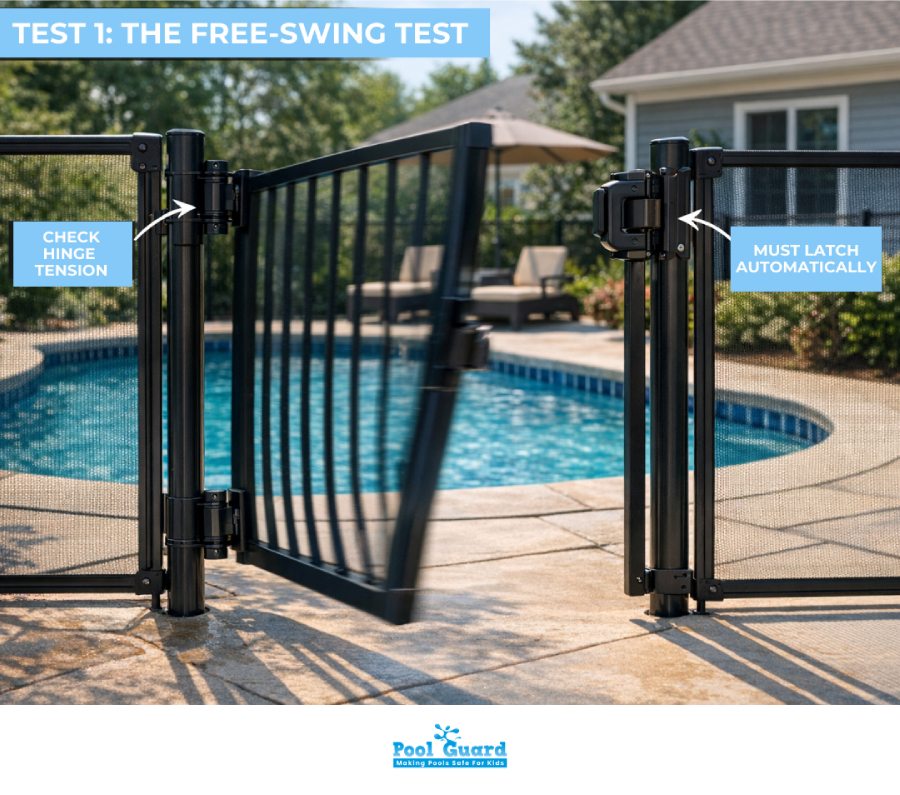
Start by opening the gate halfway, approximately 45 to 60 degrees. Release it completely and observe what happens.
The gate should close smoothly and latch on its own without hesitation. It should not slow dramatically before reaching the latch, and it should not require a small push to finish closing.
The gate fails this test if:
A properly functioning self-closing pool gate relies on hinge tension and gravity to complete the motion. If it cannot finish the job unassisted, it is unreliable.
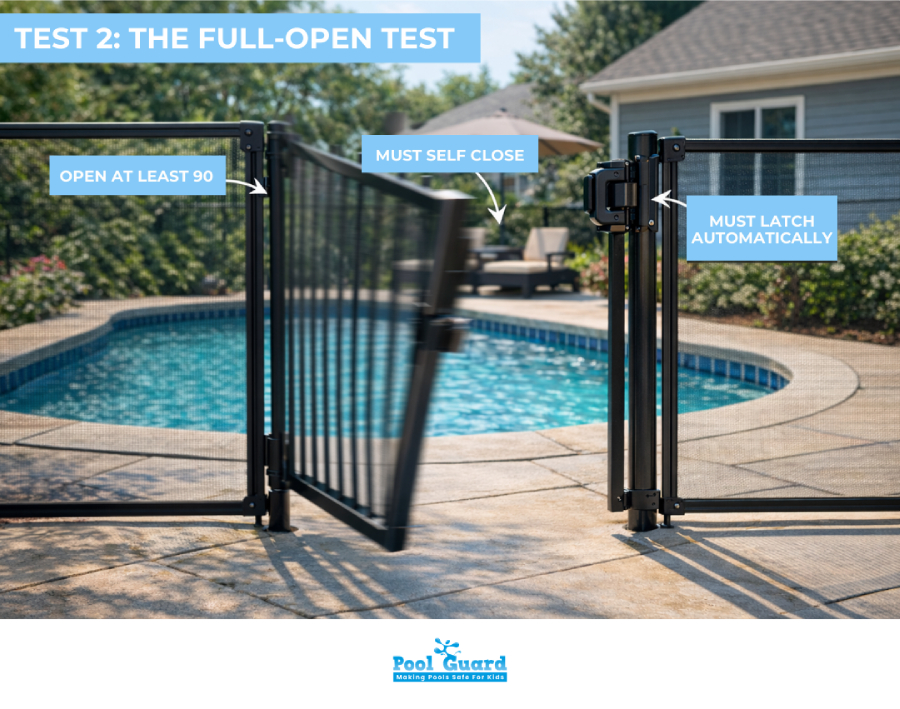
Open the gate fully — at least 90 degrees — and release it.
This test simulates real-life use. Children and guests do not open gates gently. A gate must close and latch properly even when opened to its widest position.
The gate should swing closed completely and latch automatically.
If it fails to close or does not latch when fully opened, hinge tension or alignment may be compromised.
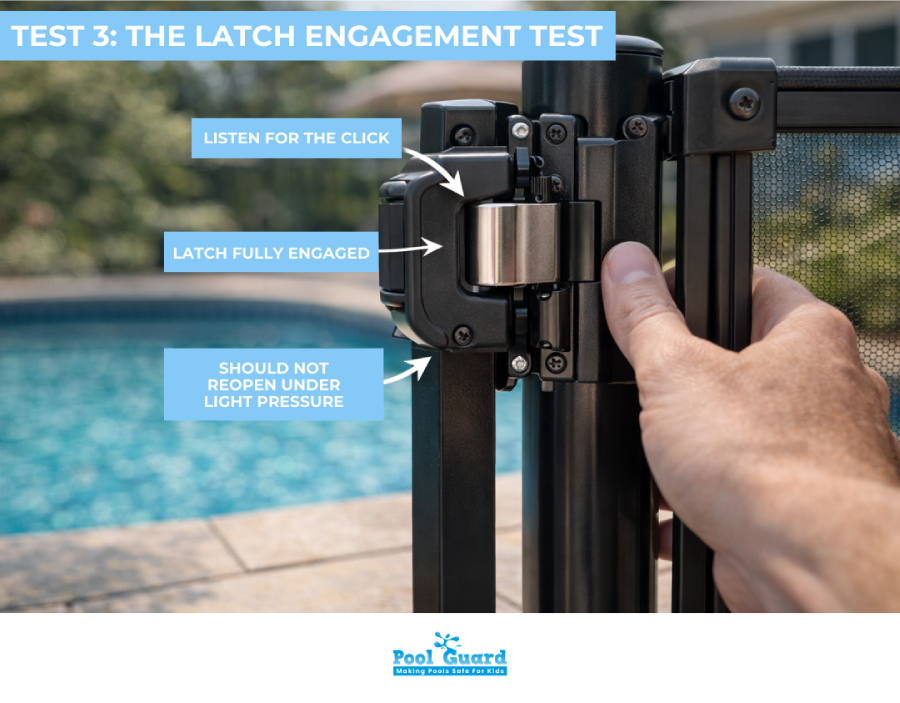
After the gate closes, listen carefully for a clear latch click. Then gently pull on the gate without touching the latch mechanism.
The gate should remain secured and should not reopen under light pressure.
This test verifies that the latch has fully engaged. A latch that only partially catches or slips loose under minimal force is unsafe. Slamming the gate to force engagement is not a solution. Proper alignment should allow consistent engagement under normal closure speed.
Many homeowners miss this test, but it reveals subtle alignment problems.
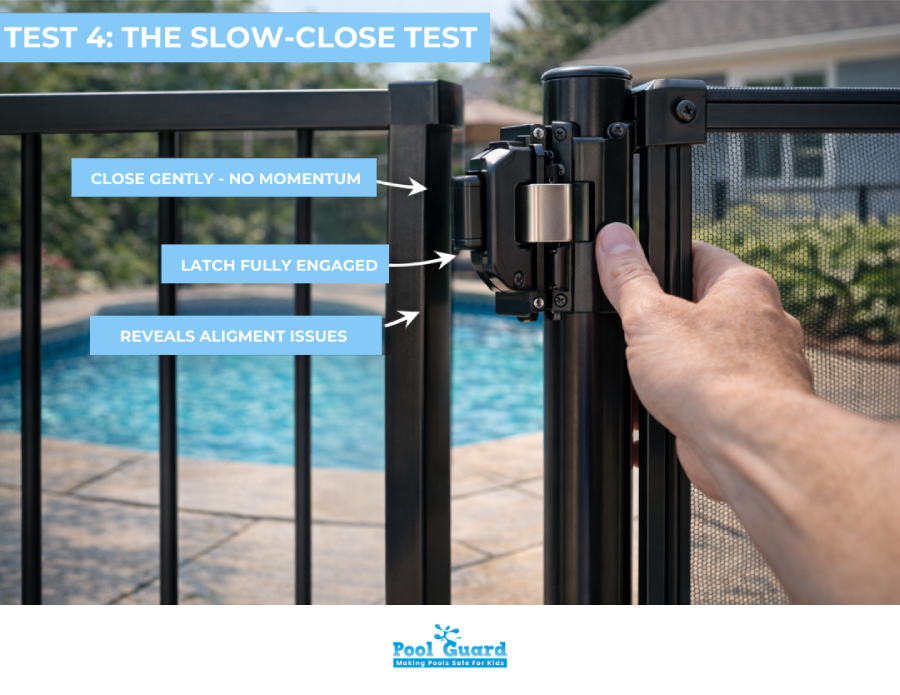
Gently guide the gate toward the closed position without allowing it to swing quickly. Let it close slowly and naturally.
The latch must still engage even without momentum.
Fast swing can mask problems because force pushes the latch into place. Slow movement exposes misalignment that otherwise goes unnoticed.
If slow closure prevents full engagement, the gate fails this test.
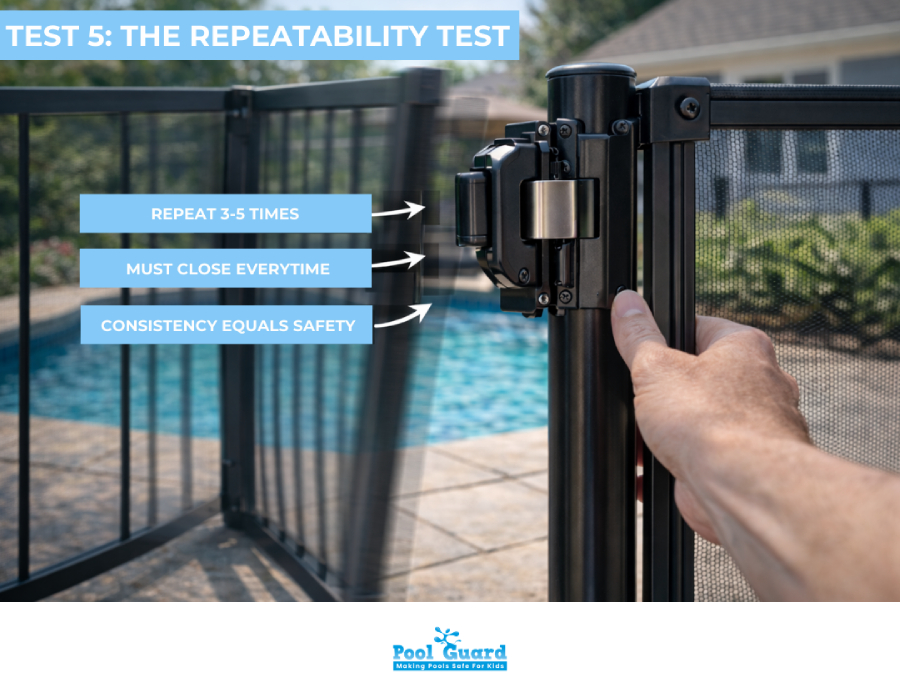
Reliability requires consistency. Repeat all previous tests at least three to five times.
A gate that passes once but fails later is not safe. Minor variations in hinge position, wind, or release angle should not affect performance. The system must work consistently every time.
Consistency is the true measure of safety.
Gate problems usually develop gradually. Because the gate still appears usable, small warning signs are easy to dismiss. Watch for:
If it fails once, it fails. There is no acceptable margin for inconsistency.
If your gate fails even one test, do not ignore it.
Do not prop it shut and assume supervision replaces mechanical protection. Supervision is essential, but barriers exist to reduce risk during brief moments of distraction.
Immediately restrict pool access if children are present. Then investigate the likely causes, which may include:
Testing identifies the problem. Adjustment corrects it. These are separate steps.
Testing is verification. Adjusting is a correction.
Many homeowners attempt to adjust hinge tension or latch height without first confirming failure patterns. That approach often leads to guesswork.
Even after adjustments, the gate must pass every test again. Hardware can drift over time due to temperature changes, ground movement, and normal use. Routine testing ensures your adjustments are actually effective.
The uncomfortable reality is that most residential pool accidents happen while adults are nearby. Distraction is common. A gate that “usually works” creates false confidence.
Self-closing systems fail quietly. Springs weaken. Magnetic latches lose alignment. Fasteners loosen. Landscaping interferes. Small changes accumulate until the gate stops securing properly.
Testing takes two minutes. The cost of not testing can be permanent.
The American Academy of Pediatrics (AAP) recommends multiple layers of protection, including secure pool barriers and close supervision. A functioning self-closing, self-latching gate is a core layer in that system.
Environmental shifts can quietly affect your gate’s performance.
In colder climates, freeze-thaw cycles can move posts slightly out of alignment. In hot climates, metal expansion and contraction can affect latch positioning. Heavy rains can shift soil, altering hinge alignment.
This is why testing before summer begins — and after major weather events — is essential.
Self-closing gates are a critical layer of pool protection, but they are not guarantees. They only protect when they function reliably and consistently.
Testing transforms a safety feature into real protection. If you cannot trust your gate to close and latch on its own every single time without assistance, it is not doing its job.
Take two minutes today. Run the tests. Remove uncertainty.
Then share this guide with another pool owner.
Please fill out the form below with your information. Your local dealer will be notified about your inquiry.
Please fill out the form below with your information. Your local dealer will be notified about your inquiry.