
Pool depth marker requirements are not cosmetic details or optional add-ons. They are enforceable safety standards that directly affect inspections, liability exposure, and insurance protection.
If you operate a public pool, manage an HOA facility, oversee compliance, or design aquatic centers, you need to understand exactly what is required and why it matters.
Improper depth markings are among the most common violations cited during health department and building inspections. They also frequently appear in litigation following diving injuries.
This guide explains what pool depth markers are, where they must be placed, how they must be designed, and how they fit into a broader water safety strategy.
Pool depth markers are permanent markings installed on the vertical walls of a pool and on the surrounding deck that clearly indicate the actual water depth at specific points.
They typically include a numerical value, such as “3 FT” or “5 FEET,” and must remain visible, legible, and accurate over time.
Pool depth marker requirements exist for two core reasons.
First, they reduce the risk of diving injuries by clearly identifying shallow areas. Water can distort perception, and swimmers often misjudge depth. Clear, visible depth information reduces impulsive dives into unsafe areas.
Second, they ensure regulatory compliance. Most public pool codes require depth markers as a condition of operation. Failure to comply can result in failed inspections, fines, and in extreme cases, temporary closure.
According to the Centers for Disease Control and Prevention, diving into shallow water is a leading cause of spinal cord injury in swimming pools. Depth visibility plays a measurable role in reducing that risk.
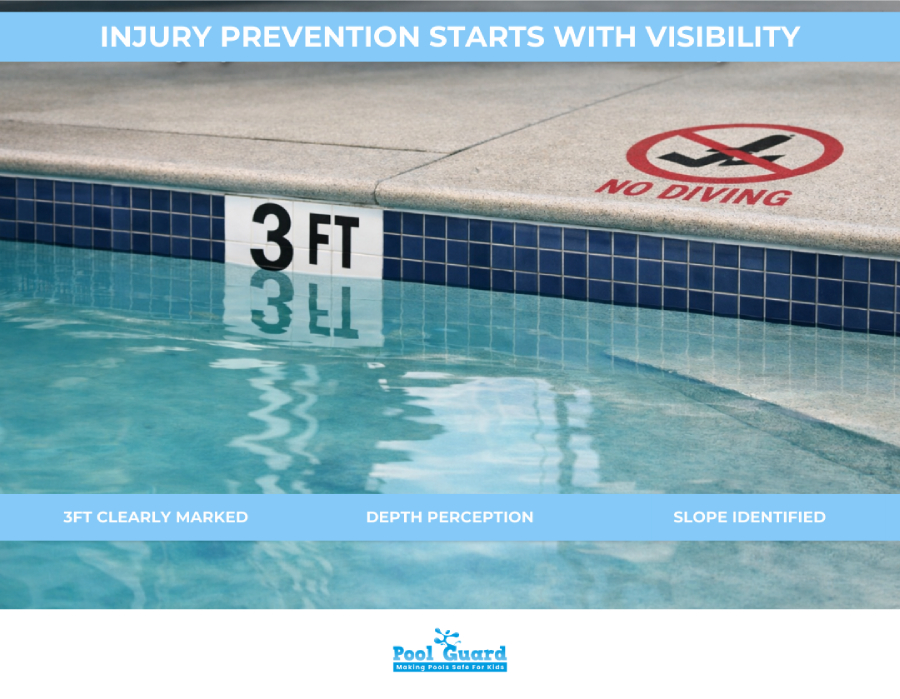
Depth markers communicate measurable water depth.
Warning signs communicate rules of behavior.
For example, a depth marker tells swimmers the water is four feet deep. A “No Diving” sign tells them diving is prohibited in that area.
Both are required in most public facilities, and neither replaces the other.
Pool depth marker requirements were developed because injuries frequently occur at slope transitions and shallow ends where swimmers misjudge depth. Clear, permanent markings remove ambiguity and reduce preventable harm.
They are a risk control tool grounded in both engineering and legal standards.
Yes, depth markers are required in all fifty states for public and commercial swimming pools.
Pool depth marker requirements are primarily governed by:
Under the ISPSC, depth markers must be installed at maximum and minimum depths, at slope transitions, and at specified spacing intervals. They must also reflect actual depth within a tolerance of plus or minus three inches.
For public operators, compliance is mandatory.
HOA pools, apartment complexes, hotels, and country clubs are typically classified as public or semi-public facilities under state law.
In these settings, failure to comply with pool depth marker requirements can increase liability exposure and complicate insurance claims. In negligence cases, the absence or improper placement of depth markers is often cited as evidence of unsafe conditions.
HOA boards often underestimate this risk until an inspection or incident forces action.
Most single-family residential pools are not legally required to install depth markers.
However, they are strongly recommended for properties that are:
When guest access increases, so does liability exposure.
Placement errors are the most common reason facilities fail inspections.
Under standard pool depth marker requirements, markers must be installed at the following locations:
These placements ensure that swimmers can easily identify water depth regardless of where they enter or move within the pool.
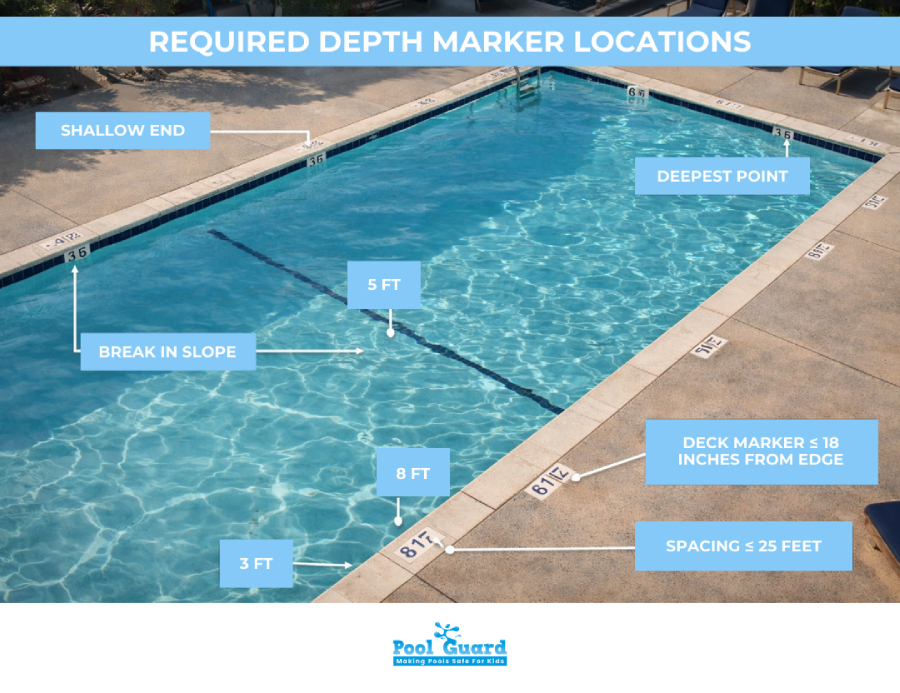
A break in slope is the point where the pool floor transitions from shallow water to deeper water.
This location is particularly important because it is a high-risk zone for diving injuries. Pool depth marker requirements specifically mandate marking this transition so swimmers understand that depth is changing.
Most codes require depth markers to be visible from both inside the pool and from the deck.
Wall markers must:
Deck markers must:
The goal is dual visibility for swimmers and deck users.
Pool depth marker requirements typically include design standards to ensure clarity and durability.
Most jurisdictions require that:
Temporary decals and fading paint often fail inspection because they do not meet permanence standards.
Durable materials such as tile, inlaid markers, or engraved deck lettering are preferred for long-term compliance.
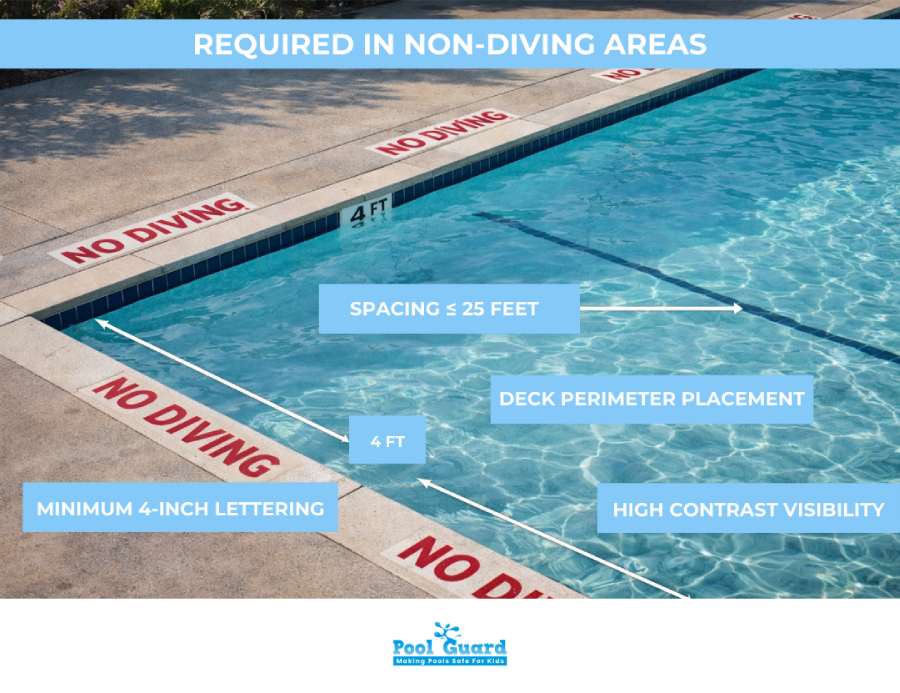
In addition to depth markers, most codes require “No Diving” markers in non-diving areas.
These markers are typically required from the shallow end up to the five-foot depth break, although some states impose stricter thresholds.
Common requirements include:
Some jurisdictions permit the international red “No Diving” symbol in place of text, but this must be confirmed under local code.
Depth markers and “No Diving” markers work together to reduce diving injury risk.
Diving injuries are often catastrophic and may result in permanent paralysis and substantial financial settlements.
In litigation, courts evaluate whether a facility complied with pool depth marker requirements. If markers are missing, incorrectly spaced, inaccurate, or illegible, this can significantly increase liability exposure.
Non-compliance can:
Depth markers are inexpensive compared to the legal and financial consequences of non-compliance.
Pool depth markers reduce diving injury risk by clearly communicating water depth.
They do not prevent unsupervised access.
They do not stop accidental entry.
They do not replace lifeguard supervision.
They do not function as physical barriers.
Effective water safety requires layered protection that includes supervision, controlled access, pool fences, and compliant signage.
Depth markers are one essential layer in a comprehensive safety system.
Pool depth marker requirements are grounded in injury prevention, regulatory compliance, and liability control.
The most important points to remember are:
Always verify local and state code before installation. When possible, design to the most stringent applicable standard.
Depth markers are not decorative details. They are critical compliance infrastructure.
If this guide helped clarify pool depth marker requirements, share it with your operations team and review your facility for inspection readiness.
Please fill out the form below with your information. Your local dealer will be notified about your inquiry.
Please fill out the form below with your information. Your local dealer will be notified about your inquiry.