In Tennessee, pool fencing isn’t optional, it’s a legal requirement. And here’s where homeowners get tripped up: meeting pool fence requirements Tennessee sets at the state level does not guarantee you’re compliant locally. Cities and counties routinely add stricter rules, and missing one detail can mean failed inspections, fines, or forced rebuilds.
Fence height, self-closing gates, latch placement, alarms, setbacks, permits, every detail matters, and assumptions are expensive.
This guide breaks down the exact pool fence requirements Tennessee homeowners must follow, including where state rules end and local codes begin, so you can build once, pass inspection, and know your pool is legally protected.
When it comes to pool safety, Tennessee doesn’t leave anything to chance. The state has adopted the International Swimming Pool and Spa Code (ISPSC) to make sure every residential pool, whether brand new or decades old, is properly secured. These rules aren’t just guidelines.
They’re enforceable safety standards designed to protect kids, pets, and guests from preventable accidents.
When it comes to pool fences in Tennessee, height isn’t just a suggestion, it’s a hard rule. The state requires that every residential pool barrier stand at a minimum of 48 inches tall when measured from the ground on the outside of the fence.
Why so specific? The shorter the fence, the easier it is for children to climb over, exposing them to a higher risk of an unpreventable accident. A 4-foot fence strikes a balance: it’s tall enough to serve as a serious deterrent, yet manageable enough for homeowners to install without special equipment.
But here’s the catch: local inspectors will measure from finished grade, not from uneven soil, mulch, or raised landscaping.
A fence is only as strong as its weakest point, and in many cases, that’s the space between the fence and the ground. According to Tennessee pool fence regulations, the bottom of your barrier must not exceed 2 inches of clearance from the ground.
Why does this matter so much? Because a small child or pet can crawl under even a modest gap, especially if the terrain around the pool is uneven. That’s why inspectors pay close attention to this detail during final inspections. This rule applies to all fence materials.
If you’re installing over grass, dirt, or gravel, make sure to level the surface first.
Even the sturdiest fence becomes ineffective if its gaps invite danger. Tennessee’s regulations are clear: no opening within the barrier may allow the passage of a sphere measuring 4 inches in diameter. This standard exists for a reason, it simulates the smallest opening a child’s head could fit through.
That means spacing between vertical pickets, decorative scrolls, or panels must be carefully measured.
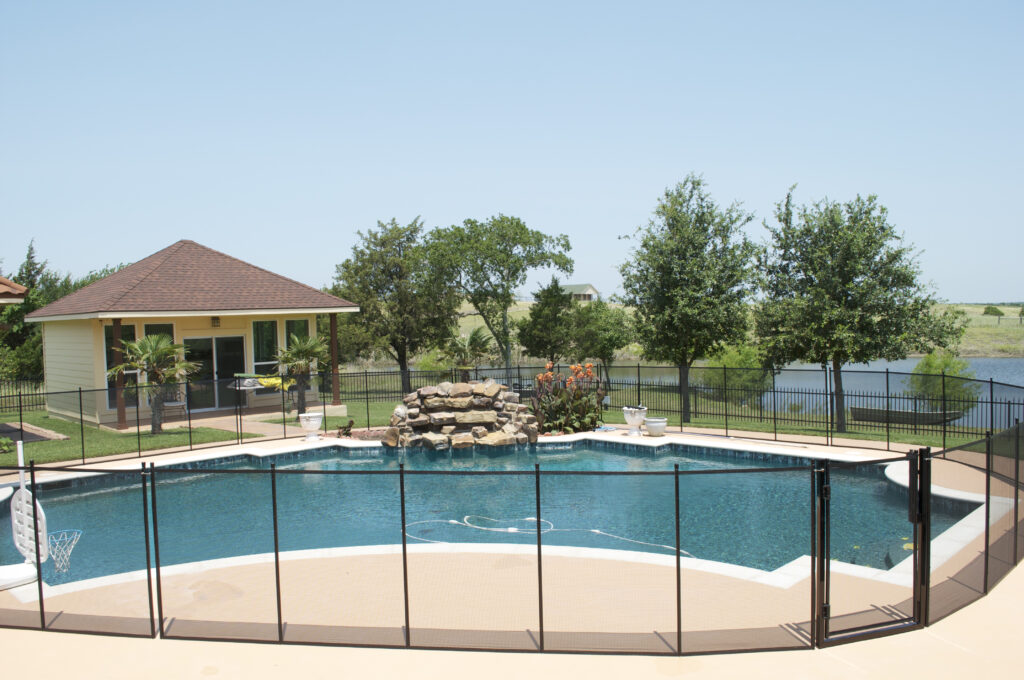
For mesh fences, tension must remain tight across all panels. For rigid systems like wrought iron or aluminum, verify picket spacing against both manufacturer specs and post-install inspection tools.
In Tennessee, a pool barrier must not only enclose but also actively defend. That’s why fences must be constructed to prevent even the most curious children from climbing over the fence.
If your fence includes horizontal and vertical members (rails), their placement is critical. When the horizontal rails are spaced less than 45 inches apart, they must be installed on the poolside, where they can’t be used as a ladder from the outside. The vertical rails in this case should not allow more than a 1 ¾ spacing. This ensures children can’t scale the fence using footholds between the horizontal and vertical beams.
Latticework, ornamental cutouts, or decorative stonework can all disqualify a fence if they inadvertently provide climbing access. That said, latticework, cutouts, and decorative elements should not exceed 1 ¾ inches in width.
While the fence forms the perimeter, the gate is your pool’s front line of defense, and it must meet the most rigorous standards of all.
Tennessee law requires every pool gate to be self-closing and self-latching, ensuring that it automatically returns to a secure, locked state after every use. Gates must swing outward, away from the pool, so that pressure from inside cannot be used to force them open.
The latch itself must be installed at least 54 inches from the ground, or if mounted lower, it must be positioned on the pool-facing side of the gate and placed at least 3 inches below the top edge. This configuration ensures that small children cannot reach over or manipulate the latch from the outside.
Magnetic self-latching mechanisms and tension-adjustable hinges are the gold standard for meeting both function and code. For superior reliability and compliance, we recommend the Pool Guard™ MagnaLatch, a magnetic, self-latching gate system designed specifically for child safety around pools.
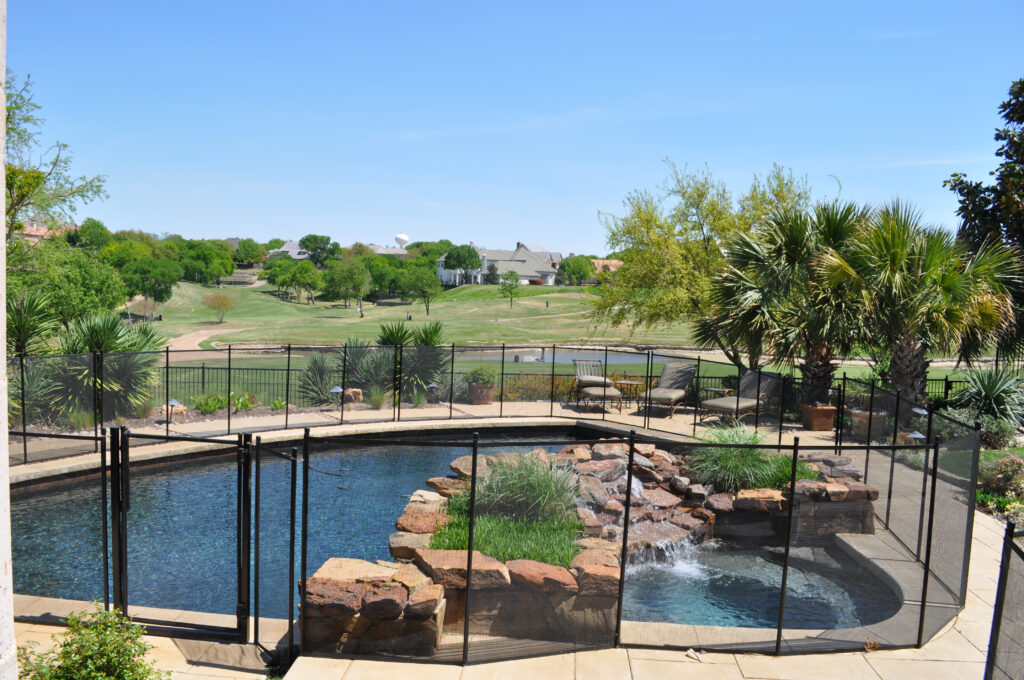
While Tennessee follows statewide safety standards like the ISPSC, local regulations can vary significantly by city or county. That’s why homeowners need to check with their local building departments: what’s legal in one area might not meet code just a few miles away. From permitting rules to fence height exceptions, each municipality may apply the law differently.
While the city follows Tennessee’s statewide pool safety standards, pool fencing in Mt. Juliet is also governed by local guidelines designed to ensure inspections are passed and violations are avoided. These city-specific rules clarify how state requirements are enforced at the local level and where additional compliance details apply.
Below is a clear breakdown of how pool fencing Mt. Juliet regulations are applied, so homeowners know exactly what inspectors look for before construction or installation begins.
| Requirement | Details |
| Fence Height | Minimum 48 inches from finished ground level (outside of barrier). |
| Vertical clearance | The maximum vertical clearance between the finished ground level and the bottom of the barrier shall be 2 inches measured from the side of the barrier. |
| Gaps & Openings | No opening shall allow a 4-inch sphere to pass through. Horizontal members must be on the pool side if spaced less than 45 inches apart, with vertical gaps of ≤1¾ inches in width. |
| Pool Gates | Gates must be self-closing and self-latching. Latches must be installed at least 54 inches from the ground. If placed on less than 54 inches on the pool side, they should be at least 3 inches from the top, with no opening over ½ inch within 18 inches of the latch. |
In Knoxville, Tennessee, pool safety is a top priority. The city enforces specific regulations for residential swimming pool barriers to prevent unauthorized access and reduce the risk of accidents, especially involving young children.
| Requirement | Details |
| Fence Height | Minimum 48 inches from finished ground level, with fences preferred to be at least 60 inches (5 feet) tall. |
| Vertical Clearance | The maximum vertical clearance between the finished ground level and the bottom of the barrier shall be 2 inches measured from the side of the barrier. |
| Gaps & Openings | Openings must not allow a 4-inch sphere to pass through. Horizontal members less than 45 inches apart must be on the pool side. Vertical spacing must not exceed 1¾ inches. |
| Pool Gates | Gates must be self-closing and self-latching. Latches must be at least 54 inches from the ground or located on the pool side with specific protections. Gates must swing away from the pool. |
In Nashville, all residential swimming pools must be enclosed by a compliant barrier that meets both statewide ISPSC standards and local zoning regulations. pool fence in nashville tn
| Requirement | Details |
| Fence Height | Fences must stand at least 48 inches tall from finished ground level. |
| Vertical Clearance | There should be no more than a 2-inch space between the ground and the base of the barrier to prevent access underneath. |
| Gaps & Openings | Fence openings must be too narrow for a 4-inch object to pass. When horizontal rails are closer than 45 inches apart, they must face the interior. Vertical spacing should be 1¾ inches or less. |
| Pool Gates | Pool gates must automatically close and lock. Gate latches must be a minimum of 54 inches high or safely positioned on the pool side. All gates must swing away from the pool area. |
If you are looking for a pool fence in Nashville TN specifically, it’s time to explore professional pool fence installation and top-rated pool fence installers in Nashville to secure your home today.
Whether you’re installing a new pool or updating an existing one, your fence must meet both state and local regulations to pass inspection and keep your family safe.
| Requirement | Details |
| Minimum Fence Height | Fences must be at least 48 inches (4 feet) tall. |
| Vertical Clearance | There should be no more than a 2-inch space between the ground and the base of the barrier to prevent access underneath. |
| Gaps & Openings | Openings in the fence should not allow the passage of a 4-inch diameter sphere. |
| Gate Requirements | Gates must be self-closing and self-latching, opening outward away from the pool area. The latch should be at least 54 inches from the ground or located on the pool side with specific spacing requirements. |
Need a legal pool fence in Chattanooga? Work with expert pool fence installers in Chattanooga who understand local code and can help you pass inspection the first time.
Yes. Tennessee law mandates that any pool deeper than 24 inches must be enclosed by a code-compliant safety barrier, whether it’s in-ground or above-ground.
No. Tennessee requires both a pool fence and an audible pool alarm for pools built after January 1, 2011. The alarm adds a second layer of protection, but it doesn’t replace the physical barrier.
Yes, most counties and cities require permitting and final inspection before the fence is considered legal. Always check with your local building department to confirm the process.
Installing a pool fence is not just a legal requirement in Tennessee but a crucial step in ensuring the safety of your family and others. By adhering to pool fence requirements in Tennessee, homeowners in Nashville, Chattanooga, and throughout Tennessee can enjoy peace of mind knowing their pool areas are secure and compliant.
Ready to install a pool fence that meets every standard, and looks great while providing maximum security?
Reach out to Pool Guard today for expert installation, premium safety materials, and full compliance with state and local codes.
Please fill out the form below with your information. Your local dealer will be notified about your inquiry.
Please fill out the form below with your information. Your local dealer will be notified about your inquiry.