Owning a swimming pool changes your responsibilities—whether you acknowledge it or not. Pools are high-risk environments, especially for children, guests, and non-swimmers. When something goes wrong, there is no buffer, no grace period, and no time to “wait and see.” Pool emergencies are often misunderstood, especially when compared to how long it takes to drown and how quickly situations escalate.
That’s why CPR for pool owners is not a bonus skill. It is the final safeguard when every other safety layer fails.
This guide cuts through myths, oversimplified checklists, and compliance fluff to explain what actually matters in real pool emergencies—and why trained pool owners are often the difference between recovery and tragedy.
According to the Centers for Disease Control and Prevention, drowning remains one of the leading causes of accidental death in children ages 1–4 and a major risk for adults as well. Most drownings occur in residential pools—not public facilities with lifeguards.
The dangerous assumption is that drowning is obvious. It isn’t. There’s usually no splashing, yelling, or dramatic struggle. Victims lose oxygen quietly, often within arm’s reach of supervision.
Even in urban areas, emergency medical services typically arrive 6–10 minutes after a 911 call. Brain injury from oxygen deprivation can begin in 4–6 minutes.
That gap is where CPR lives.
Without immediate action from someone already on site, survival odds collapse before professionals ever arrive. CPR doesn’t replace EMS—it keeps the brain alive long enough for them to matter.
From a legal standpoint, pools create an elevated duty of care for homeowners. From a practical standpoint, they combine water, panic, delayed recognition, and untrained bystanders. CPR training is part of responsible pool ownership in the same way fencing and alarms are—not because it’s pleasant, but because it’s necessary. These risks are reinforced by broader drowning statistics that highlight how frequently residential incidents occur.
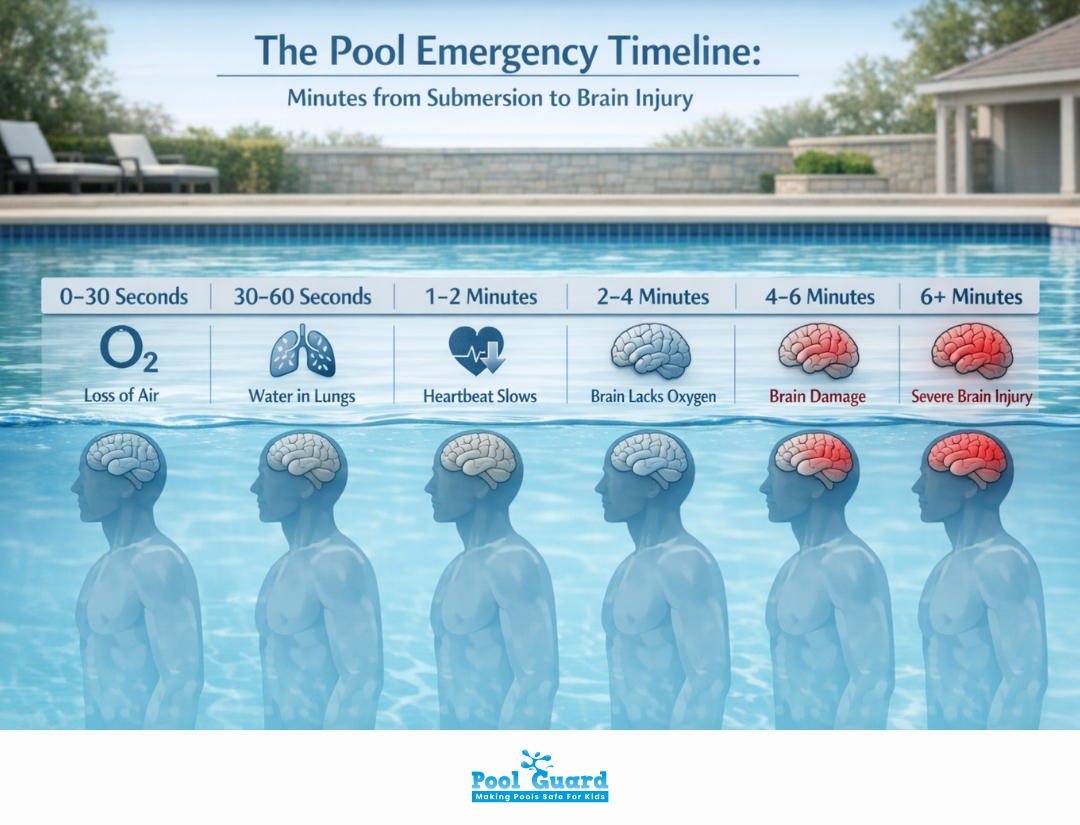
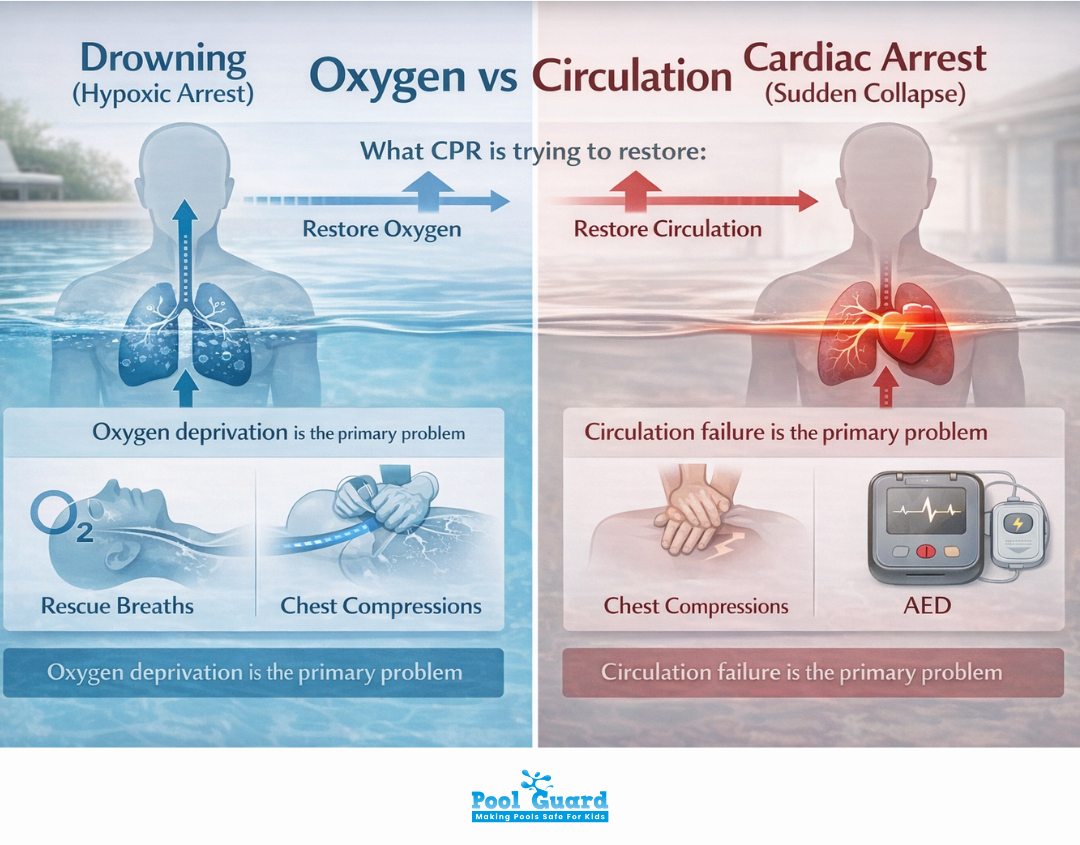
Most CPR training examples focus on sudden cardiac arrest. Pool emergencies are different. Drowning is primarily a hypoxic event—oxygen deprivation—before the heart stops.
That distinction matters.
When water enters the airway, oxygen delivery plummets. The heart may still be beating, but the brain is already in crisis. Restoring oxygen is the priority. This silent progression is similar to near drowning cases, where symptoms may not be immediately obvious.
Wet decks, slippery surfaces, and panicked witnesses complicate rescues. Victims are often pulled from the water later than anyone realizes because bystanders misinterpret gasping or weak movement as “still breathing.” This is why supervision strategies like assigning a water watcher remain critical even when safety systems are in place.
In drowning-related CPR, ventilation is critical. Chest compressions circulate blood, but without oxygen, circulation alone doesn’t solve the problem. This is why drowning response differs from compression-only CPR messaging.
Your safety comes first. Secondary victims help no one.
Removing the victim quickly but safely prevents the emergency from escalating.
Gasping, irregular breaths, or brief movements are not normal breathing. This is where many pool owners lose precious time.
If the person is unresponsive and not breathing normally, treat it as a life-threatening emergency.
If others are present, delegate clearly. If you are alone, call first, then begin care.
CPR without EMS is a holding action—not a solution.
This section explains principles, not certification steps. Formal training from recognized providers is essential.
Children deteriorate faster because of smaller oxygen reserves. Outcomes depend heavily on how quickly oxygen delivery is restored.
This is why pediatric CPR training is critical for family pool owners—not optional.
The American Red Cross and similar organizations emphasize that CPR effectiveness improves dramatically when rescuers are trained and confident, not hesitant.
The truth: imperfect CPR started early is far better than perfect CPR started late.
AEDs are designed to be used in wet environments, but the chest must be dried quickly for pad placement.
AEDs treat specific heart rhythms. In pure drowning cases, oxygen deprivation is the primary problem. That’s why CPR comes first, with AEDs as a powerful complement—not a replacement.
When cardiac arrest follows drowning, early CPR plus AED use dramatically improves survival odds.
Most U.S. states have Good Samaritan laws that protect individuals who provide reasonable emergency care in good faith. While laws vary, training reduces both legal exposure and hesitation.
This is not legal advice—but risk awareness. Courts look more favorably on action than inaction, especially from pool owners who knowingly manage a high-risk environment.
Reading a guide is not training. Watching a video once is not preparation.
Hands-on instruction builds:
Online courses can supplement learning, but they don’t replace physical practice. Skill decay is real.
Most experts recommend refreshing CPR skills every 1–2 years. The cost is trivial compared to the consequences of being unprepared.
CPR works best inside a system—not in isolation.
An effective pool emergency plan includes:
Prevention reduces incidents. CPR limits damage when prevention fails.
This layered approach is where modern pool safety solutions—including removable pool fences and alarms—naturally belong. Response without prevention is reactive. Prevention without response is incomplete.
CPR saves lives—but only after every other safeguard has failed.
Responsible pool owners think differently. They plan for emergencies they hope never happen. They understand that preparation is not pessimism—it’s competence.
If you own a pool, CPR for pool owners is not about fear. It’s about readiness, accountability, and respect for the risks you manage. Share this guide, review pool safety fence options, and explore additional pool safety resources to reduce preventable risk.
Please fill out the form below with your information. Your local dealer will be notified about your inquiry.
Please fill out the form below with your information. Your local dealer will be notified about your inquiry.