Houston isn’t just hot — it’s built for pools.
From rooftop lazy rivers to backyard fiberglass builds, swimming pools are woven into the city’s real estate, lifestyle, and climate reality. But how common are pools in Houston? What do they cost? Do they increase home value? And how does Houston compare nationally?
This guide compiles the most current, data-backed pool statistics for Houston into one authoritative resource — covering construction permits, installation costs, public pool usage, ROI, soil conditions, and hotel pool trends. Whether you’re a homeowner, real estate investor, builder, or safety advocate, this is your data-driven snapshot of Houston’s pool landscape.
Houston continues to solidify its position as one of Texas’ most active and resilient residential swimming pool construction markets. Despite normal seasonal fluctuations across the state, Houston’s permit volume and construction value reflect sustained demand rather than short-term spikes.
In April 2025, Houston recorded:
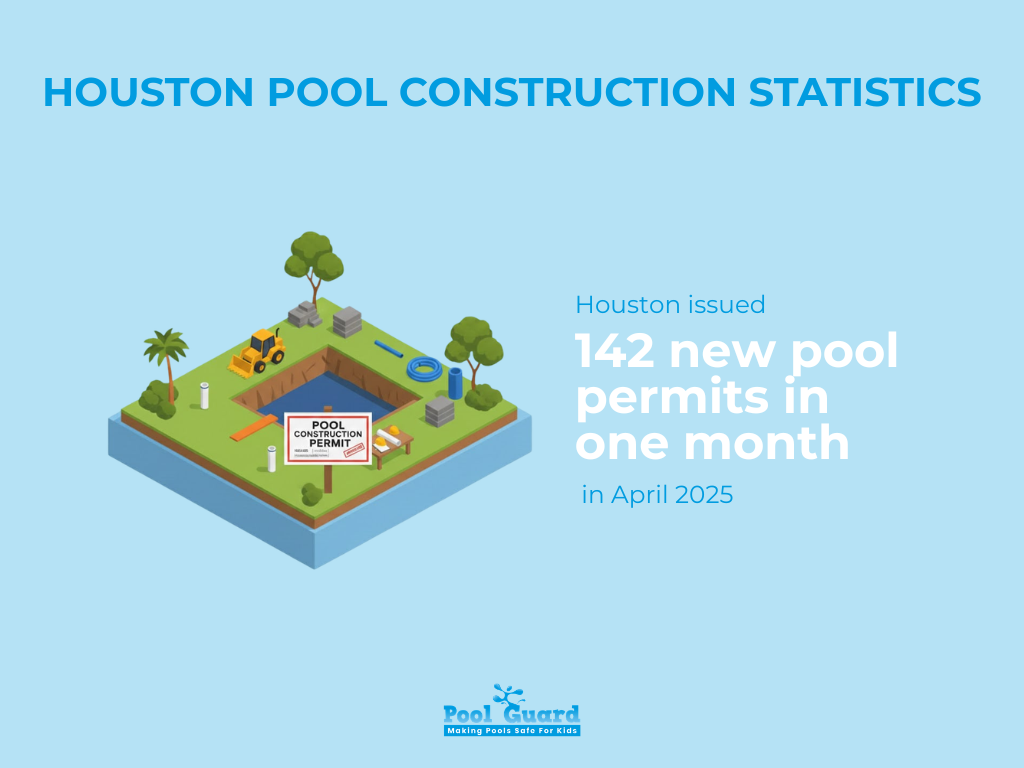
To put that in context, while statewide Texas permits declined 7% month-over-month — dropping from 550 in March to 511 in April — Houston maintained steady activity levels and remained one of the primary contributors to total construction volume.
Houston’s pool market is not speculative or driven by temporary hype cycles. The data reflects consistent homeowner demand across metro Houston, even when broader state totals fluctuate. With nearly 100 permits issued in Harris County alone in a single month, the construction pipeline remains active and structurally supported by climate, housing trends, and long-term lifestyle demand.
In short: Houston is not just participating in Texas’ pool market — it is anchoring it.
Installing an in-ground pool in Houston costs more than the national average — and that’s not arbitrary. Between expansive clay soils, high water tables, humid climate conditions, and complex permitting requirements, Houston pools require more engineering precision than many other markets.
Here’s what the data shows.
In 2026, the typical cost to install an in-ground pool in Houston falls within the following range:
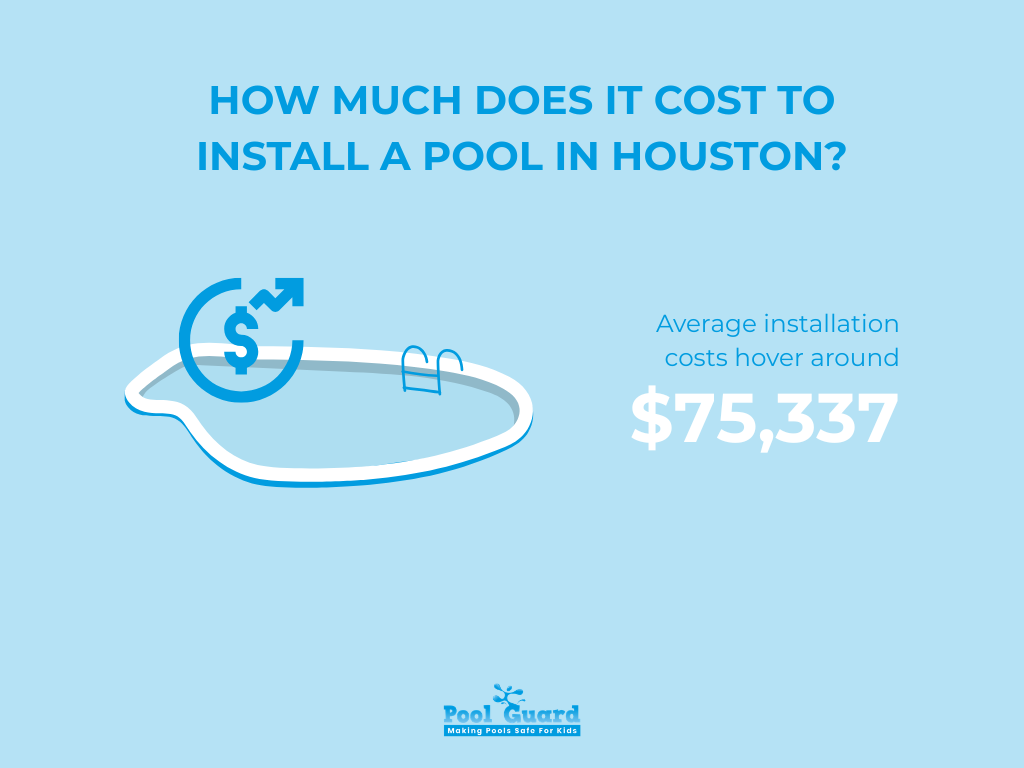
The wide range reflects differences in size, materials, customization level, soil stabilization requirements, and add-ons like decking, lighting, and integrated spas.
While national averages trend lower, Houston-specific site preparation and climate-related maintenance considerations push total project costs upward.
Pool size remains one of the most predictable cost drivers. Larger surface area increases excavation volume, material requirements, plumbing complexity, and finishing labor.
Here’s how average costs scale by size in Houston:
| Pool Size | Average Cost |
|---|---|
| 10×10 (100 sq. ft.) | $17,500 |
| 12×24 (288 sq. ft.) | $25,200 |
| 14×28 (392 sq. ft.) | $34,000 |
| 16×32 (512 sq. ft.) | $44,800 |
| 20×40 (800 sq. ft.) | $70,000 |
Notice how costs rise steadily with square footage. A 20×40 pool can cost roughly four times more than a compact 10×10 configuration, not simply because of size, but because larger pools typically include upgraded finishes, enhanced filtration systems, and more extensive decking.
Material choice directly affects both upfront investment and long-term maintenance requirements.
| Material | Cost Range |
|---|---|
| Concrete | $65,000–$120,000 |
| Fiberglass | $25,000–$60,000 |
| Vinyl | $20,000–$40,000 |
Concrete pools command the highest price due to durability and full customization flexibility. Fiberglass offers a balance of longevity and reduced maintenance. Vinyl provides the lowest upfront cost but requires liner replacement over time.
In Houston’s humid subtropical climate — where summer temperatures frequently reach the 90s and 100s — fiberglass pools perform especially well because their nonporous surface resists algae growth more effectively than porous concrete.
That matters in a city where heat accelerates organic growth.
Labor accounts for 25%–50% of total project cost, making it one of the largest budget variables.
Typical professional rates in Houston include:
Excavation costs often increase in Houston due to expansive clay soils. Builders may need to remove unstable soil, install structural fill, or add vertical moisture barriers — all of which require skilled labor and time.
In other words: the ground beneath your pool can materially affect your final invoice.
Houston’s ground conditions are one of the least discussed — yet most financially impactful — factors in pool construction.
Simply put: Houston’s soil is not builder-friendly.
The region contains a mix of:
Each of these presents structural challenges, but expansive clay is the primary cost driver.
To prevent structural damage, builders typically:
This adds engineering precision, additional labor, and material costs. They also add time to the project schedule.
But skipping them isn’t an option in many Houston neighborhoods.
Yes — but only when it aligns with neighborhood expectations and buyer demographics.
Pools in Houston are not universally value-boosting assets. They are market-dependent features. The difference between a smart investment and a sunk cost often comes down to location, condition, and surrounding home values.
According to a Redfin metro-level analysis:
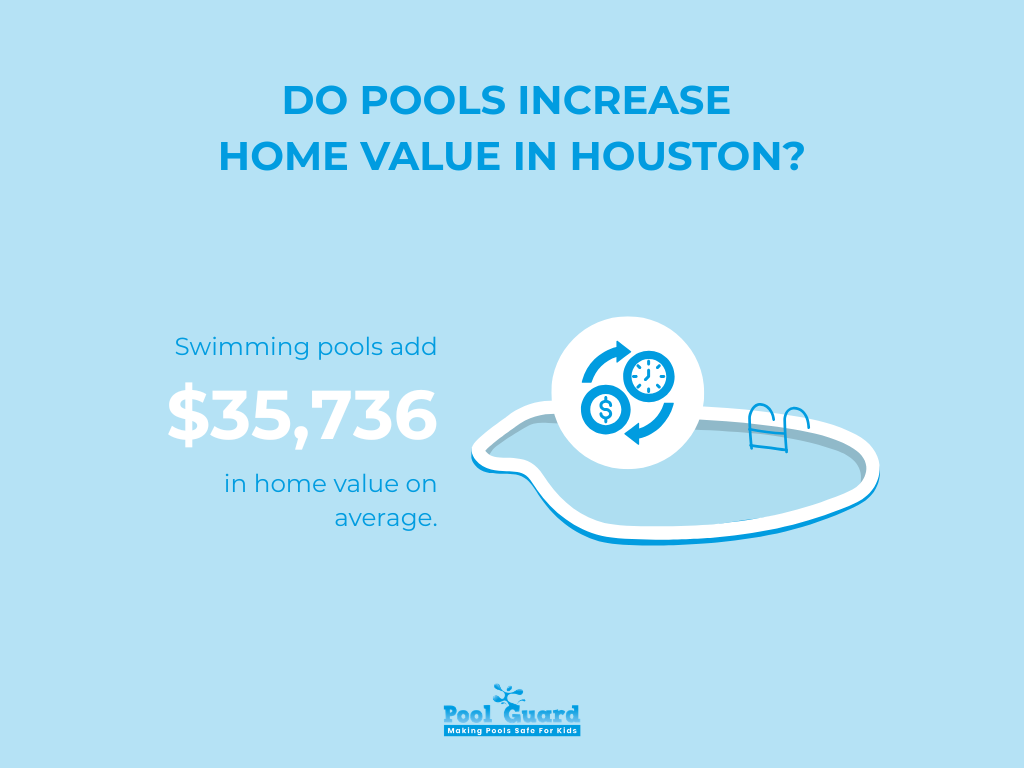
That range is wide for a reason.
In higher-end Houston neighborhoods where pools are common, buyers often expect them. In those markets, a well-maintained pool supports pricing power. In neighborhoods where pools are rare, the return may be limited — or even negative — due to maintenance concerns.
If most homes in your area have pools, not having one can actually hurt resale competitiveness. In those cases, the pool functions less as a luxury and more as a market standard.
However, if you install a pool in an entry-level neighborhood where few homes have one, buyers may discount it due to:
Houston’s heat makes pools desirable. But desirability alone does not guarantee return.
Here’s how Houston compares to other major metro areas in terms of pool-driven home value increase:
| Metro | Value Added |
|---|---|
| Los Angeles | $95,393 |
| Austin | $52,228 |
| Houston | $35,736 |
| Phoenix | $11,591 |
Houston sits in the mid-to-upper tier nationally. It significantly outperforms hot-climate markets like Phoenix but trails ultra-premium markets like Los Angeles.
That positioning reflects Houston’s housing economics: strong pool demand, but broader price bands and more moderate luxury concentration than coastal markets.
If your goal is pure investment return, a pool in Houston should be evaluated through:
If your goal is lifestyle enhancement — Houston’s climate strongly supports it.
But if your goal is resale maximization, precision matters.
In Houston, pools increase value — but only when they fit the market around them.
Houston ranks #13 nationally among U.S. cities with the highest percentage of residential pool ownership — placing it firmly within the upper tier of pool-dense metro areas.
While the referenced survey did not publish Houston’s exact percentage of pool-equipped homes, its national ranking confirms strong residential penetration compared to most American cities.
At the national level:
Texas is also identified as one of the states with a high concentration of in-ground pool ownership, alongside markets like California and Florida.
Given Houston’s population size and climate conditions, it plays a major role in that statewide concentration.
Houston operates 24 public swimming pools, forming a critical part of the city’s recreational and heat-response infrastructure.
In a metro area where summer temperatures regularly reach the 90s and 100s, public pools are not just amenities — they function as cooling centers, community hubs, and essential public health resources.
Visitor data from 2017 to 2019 shows consistently strong public engagement across Houston’s open facilities.
Most notably, T.C. Jester Pool nearly doubled the visitor count of the second-most popular facility, Emancipation Park, demonstrating concentrated demand at high-amenity locations.
This level of usage indicates that public aquatic infrastructure plays a meaningful role in Houston’s seasonal lifestyle patterns.
Based on visitor data:
These facilities serve diverse neighborhoods across Houston and vary in design, capacity, and programming.
Houston’s public pools typically include:
The variety of features reflects broad user demand — from competitive swimmers to families seeking recreational relief.
Houston’s pool culture doesn’t stop at residential backyards. The city’s hospitality sector heavily leverages aquatic amenities as competitive differentiators — especially in the luxury and downtown markets.
In a climate where summer heat dominates for months, pools are not optional hotel perks. They are revenue drivers.
These features are not symbolic. They reflect measurable investment into pool-centered experiences designed to attract both tourists and local “staycation” demand.
When hotels allocate significant capital to rooftop engineering, large-volume water features, and resort-style multi-pool systems, it signals something important:
Pools are economically strategic assets in Houston.
Houston’s hospitality investments reinforce the city’s broader pool ecosystem:
Together, these segments create a city-wide normalization of pool ownership and usage.
In Houston, pools aren’t niche. They are embedded into lifestyle, real estate, and hospitality economics.
High pool density always increases safety responsibility.
National data highlights the scale of the issue:
In a pool-dense metro like Houston — with strong residential adoption, 24 public pools, and high hotel pool exposure — these statistics carry direct relevance.
Houston’s long warm season increases:
The majority of child drowning incidents occurring at private residences underscores a critical point: the danger isn’t primarily at public facilities — it’s at home.
In a city where pools are common, protective systems are not aesthetic add-ons.
They are structural risk controls.
The Bottom Line:
In Houston’s pool ecosystem — spanning residential builds, public facilities, and commercial luxury properties — safety infrastructure must scale with density.
Barriers and access-control systems are not just upgrades.
Houston is not just a “pool-friendly” city — it’s structurally and economically built around them.
Pools in Houston aren’t luxury extras — they’re climate infrastructure, lifestyle assets, and real estate variables with measurable economic impact.
The data behind Pool Statistics for Houston tells that:
Houston is a high-density pool market supported by consistent construction permits, above-average installation costs driven by soil complexity, measurable home value increases, strong public facility usage, and a hospitality sector that heavily invests in aquatic amenities.
At the same time, national drowning statistics remind us that high pool density demands proportional safety awareness — especially in private residential settings where the majority of incidents occur.
If you’re building, buying, selling, or upgrading, understanding these pool statistics for Houston gives you leverage. It allows you to evaluate ROI realistically, anticipate construction variables, assess neighborhood competitiveness, and plan for safety infrastructure before risk becomes liability.
Houston’s pool market is mature, climate-aligned, and structurally embedded into the city’s housing and hospitality economy. That means decisions should be data-driven — not trend-driven.
Use the numbers. Compare the context. Evaluate the neighborhood. Plan for protection.
And if this guide helped clarify the landscape, share it, reference it, and keep it bookmarked as Houston’s pool market continues to evolve.

Please fill out the form below with your information. Your local dealer will be notified about your inquiry.
Please fill out the form below with your information. Your local dealer will be notified about your inquiry.