Liquid pool covers are marketed as an invisible, effortless way to keep your pool warm, reduce evaporation, and save money. Some pool owners swear by them. Others say they noticed little to no difference.
So—do liquid pool covers work, or are they just clever pool-industry marketing?
The short answer: yes, liquid pool covers do work—but only within specific limits. They are not heaters, not replacements for physical covers, and not universally effective. When used in the right conditions, they can meaningfully reduce heat and water loss. Used in the wrong conditions, they’re an ongoing expense with little return.
This guide cuts through the hype. You’ll learn:
A liquid pool cover (also called a liquid solar cover) is a biodegradable chemical formulation—typically based on fatty alcohol compounds—that spreads across the surface of your pool and forms a monomolecular film.
This film is:
Despite the name, a liquid pool cover does not heat your pool. Instead, it acts as an evaporation suppressant.
Think of it like putting a lid on a pot of water—not to add heat, but to stop heat from escaping.
According to the U.S. Department of Energy, up to 70% of swimming pool heat loss occurs due to evaporation, not air temperature or ground loss, which aligns with data shown in how evaporation impacts pool heat loss.
When water evaporates:
Each pound of water that evaporates at around 80°F removes over 1,000 BTUs of heat from the pool.
A liquid pool cover:
This reduced evaporation:
Yes—but performance varies widely.
According to guidance cited in the Pool & Spa Operator Handbook by the National Swimming Pool Foundation, liquid covers consistently show measurable—but moderate—evaporation reduction, especially when paired with heaters or physical pool covers.
| Factor | Liquid Pool Cover | Solar Blanket |
| Heat retention | Moderate | High |
| Evaporation reduction | 15–40% | 30–50%+ |
| Ease of use | Excellent | Poor–Moderate |
| Ongoing cost | Yes | No (after purchase) |
| Wind resistance | Low | High |
| Safety | None | None (unless safety cover) |
Key insight:
A solar blanket is more effective—but only when it’s actually on the pool. A liquid cover works even when convenience wins over discipline. If you’re comparing options beyond liquid solutions, it helps to understand the different types of pool covers available and how each performs in real-world conditions.
Yes. When used according to manufacturer instructions, liquid pool covers are considered safe.
Most products are:
Studies referenced by industry regulators have found toxic exposure risk to be negligible at recommended dosages.
Important clarifications:
This is where most marketing pages go silent—but it matters.
Avoid or temper expectations if:
In these cases, evaporation suppression is frequently disrupted, reducing effectiveness—especially when external factors like standing water are involved, which may require removing standing water from a pool cover in traditional setups.
A liquid pool cover is usually a smart choice if:
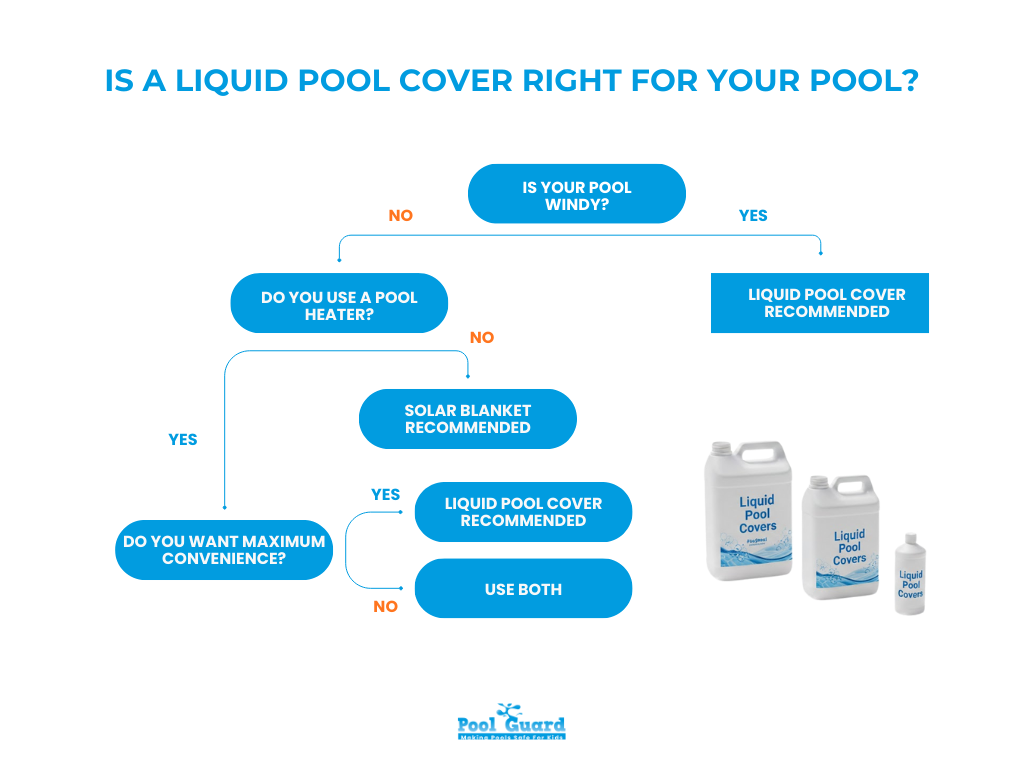
It’s usually not worth it if:
Liquid pool covers do exactly what they claim to do: they reduce evaporation. That alone makes them scientifically valid and genuinely useful for conserving both heat and water. When used correctly, they can lower heating costs, extend your swim season, and simplify routine maintenance.
That said, they are not magic. Liquid covers do not actively heat your pool, they do not replace a physical cover, and their effectiveness varies with wind, temperature, and usage patterns. Expecting more than evaporation control is a setup for disappointment.
Used strategically, a liquid pool cover is a practical efficiency tool, but it should always be part of a broader approach to complete pool safety resources. Used blindly, it feels underwhelming. Smart pool owners understand the difference and deploy it accordingly—not as a cure-all, but as part of a broader pool management strategy.
Share this guide, bookmark it for pool-season planning, or explore pool safety and efficiency solutions at Pool Guard USA.

Find your local dealer by entering your zip code above.
Please fill out the form below with your information. Your local dealer will be notified about your inquiry.
Please fill out the form below with your information. Your local dealer will be notified about your inquiry.