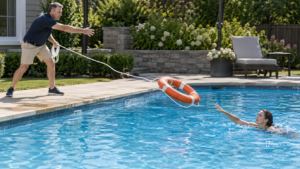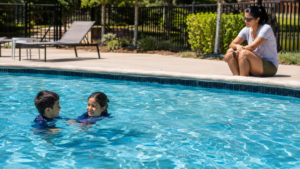
Every summer, thousands of parents make the same well-intentioned mistake by investing in floaties, pool alarms, and swimming lessons, and assume they’ve done enough. They haven’t. Not because those things are useless, but because they’re solving the wrong problem.
The real danger isn’t a toddler who can’t swim. It’s a toddler who reaches the water alone, unnoticed, in the 30 seconds you stepped inside to answer the phone.
This guide breaks down what swimming pool safety for toddlers actually requires. This includes the science, the failure points, and the hierarchy of protection that child safety experts, the American Academy of Pediatrics (AAP), and the U.S. Consumer Product Safety Commission all agree on.
Drowning is the #1 cause of unintentional death in children ages 1-4 in the United States. – Centers for Disease Control and Prevention (CDC)
That statistic carries more weight when you understand why toddlers are so uniquely vulnerable.
A toddler who finds a gate unlatched doesn’t think twice. They explore. Water sparkles, ripples, and invites curiosity. They don’t know it can kill them.
A child can lose consciousness in as few as 30 seconds. There’s no dramatic splashing, no screaming – the Hollywood version of drowning bears no resemblance to reality. Children slip under quietly. By the time a parent notices, minutes may have passed.
According to research cited by the AAP, 69% of drownings in children under age five occur when no one planned for the child to be near water. A birthday party. A barbecue. A quick trip inside. These are the moments that turn ordinary afternoons into tragedies.
No parent stares at a pool every second of every day. The phone rings. A sibling needs attention. A guest arrives at the door. These are facts of life, not failures of parenting. The goal of toddler pool safety isn’t to eliminate human imperfection; it’s to design an environment that accounts for it.
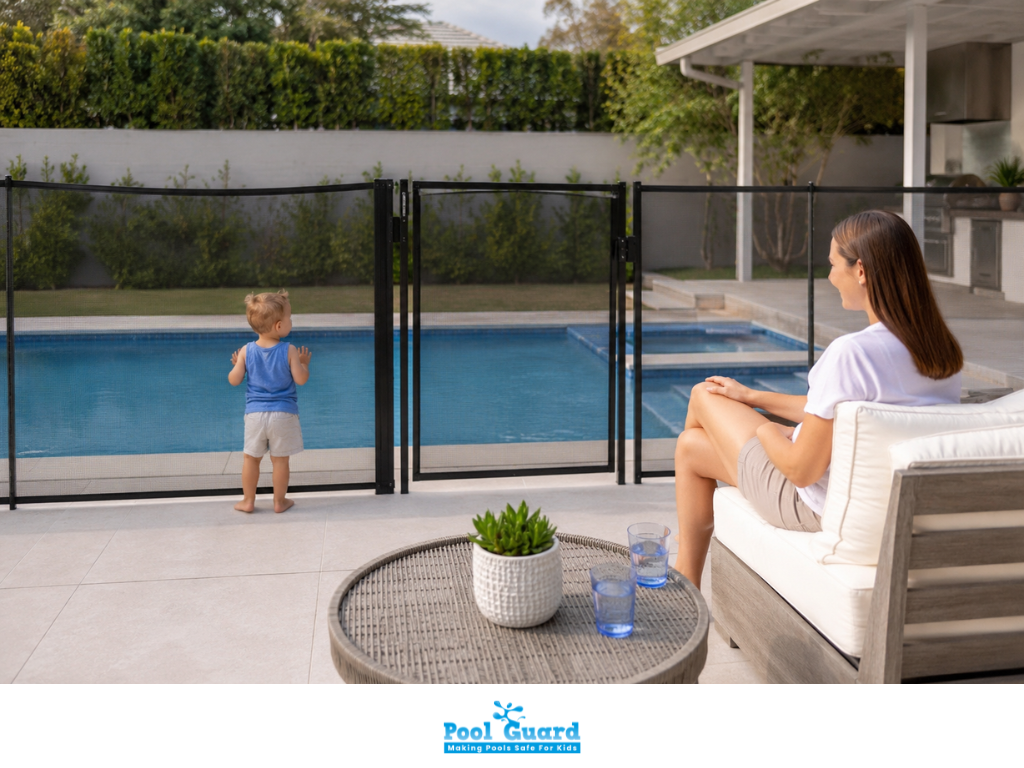
Most pool safety conversations focus on the wrong thing. Parents often focus on whether their child can swim, when the real concern is much simpler: could that child reach the pool unnoticed?
Because drowning usually isn’t just about swimming ability. More often, it’s about access.
You see it in the way toddlers move through a home. They trail older siblings through open doors, wander away from backyard gatherings while adults are distracted, and slip through gates that weren’t fully latched. To them, it’s just another discovery. They move with the same confidence and curiosity they bring to everything else around them.
That’s not bad behavior. That’s exactly how toddlers behave. Which is why every effective pool safety strategy starts with one concern: what stands between my child and the water when nobody is watching?
The most dangerous moment usually isn’t swim time. It’s the five minutes when everyone thought someone else was paying attention.
Not all pool safety devices for toddlers protect equally. Every measure falls into one of two categories – it either stops your child from reaching the water, or it alerts you after they have already reached it.
That gap, prevention versus reaction, is everything. A physical barrier stops a toddler before they ever touch the water, no matter who’s watching. An alarm going off means your child is already there. Everything now depends on how fast you respond, and drowning doesn’t wait.
There’s also a difference between continuous and conditional protection. A pool fence works around the clock without anyone remembering to activate it. A cover only protects when it’s on. An alarm only helps if someone hears it in time.
A properly installed, four-sided pool fence is the single most evidence-backed pool safety device available for toddlers. Research published in peer-reviewed safety literature suggests that four-sided isolation fencing can prevent more than 50% of all pool drownings in young children.
The reason it works is that it creates an unconditional physical barrier that requires no memory, no behavior, and no technology. It doesn’t depend on anyone turning it on, closing it, or remembering to use it, so long as the gate latches properly.
Per AAP and ASTM International standards (ASTM F2286), an effective toddler pool fence must meet several requirements.
It should be at least 4 feet high with no footholds or horizontal rails that could allow climbing. It must completely isolate the pool on all four sides, separating it from both the house and the yard. The gate should be self-closing and self-latching, opening away from the pool. The gate latch must be positioned at least 54 inches from the ground or placed on the pool side of the gate. Finally, there should be no gaps larger than 4 inches between vertical slats or beneath the fence.
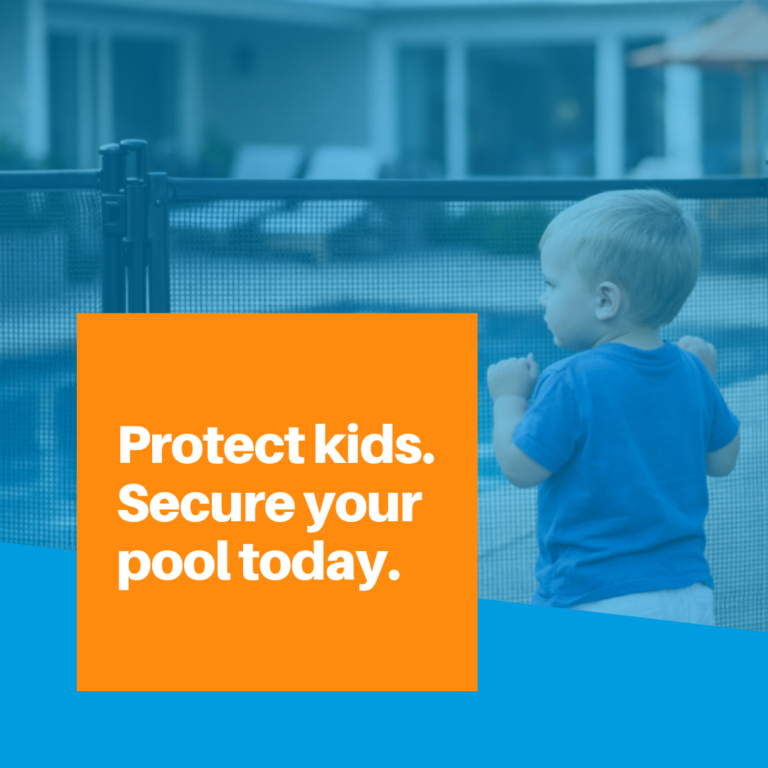
Mesh pool fences are particularly effective for toddlers as they’re non-climbable (no horizontal structure to grip), removable for adult convenience, and provide clear sight lines so the pool remains visible to supervising adults.
ASTM-certified safety covers and nets are designed to support weight and block pool access when properly deployed. They can serve as a secondary layer of protection, but they come with a fundamental limitation – they only work when they’re on. A pool cover that’s been removed for a swim and not replaced is no protection at all.
Additionally, improper covers can collect standing water on their surface, creating a secondary drowning hazard. Never rely on a cover as a primary safety measure for toddlers.
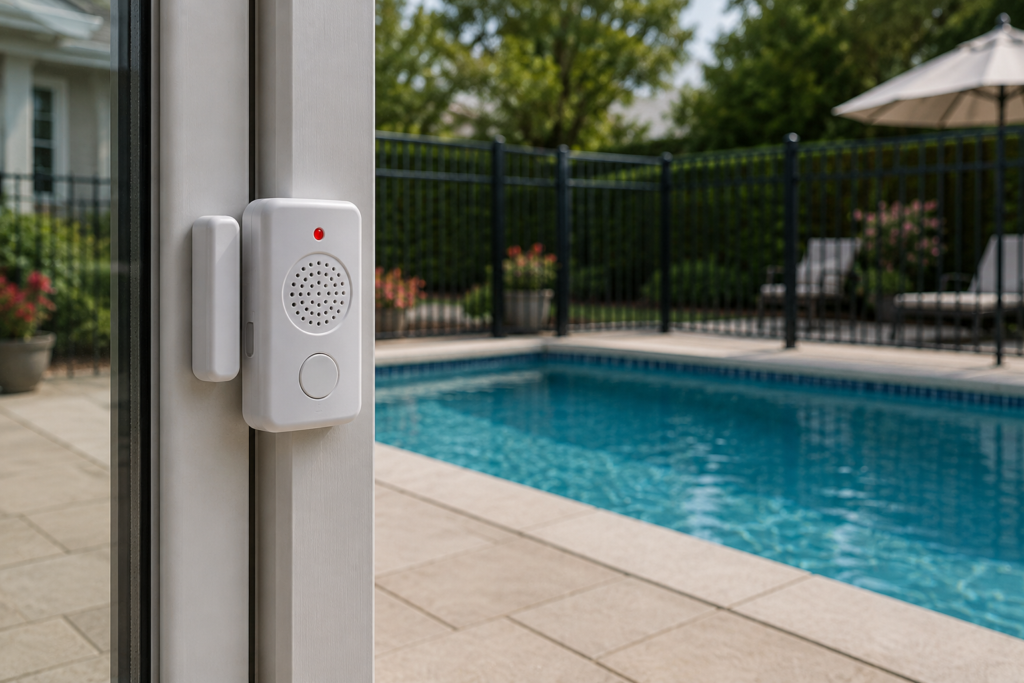
Pool alarms, surface wave alarms, and wearable wristband alarms all serve the same function: they alert you after a child has already entered or approached the water. That makes them reactive, not preventive, and that distinction matters.
Each type comes with its own reliability caveat. Surface wave sensors can be triggered by wind or animals. Gate alarms only work if a caregiver is within earshot and responds immediately. Wristband alarms are only as reliable as the habit of putting one on your child every single time.
What all three have in common is that by the time the alarm sounds, a child is already in danger. They are a valuable secondary layer, but used alone, they ask too much of human response time.
The AAP recommends close, constant “touch supervision”, staying within arm’s reach of any child under five near water, at all times. This is the most immediate safety net available once a child is already near the pool.
Swim lessons, starting at age one per AAP guidance, can meaningfully reduce drowning risk for toddlers. However, no swim lesson makes a toddler drown-proof. Panic, fatigue, disorientation, and simple developmental limits mean that even children with water skills can drown. Supervision is essential regardless of swimming ability.
One particularly effective supervision technique for gatherings is the “water watcher” handoff. One designated adult is solely responsible for supervising children near water at all times – no phone, no conversation, no drink.
When you map every safety measure against the core risk – a toddler accessing the pool alone and unnoticed – only one solution addresses it completely and continuously: a compliant, four-sided pool fence with a self-latching gate.
“Fencing that completely surrounds pools on all four sides reduces the risk of drowning by 83% compared to three-sided fencing or no fencing.” — Cited in AAP Policy Statement on Drowning Prevention, Pediatrics
Every other layer in the toddler pool safety stack has a conditional failure mode. Supervision depends on humans who tire, get distracted, and make assumptions. Alarms depend on hearing, response time, and correct installation. Covers depend on consistent use. Swim lessons depend on the child remaining calm and capable under stress.
A properly installed fence with a self-latching, self-closing gate doesn’t have these failure modes.
Even families who have invested in pool fencing can leave gaps in protection. Here are the most common failure points safety professionals see.
A gate that doesn’t fully self-latch after every open-and-close cycle is the most common vulnerability. Test your gate latch weekly. The latch should engage automatically every single time, not most of the time. If the gate can be pushed open without engaging the latch, fix it before the next swim.
Horizontal fence rails, pool furniture near the fence line, patio planters, and even thick hedges can all serve as footholds for a determined toddler. Walk the perimeter of your fence and remove anything within 36 inches that could be used to climb. This is one of the strongest arguments for mesh fencing, as no toddler can get a grip on it.
A fence installed on uneven ground may have gaps beneath it wide enough for a small child to squeeze through. Any gap larger than four inches under or between fence panels is a compliance failure and a potential tragedy. Have your installation inspected by a certified pool fence professional.
The most overlooked failure point is social: guests who prop gates open for convenience, older siblings who leave gates ajar, or the assumption, especially at parties, that “someone else” is watching. Build a culture around your fence. Explain to every guest, every caregiver, and every older child that the gate closes and latches every single time, no exceptions.
| Feature | Requirement | Why it matters |
| Height | 4 feet minimum | Most toddlers cannot climb a 4-foot barrier without footholds |
| Four-sided isolation | Required | Three-sided fencing leaves a direct access path through the home |
| Self-closing gate | Required | Eliminates reliance on anyone remembering to close the gate |
| Self-latching gate | Required | Ensures the gate is secured even when closed quickly or by a child |
| Latch height | 54 inches from the ground, or poolside | Keeps the latch out of reach for toddlers |
| Vertical slat spacing | No gap greater than 4 inches | Prevents a toddler’s body from fitting through |
| Climb resistance | No horizontal footholds | Mesh and vertical-only designs are significantly harder to scale |
| ASTM compliance | ASTM F2286 | The standard specifically developed for pool barrier performance |
The AAP, CDC, and CPSC all recommend a “layers of protection” approach to swimming pool safety for toddlers. This is the right framework, but layers are not equal, and treating them as equivalent can create a false sense of security. Think of it as a hierarchy, not a checklist:
Each layer exists to catch the failure of the layer before it. None of them replaces the one above them in the hierarchy. Start at Layer 1.
Use this pool safety checklist before every swim season, and after any changes to your yard or pool setup.
Drowning happens in seconds, supervision lapses are inevitable, and no alarm, floatie, or swim lesson can close the gap between when a toddler enters the water and when a caregiver responds. The only reliable answer to pool safety for toddlers is to prevent access in the first place – a four-sided, compliant fence with a self-closing, self-latching gate, installed correctly, inspected regularly, and supported by additional layers of covers, alarms, active supervision, and swim skills.
The families who prevent drownings aren’t the ones who watch most carefully. They’re the ones who built an environment where a momentary lapse doesn’t become a catastrophe. The safest pool is the one your toddler cannot reach in the first place.
Please fill out the form below with your information. Your local dealer will be notified about your inquiry.
Please fill out the form below with your information. Your local dealer will be notified about your inquiry.