A pool day starts with sunscreen, snacks, and a life vest grabbed off the store rack. Picking the best kids life vest takes more than color or size on the tag. Weight range, fit, and type rating decide whether that vest keeps a child’s face out of the water when it counts. Most parents don’t realize this until they’re standing at the shelf, comparing straps and buckles with no clear answer in sight.
This guide covers what those ratings actually mean and how to size a vest correctly. You’ll learn how toddler, baby, and pool vests differ, and how to test a fit before your child ever touches water. Discover below what to avoid, from oversized jackets to worn-out foam that’s lost its float.
Parents use “life vest” and “life jacket” interchangeably, and in practice, they’re the same. Approved products are labeled “life jacket” or “PFD” (personal flotation device); “life vest” is just consumer shorthand.
What matters isn’t the name, it’s the type rating. Arm floaties for toddlers, pool noodles, and novelty floats carry no type rating at all and don’t qualify as safety devices. For boating or open water, choose a properly approved life jacket, not a swim aid.
According to the National Drowning Prevention Alliance, the Coast Guard classifies most kids’ vests as Type II or Type III. Type I exists too, built for open or rough water, where rescue may take longer.
| Type | Turns Child Face-Up If Unconscious | Best For | Mobility |
| Type I | Yes | Open water, rough conditions, offshore boating | Lowest, bulkier fit |
| Type II | Yes | Pools, calm water, young or weak swimmers | Standard |
| Type III | No | Supervised swim practice, general boating | Higher, more comfortable |
Type III won’t self-right a child who can’t tread water, so it suits supervised swim practice better than open water. Picking the best kids life jacket starts with matching the type rating to where your child actually swims.
Every approved vest lists a weight range that determines fit; same-age kids often need different sizes. If your child falls between two ranges, size up, not down. A larger vest cinched properly with a crotch strap outperforms a smaller one that cannot buckle to spec.
Pool, boating, paddleboarding, and lake swimming call for different builds; some suit calm water, others must keep a child’s head up in rougher conditions. The best kids life vest for your family depends on where you actually swim, not what’s on sale at the store.
| Check | What to look for |
| Fit | Snug, won’t ride up |
| Straps | Adjustable |
| Buckles | Secure, close fully |
| Color | Bright, high visibility |
| Movement | Free arm and leg motion |
| Condition | Inspect before every use |
Toddlers move fast and unpredictably, so security for them matters more than looks. A vest with a favorite character is useless if it slides up around a child’s ears when they lean forward.
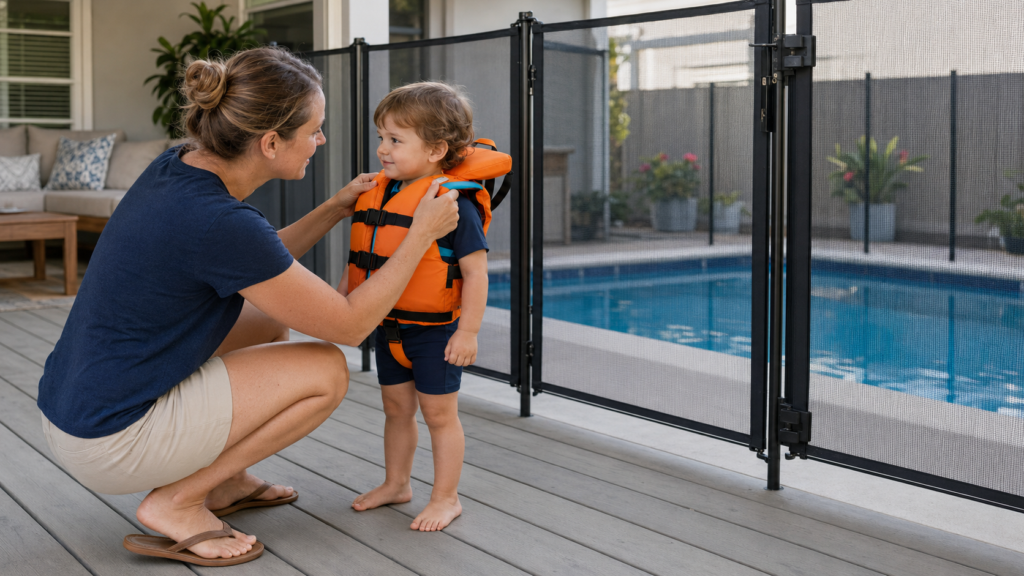
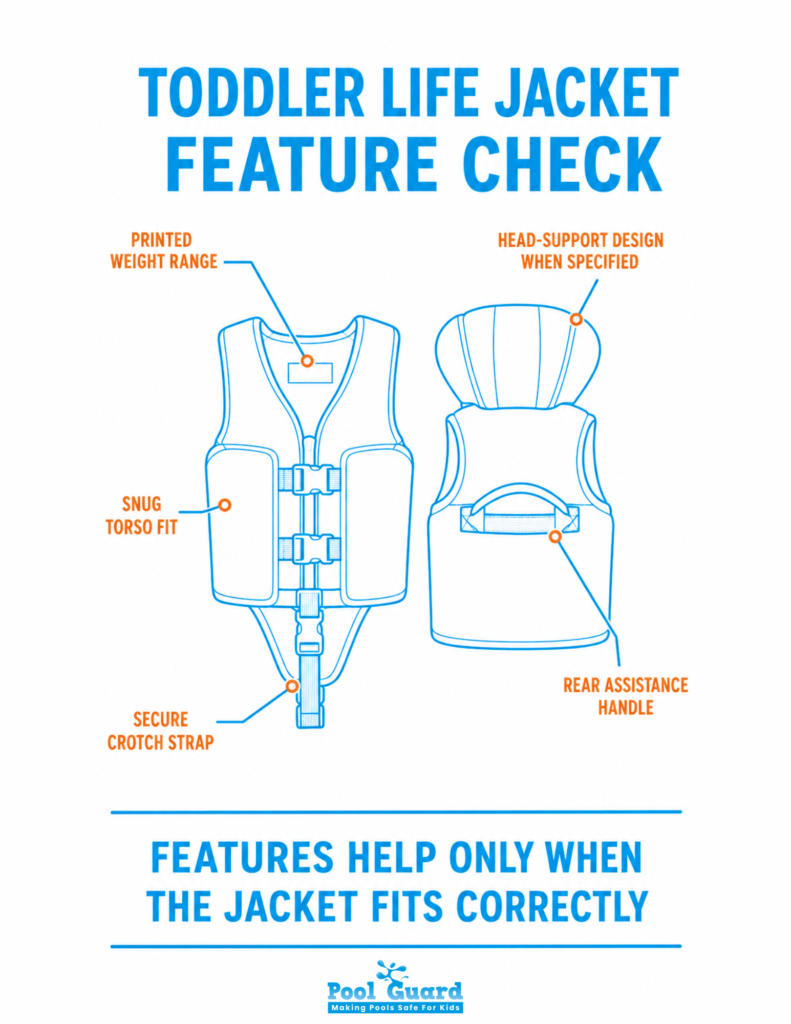
Check the toddler weight range and chest/shoulder fit. As a working test, you should be able to fit two fingers, not a flat hand, between the shoulder strap and your toddler’s collarbone; anything looser will ride up. A crotch strap is essential too; it stops the vest from riding up over a toddler’s head while kicking or being pulled through water.
Add a grab handle, a bright, visible color, and material that won’t chafe. Buckles should be simple enough for an adult to secure fast on a squirming kid. For weak or new swimmers, a head-and-neck support keeps the face out of the water.
Babies need a jacket built for their size, not a scaled-down toddler vest. Check the infant weight range closely; babies grow fast, and fit can turn poor within months.
Head support is critical, since infants can’t hold their heads up on their own. According to Katchakid’s review of children’s PFDs, infant and toddler vests are typically Type II, with a padded neck collar that helps keep the baby’s face up and out of the water, rather than relying solely on torso foam. Add a secure crotch strap to stop ride-up and a grab handle for quick lifts.
Test the fit at home first – fasten every strap and buckle, check for gaps or slipping. Even with a well-fitted vest, babies need constant touch supervision near water. A baby life jacket doesn’t make water safe alone; it works only alongside an adult holding or closely supervising the child.
Supervision matters most. The American Red Cross recommends close, constant attention around water, even with a lifeguard present, no matter how well the child swims or how shallow the water looks. Put the phone away.
Many home pool drownings happen during non-swim times, and the Red Cross notes children are often out of sight for less than five minutes before it happens, usually as swimming is winding down and everyone assumes the water is clear. Clear toys and distractions, and secure the pool fence and self-locking gate as soon as swim time ends.
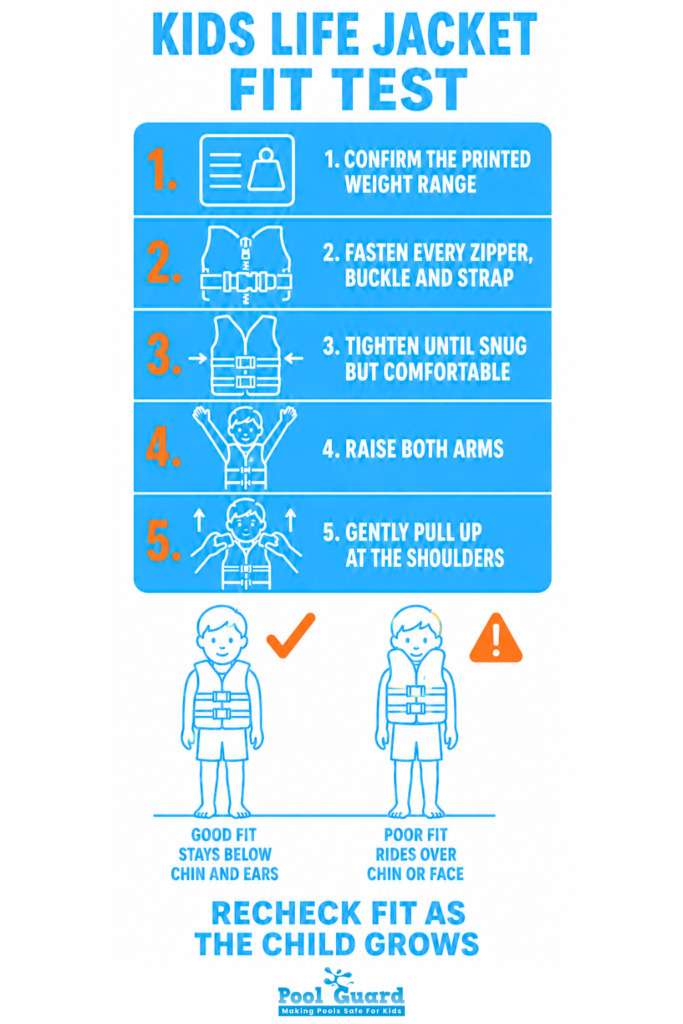
Even the right size can fit poorly. Test it at home before getting in the water.
| Step | Action |
| 1 | Confirm the child’s weight is within the vest’s labeled range |
| 2 | Fasten every buckle, zipper, and strap |
| 3 | Tighten until snug, not loose, not restrictive |
| 4 | Have the child raise both arms |
| 5 | Gently pull up at the shoulders or arm openings |
| 6 | If the vest rides up over the chin, ears, or face, it’s too loose or too large |
| 7 | Test the fit in shallow water with an adult present |
Repeat this test at the start of every swim season, not just at purchase. A vest that fits in spring can fail the same test by late summer after a growth spurt. The best toddler life jacket for swimming only stays the best fit if you retest it, not just buy it once and forget.
Yes. A life vest helps a child float but doesn’t prevent every pool emergency, and it doesn’t replace a watchful adult. Flotation and safety aren’t the same thing.
A life vest is a backup, not a babysitter. Always assign a water watcher focused entirely on the kids, not a phone. Swim lessons and strict pool rules build real skills and cut risk when supervision briefly slips.
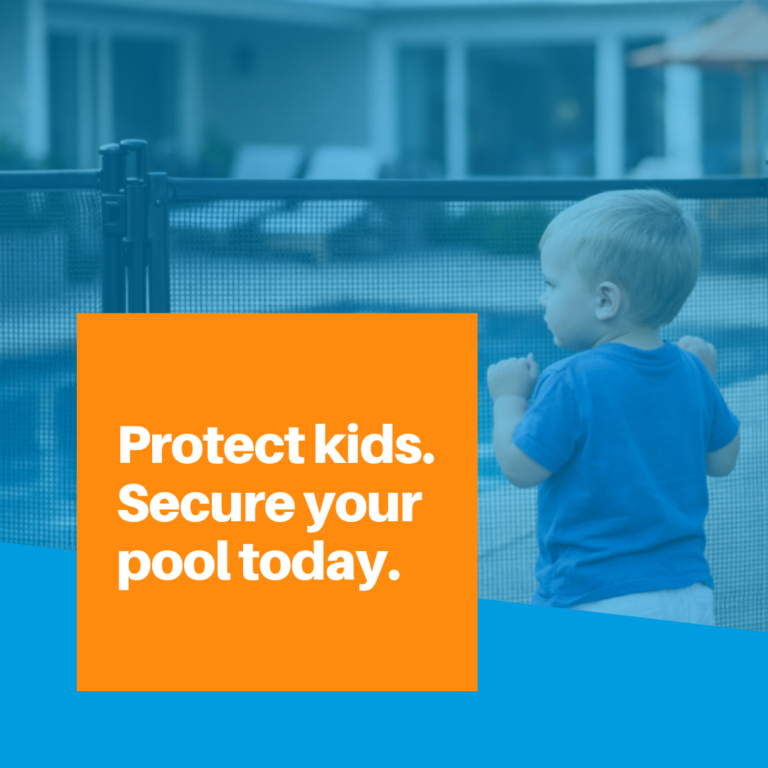
Pool barriers should fully enclose the pool, be at least 4 feet high, and have self-closing, self-latching gates that open outward, away from the pool, with the latch out of a child’s reach. Outward-opening gates are safer because pushing on them closes the gate instead of opening it, reducing the chance of a child entering the pool unsupervised.
Choosing the best kids life vest comes down to a few plain facts. Correct weight range, snug fit, and the right type rating for where your child swims. No amount of style or character print replaces those basics. A vest that fits properly and matches its use gives a child real support in the water, whether that’s a pool, a lake, or a boat.
Ultimately, a life vest is one part of a larger safety plan, not a stand-in for supervision. With the right approach to sizing, fit checks, and regular inspection, parents can trust their gear while staying close. That combination, not the vest alone, keeps kids safer around water.
Please fill out the form below with your information. Your local dealer will be notified about your inquiry.
Please fill out the form below with your information. Your local dealer will be notified about your inquiry.