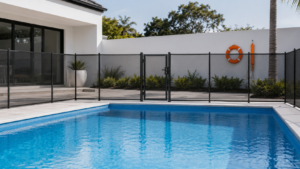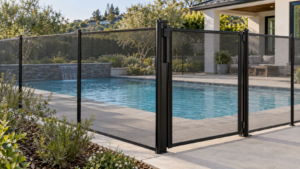
Choosing a pool fence often starts with style, but the safer choice depends on far more than appearance. A horizontal vs vertical pool fence comparison really comes down to climbability, rail placement, openings, and proper installation. Either design can work, yet either can also create footholds if the details are wrong.
That is why looking only at board direction can be misleading. This guide breaks down how both designs compare for safety, code requirements, cost, and maintenance. You’ll also learn when horizontal fencing can meet barrier standards and why vertical fencing is not automatically safer. The guide also covers when a separate pool barrier makes more sense.
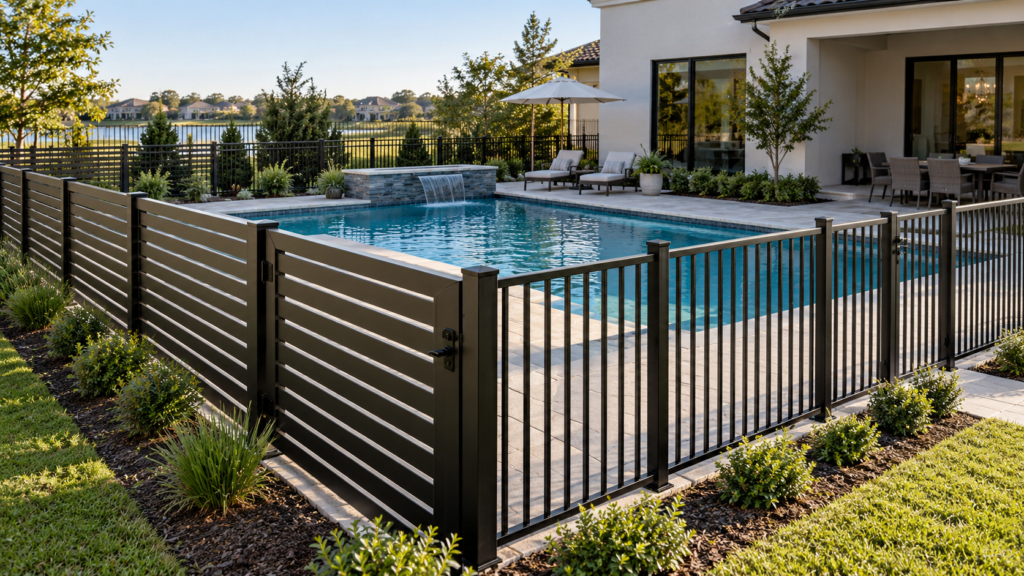
Among the many types of pool fences available, horizontal and vertical styles are two of the most commonly compared, though the choice comes down to more than just visual preference.
| Factor | Horizontal Fence | Vertical Fence |
| Appearance | Clean side-to-side lines; a favorite in contemporary and minimalist builds | Upright lines; fits both traditional and modern architecture |
| Climbability | Exposed slats, spaced evenly, can form a ladder-like foothold pattern | Support rails on the wrong face can still create footholds – orientation doesn’t eliminate the risk on its own |
| Privacy & Visibility | Governed by gap width, board profile, and viewing angle – not by direction alone | Same variables apply; neither orientation is inherently more private |
| Sloped Yards | Often needs stepped panels or careful adjustment to control ground-level gaps | Some systems follow the grade naturally; others still require stepping depending on the product |
| Best Suited For | Feature fencing, general boundaries, flat sites | Boundaries needing height and structure, sites with grade changes |
There is no clear winner. A credible comparison of horizontal vs vertical fence pros and cons should not claim one is universally safer. Fence codes focus on gap size, rail placement, fence height, and latch height, not orientation alone.
Are Horizontal Fences Safe Around Pools?
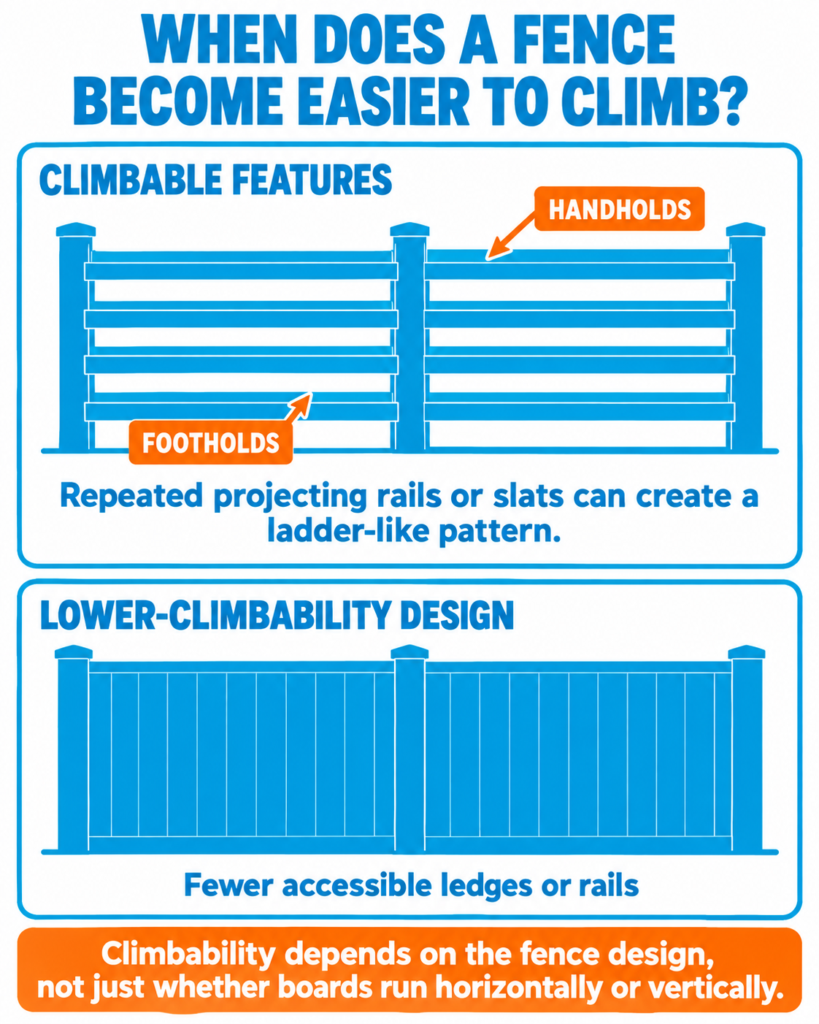
Horizontal fences can be safe around pools, but only when they are designed specifically as pool barriers. The main concern is climbability. Widely spaced horizontal slats can act like ladder rungs, giving children footholds and handholds that make the fence easier to climb.
That doesn’t mean every horizontal design is unsafe. A smooth, solid panel with no exposed rails or protruding edges can be much harder to climb. The key is eliminating climbable gaps, ledges, and supports on the side facing away from the pool. Vertical fences can have similar problems if their horizontal rails are accessible from the exterior.
Ultimately, pool-barrier safety depends more on the fence’s layout and climbability than on whether the boards run horizontally or vertically. A horizontal pool fence should be purpose-built, installed according to applicable pool-barrier requirements, and designed without accessible footholds. A standard horizontal privacy fence should not automatically be assumed suitable for pool use.
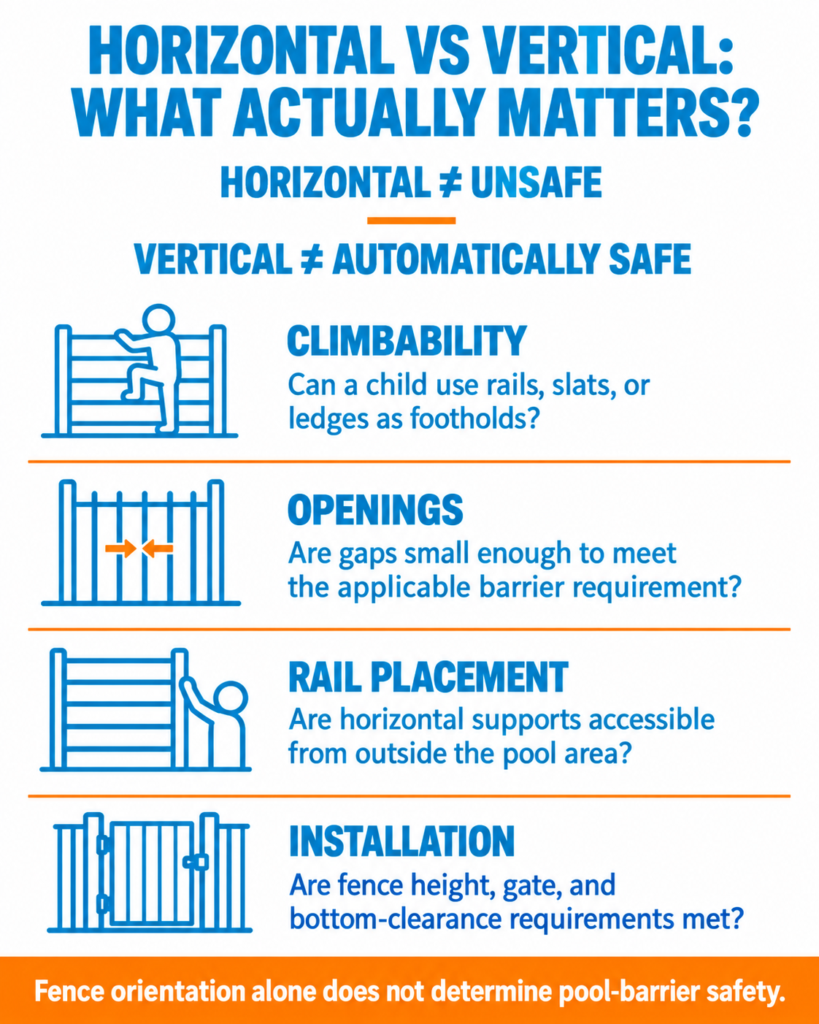
Regardless of which orientation you choose, a compliant pool barrier needs to satisfy the same core checklist:
U.S. guidance from the Consumer Product Safety Commission (CPSC) and the International Swimming Pool and Spa Code (ISPSC) both call for a barrier at least 48 inches above grade, measured on the side facing away from the pool.
No gap in the barrier should allow a 4-inch sphere to pass through; a benchmark sized around a young child’s head and chest.
The gap between the ground and the bottom of the fence should be minimal; CPSC guidance allows up to four inches, while the ISPSC model code tightens that to two inches. Always confirm which standard your local jurisdiction has actually adopted, since amended local codes can be stricter than either baseline.
Where a fence combines horizontal rails and vertical pickets, and the rails are spaced less than 45 inches apart, codes generally require those rails to sit on the pool-facing side, precisely to prevent them from being used as external footholds. When rail spacing exceeds 45 inches, the rules shift to tighter vertical picket spacing instead.
Pedestrian gates should open away from the pool and include self-closing, self-latching hardware. When the latch release sits below 54 inches, it needs to be positioned on the pool side, at least three inches below the gate’s top edge, with no gap larger than ½ inch within 18 inches of the release mechanism.
Keep furniture, planters, grills, and anything else that could act as a step-up clear of the barrier’s exterior; overlooking this detail can undermine an otherwise perfect fence design.
These specifics are guidelines and model code language, not universal law. Actual requirements vary by state, province, and municipality, and some regions layer on stricter local rules. Before finalizing a design, confirm the exact specs with your local building department. This single step resolves more compliance disputes than any style choice ever will.
Cost differences between horizontal and vertical fences depend mainly on:
A horizontal fence is not automatically more expensive. Horizontal designs may require closer post spacing to prevent boards from sagging, increasing material and labor costs. They also require precise leveling, especially on sloped ground. Vertical fences are generally easier to adjust to grade because individual pickets can be stepped or positioned more easily.
Maintenance follows the same pattern, as material matters more than direction. Horizontal wood boards may be more prone to cupping or sagging because their upper surfaces can hold moisture, while composite and aluminum systems are less affected by these issues.
For an accurate comparison, request quotes based on the same fence height, length, material, gate count, and site conditions. This gives you a meaningful horizontal-versus-vertical cost comparison.
Yes. Your yard’s privacy fence and pool safety barrier don’t have to be the same structure. You can keep an existing horizontal privacy fence around the property and add a dedicated, code-compliant barrier around the pool. This allows you to keep the existing fence while meeting pool-specific requirements for climbability and gaps.
Removable mesh pool fencing is one option. These see-through barriers can be installed around the pool without replacing the existing fence. They address a different purpose than horizontal or vertical privacy fencing by providing a pool-specific barrier while maintaining visibility.
Make sure the outer fence and nearby features, such as retaining walls, garden beds, or outdoor furniture, don’t create a climbing path over the pool barrier. Pool safety depends on the entire setup, not just the barrier itself.
The horizontal vs vertical pool fence choice isn’t really about which style looks better in your backyard. What matters most is choosing a design that meets local requirements, uses appropriate measurements, and makes it difficult for a determined toddler to reach the water. Start with safety and compliance, and let that decision guide whether horizontal or vertical better suits your space, not the other way around.
Of course, even the best-designed fence only reduces risk; it doesn’t replace self-latching gates, regular hardware checks, or active adult supervision whenever children are near the water.
That’s the standard we build toward at Pool Guard USA: removable safety fencing designed to meet compliance and safety requirements first, in whatever style ultimately fits your yard.
It depends on placement, not just orientation. Where a fence has both horizontal rails and vertical pickets, and the rails are spaced less than 45 inches apart, those rails must face the pool side of the fence, not the outside, specifically so kids can’t use them as a foothold to climb over. A vertical-style fence can still fail this test if its rails end up on the wrong side.
Not automatically. A privacy fence is typically designed as a visual screen, not a certified barrier, and may not meet pool-specific requirements around gap size, bottom clearance, or rail placement. If you want to use an existing horizontal fence as part of your pool barrier, have it assessed against your local pool-safety code; you may need modifications or a separate dedicated barrier around the pool itself.
Sometimes. Adjustments to rail placement, added infill to close gaps, or hardware upgrades on gates can bring some fences into compliance. In other cases, the underlying structure makes retrofitting impractical, and installing a purpose-built barrier, including options like mesh pool fencing, ends up being the more reliable path. A local inspector or fencing professional can assess which route makes sense for your specific fence.
Usually, yes. Most jurisdictions require a permit and inspection before a pool barrier is considered compliant, since inspectors check specific details like gap size, gate swing direction, and latch height that are easy to miss without a code reference. Check with your local building department before installation.

Find your local dealer by entering your zip code above.
Please fill out the form below with your information. Your local dealer will be notified about your inquiry.
Please fill out the form below with your information. Your local dealer will be notified about your inquiry.