Canada has no single, national pool fence law. Instead, specific pool fence regulations Canada enforces depend entirely on your province, city, pool type, and yard layout. This means a fence design that passed inspection in Calgary might get red-tagged in Ottawa.
These strict fencing rules matter because drowning remains a leading cause of injury death for Canadian children, especially toddlers. Safety studies show these fatalities most often happen where proper barriers are missing entirely. A compliant fence is the only physical barrier that keeps working the exact moment adult supervision lapses.
This guide breaks down current nationwide rules. It covers baseline requirements, specific laws for Ontario, Toronto, and Quebec, and above-ground pool rules. It also highlights common mistakes that fail inspection.
Before getting into provincial specifics, it’s worth knowing the core requirements that show up in some form almost everywhere in Canada. If you only remember one section of this guide, make it this one:
| Requirement | Core Baseline Rule |
| Minimum Height | Typically 1.2 meters (4 feet); many cities require more |
| Gate Mechanism | Must be self-closing and self-latching |
| Latch Placement | Positioned out of a child’s reach at a set height from the ground |
| Maximum Gaps | Openings and gaps must be under 10 centimeters (4 inches) |
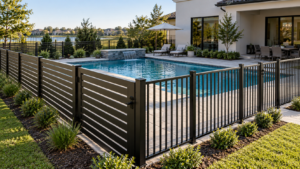
| Anti-Climb Design | No horizontal rails, footholds, or ledges on the outside |
| Clear Zone | No nearby planters, furniture, or equipment to boost a child over |
| Access Control | Secure gates and barriers on decks, stairs, and ladders |
Every province layers its own detail on top of this baseline, and cities frequently go further than their province. Two rules of thumb will save you a lot of grief – the provincial code is a floor, not a ceiling, and your municipality gets the final word.
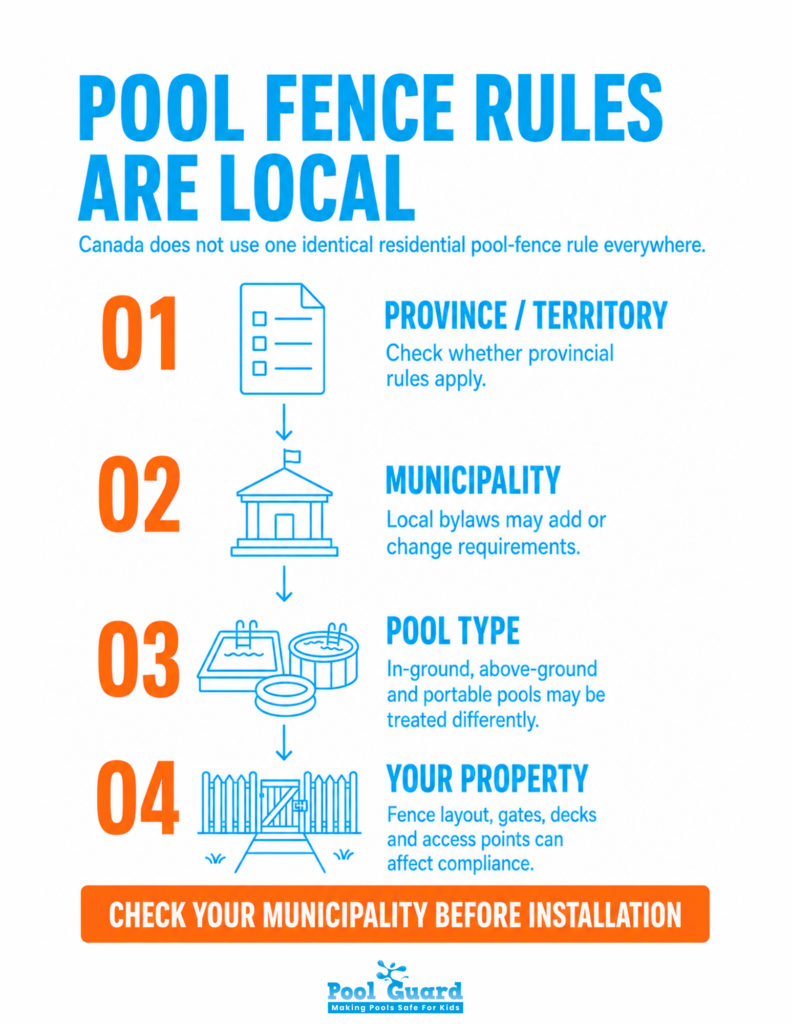
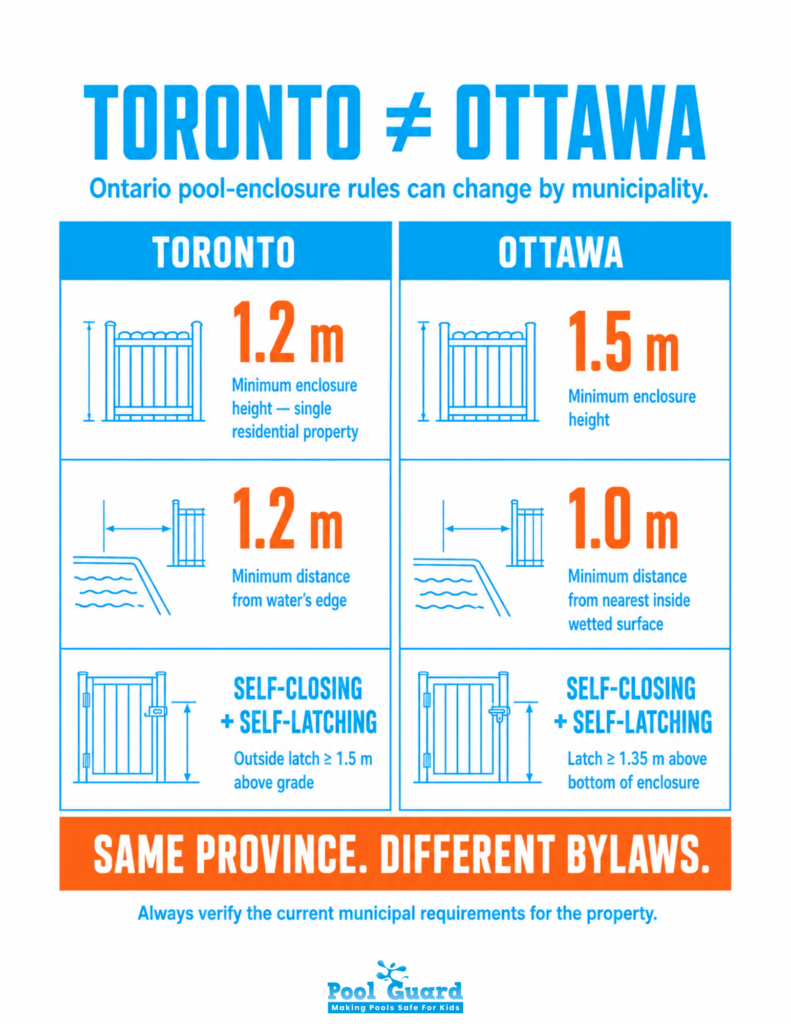
Ontario pool enclosure requirements vary by municipality rather than following one province-wide standard. For example, Toronto requires a minimum 1.2-meter enclosure for pools on single residential properties, while Ottawa requires 1.5 meters. Both municipalities also have specific requirements for gates and inspections.
Because requirements can differ significantly between municipalities, homeowners should confirm whether a building or zoning permit is required and the exact minimum fence height. It is also important to check local rules for gate placement, latch height, swing direction, and whether an inspection is required before the pool can be filled. The rules may also differ for above-ground and in-ground pools.
Cities across the Greater Toronto Area and elsewhere in Ontario don’t necessarily share the same standards. Toronto, Ottawa, Mississauga, Hamilton, and Vaughan can have different requirements, so a fence that meets the rules in one municipality may not meet them in another. For example, Mississauga’s pool enclosure bylaw includes requirements that differ from Toronto’s.
Toronto pools fall under Municipal Code Chapter 447, and the city treats pool enclosures as a distinct category from ordinary backyard fencing. A few things are consistent across sources on Toronto’s rules:
Toronto’s minimum enclosure height is 1.2 meters for single residential properties, while multiple residential and non-residential properties require 1.8 meters. Because other requirements can depend on the property and enclosure design, confirm the current rules with Toronto Building or 311 before ordering materials.
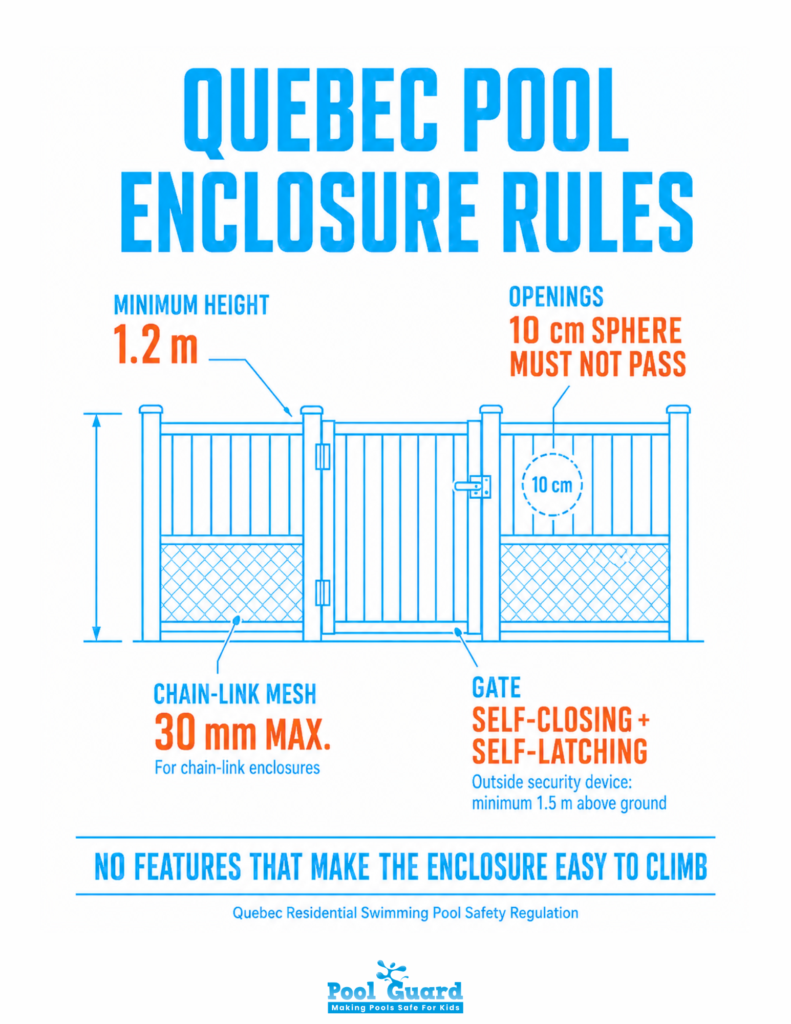
Quebec’s Residential Swimming Pool Safety Regulation sets province-wide requirements for residential pool access and enclosures. The rules apply to permanent or temporary outdoor pools with a water depth of 60 centimeters or more, including in-ground, above-ground, semi-inground, and portable pools.
The rules for older pools have changed over time, so owners of pools installed before the current requirements took effect should confirm their applicable compliance deadline with their municipality or Quebec’s current regulations.
Usually yes, but with an important nuance. Most provinces judge above-ground pools by the same water-depth threshold they use for in-ground pools, generally around 600 millimeters (24 inches) or 60 centimeters depending on the province. Where things differ is the barrier itself.
If the pool wall is rigid, smooth, and tall enough, typically 1.2 meters or more, with no external deck or fixed ladder, the wall itself can sometimes count as the barrier. However, adding a deck, fixed staircase, or platform that provides access to the pool’s edge may require its own secured gate or enclosure.
Removable ladders paired with a self-latching gate can be treated differently from fixed stairs in some provinces, so check your local requirements. Inflatable and temporary pools that hold enough water to meet the applicable depth threshold are generally not exempt simply because they are not permanent.
In-ground pools almost always need a full perimeter enclosure because the pool is accessible from ground level on every side, with nothing built in to prevent direct access to the water.
Before you call a contractor or order materials, get answers to these questions from your municipality directly:
Five minutes on the phone with your local building department before you buy anything will save you from the single most common and most expensive mistake in this whole process – installing a fence, then finding out it doesn’t pass.
Most pool fence problems come down to a handful of recurring mistakes:
Every mistake on the previous list is preventable with the right layout and hardware from the start. Pool Guard USA works with homeowners to plan pool barriers around compliance, not just appearance.
The process includes controlled, single-point access designed around the yard’s actual layout, along with durable mesh panels built to withstand Canadian winters without warping or sagging. Clear sightlines also keep the pool visible from the house, making visibility an important safety feature as well as a design choice.
Self-closing, self-latching gate hardware can be installed at the required height, while professional layout guidance helps ensure the fence meets applicable local requirements rather than relying on guesswork.
Understanding pool fence regulations Canada from the beginning helps turn a pool fence from a permit hurdle into what it is meant to be – a reliable barrier that helps prevent a serious accident.
Please fill out the form below with your information. Your local dealer will be notified about your inquiry.
Please fill out the form below with your information. Your local dealer will be notified about your inquiry.