Cold water safety is about more than preventing hypothermia. In many emergencies, breathing and swimming ability begin to fail long before body temperature drops dangerously low. That risk matters in lakes, rivers, oceans, unheated pools, and during boating or paddling accidents. Even a warm, sunny day can create a false sense of security when the water itself remains cold.
The key is understanding what happens first. Cold shock affects breathing, physical performance declines next, and hypothermia can follow during longer exposure.
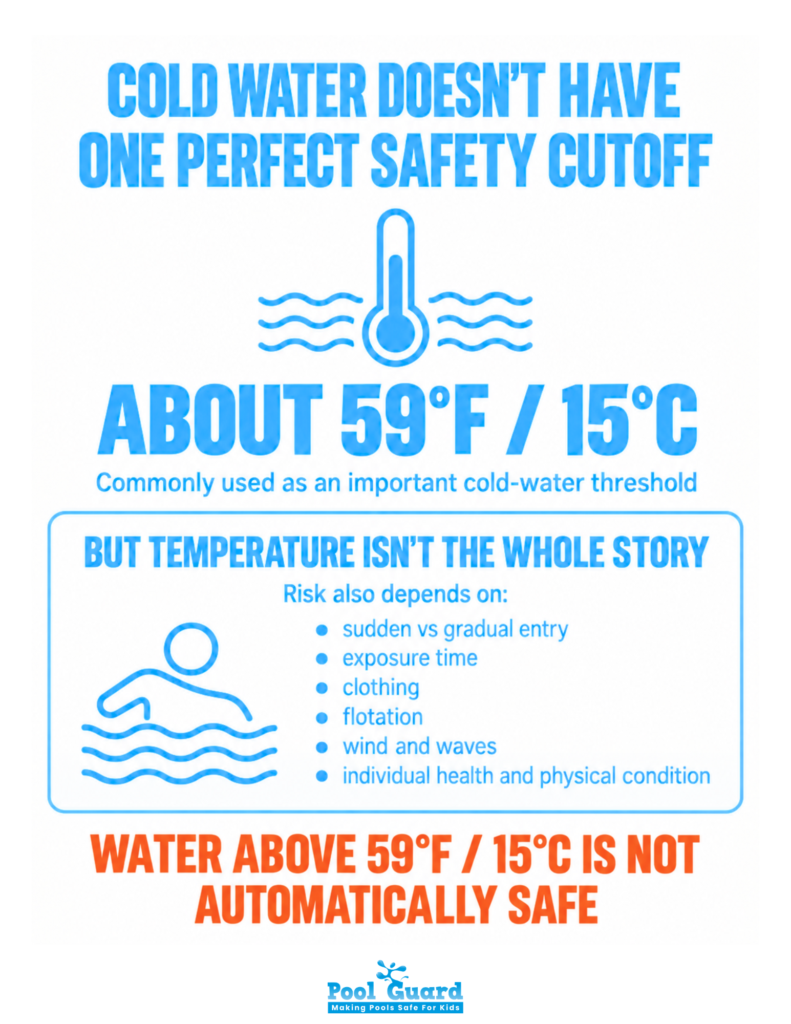
No exact temperature marks the line between safe and dangerous. Your risk depends on the water temperature, how quickly you enter, what you are wearing, and how long you remain exposed.
Many safety organizations use about 59°F (15°C) as an important cold-water threshold. The RNLI, Royal Life Saving Australia, and other water-safety organizations warn that sudden immersion at or below this temperature can trigger a powerful cold-shock response.
That does not mean 60°F water is automatically safe. The National Weather Service warns that cold-water reactions can occur at higher temperatures, especially when entry is sudden and unexpected.
Air temperature can also be misleading. A lake may remain dangerously cold during a warm spring afternoon because water heats much more slowly than the surrounding air. For that reason, cold water safety decisions should always be based on the water temperature and conditions, not simply how comfortable the weather feels.
Cold water shock is the body’s immediate reaction to sudden cold-water immersion. Rapid skin cooling can trigger an involuntary gasp, fast breathing, a rising heart rate, and higher blood pressure.
Those reactions can become dangerous almost immediately. A gasp while your face is underwater can pull water into the airway. Rapid breathing can also make it harder to stay calm, swim effectively, or make good decisions. Cold shock can affect strong swimmers as well as beginners. It can also place extra strain on the heart, especially in people with underlying cardiovascular conditions.
Yes. Cold water shock can kill you, mainly because it can quickly increase the risk of drowning. An involuntary gasp or rapid breathing can make it difficult to keep your airway clear. Panic and poor breathing control can also make swimming much harder, even for confident swimmers.
Cold exposure can also place sudden strain on the heart by increasing heart rate and blood pressure. In some people, especially older adults, cardiovascular stress can contribute to serious complications. This is why cold-water danger should not be viewed as a simple countdown to hypothermia.
Cold shock comes first, physical performance can decline next, and hypothermia becomes a greater threat with longer exposure.
The negative effects of swimming in cold water extend far beyond discomfort. Breathing is usually the first major problem. Sudden immersion can trigger gasping and rapid breathing, which makes swimming efficiently much harder.
Muscles and nerves then begin losing performance. Hands become less useful, grip strength falls, coordination deteriorates, and powerful swimming strokes become harder to maintain. This matters because self-rescue often depends on small physical tasks. Gripping a ladder, opening a buckle, climbing onto a dock, or holding a rope can become unexpectedly difficult.
Cold exposure can also affect judgment. Panic, fatigue, breathing difficulty, and eventually hypothermia can interfere with decision-making. That creates a dangerous mismatch between confidence and capability. Someone may still believe they can swim a long distance even as their body is losing the ability to complete it. Being a strong swimmer helps, but it does not make someone immune to cold.
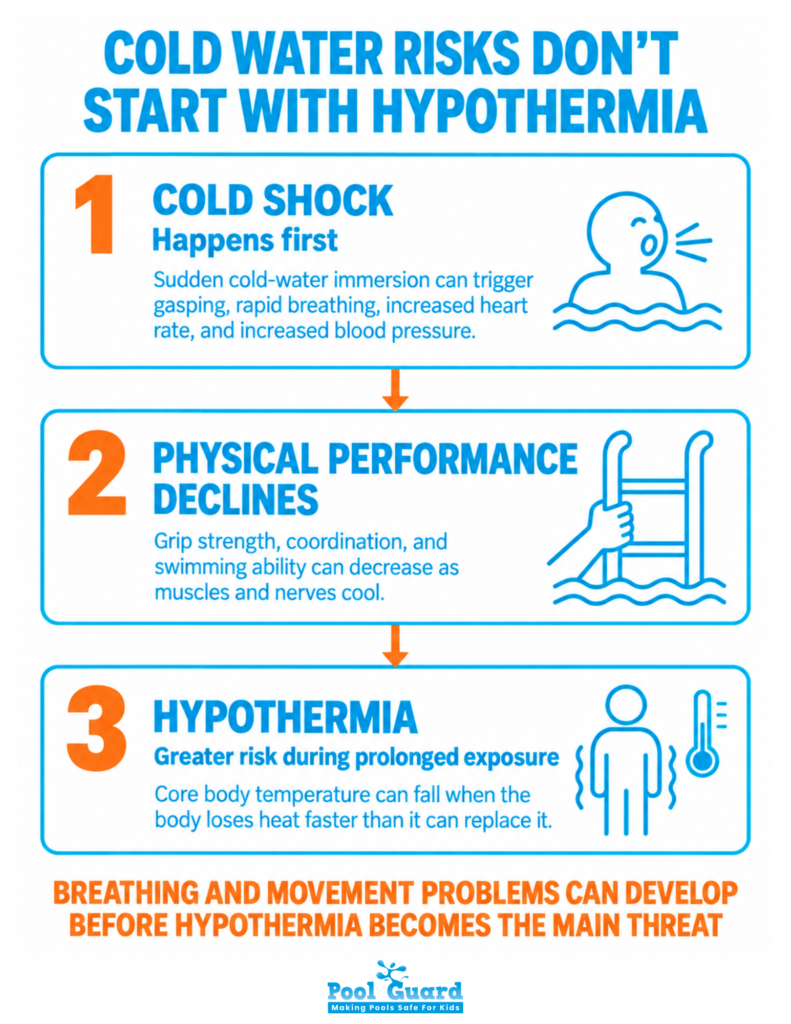
One of the biggest cold-water safety misconceptions is that hypothermia is the first thing to worry about. It usually is not.
Washington State Parks describes a progression that begins with cold shock, moves into short-term swimming failure, and then progresses toward hypothermia during longer exposure. During the swimming-failure stage, the arms and legs cool quickly. Strength, dexterity, and coordination can fall enough that a capable swimmer can no longer keep the airway safely above the surface.
Hypothermia becomes the larger problem during prolonged immersion. It occurs when the body loses heat faster than it can replace it and core temperature begins falling dangerously low. The practical lesson is simple – you can drown from breathing or movement failure before hypothermia becomes the primary threat.
Knowing how to avoid cold water shock starts with reducing several risks at once rather than relying on a single technique.
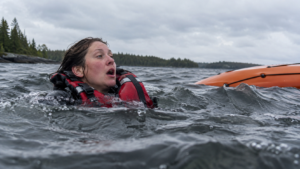
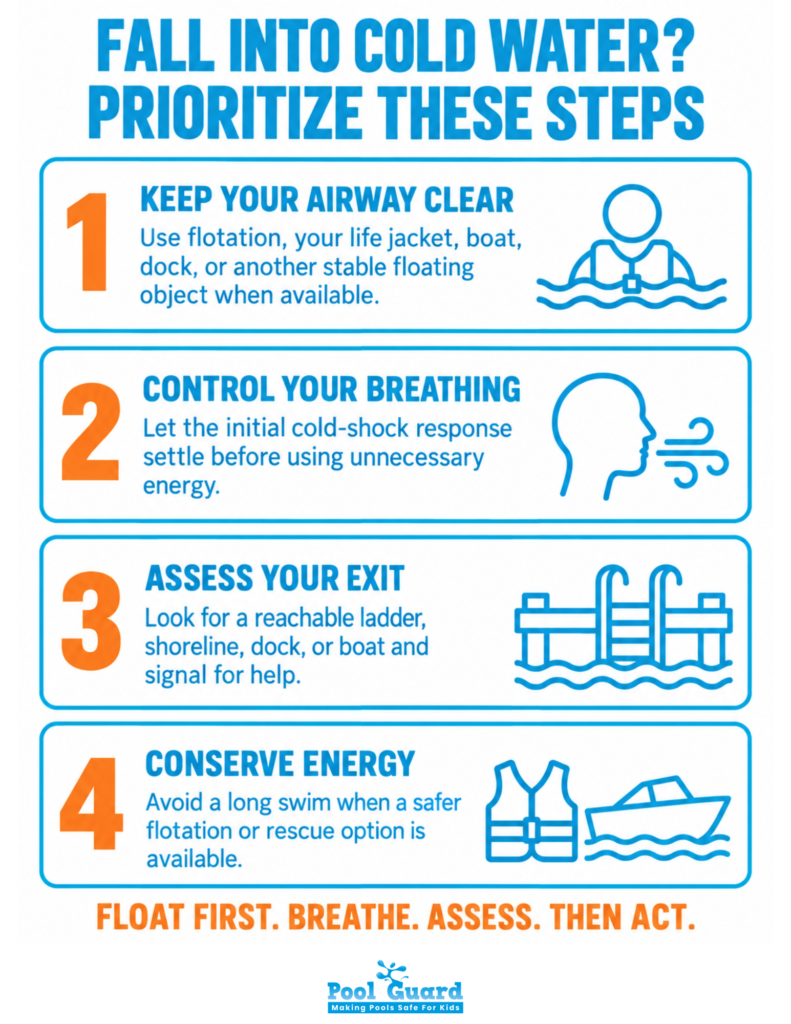
The instinct after falling into cold water is often to swim hard, but that can be the wrong first move. Your priority is keeping your mouth and nose above the surface using a life jacket, floating object, boat, dock, or anything else that provides stable flotation.
Next, focus on breathing. The RNLI’s Float to Live guidance reflects this: float first and let the initial cold-shock response pass, rather than fighting the water. Once your breathing steadies, assess the situation.
Look for a reachable ladder, shoreline, dock, or boat, and signal for help before spending energy. Swimming can make sense if the exit is close and your breathing is controlled, but it becomes risky when the distance is uncertain or conditions work against you.
If you’re wearing a life jacket and rescue is likely, staying with a boat or large floating object is often safer than a long swim. While waiting, minimizing movement helps conserve heat.
The Heat Escape Lessening Position (HELP) does this while wearing flotation: knees drawn toward the body, arms close, airway clear. Groups can huddle together for the same effect. The goal is less exposed surface area, without blocking anyone’s breathing.
Cold-water education sometimes uses memorable time frameworks such as the “1-10-1” principle, which describes roughly 1 minute to control breathing, about 10 minutes of meaningful movement, and around 1 hour before unconsciousness from hypothermia in cold water. These models can be useful because they reinforce the correct sequence: breathing problems appear first, effective movement declines afterward, and hypothermia generally becomes important later.
The problem begins when those numbers are interpreted as guaranteed survival times. They are not. Two people in the same water can deteriorate at very different rates because of clothing, body size, health, flotation, waves, injuries, physical activity, and other conditions.
No one should remain in dangerous water because a chart suggests they have more time. Use timing frameworks to understand the order of risks, not to predict exactly how long someone will remain functional.
Getting out of the water doesn’t always end the emergency. Core body temperature can continue dropping after immersion ends. This continued cooling is often called afterdrop.
Move the person away from wind and cold as quickly as possible. Replace wet clothing with dry layers when practical and wrap the person in blankets or other insulation. Suspected hypothermia should be treated carefully. Confusion, severe fatigue, poor coordination, breathing difficulty, chest pain, or loss of consciousness are reasons to seek emergency medical help.
Avoid aggressively rubbing cold arms or legs. Rapid heating with a very hot bath is also inappropriate when significant hypothermia is suspected. Alcohol should not be used as a warming method.
If the person is unresponsive and not breathing normally, call 911 and begin CPR according to your training and emergency-dispatcher instructions. Rescue is not complete simply because someone has reached dry land.
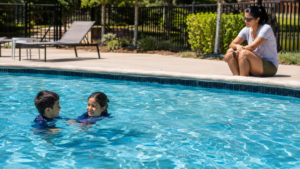
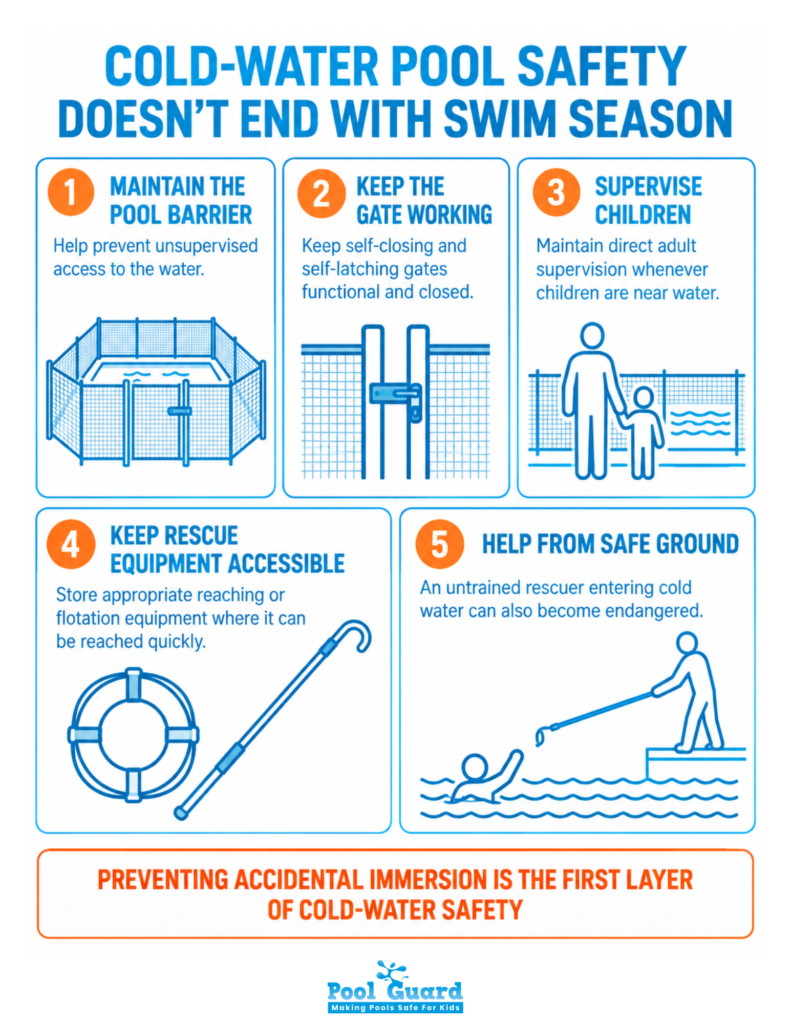
Cold-water safety is often discussed in the context of lakes and oceans, but residential pools deserve attention too. An unheated pool can become extremely cold during spring, fall, or periods of cool weather, and children may enter a closed or unused pool unexpectedly. That makes access prevention essential year-round.
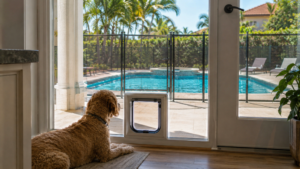
For residential pools, the safest cold-water emergency is the one that never happens. Barriers, gates, supervision, and rescue readiness all reduce the chance of an accidental immersion becoming fatal.
Cold water does not directly cause the common cold. Colds are caused by respiratory viruses.
Cold-water swimming can still create other health problems. Prolonged exposure may cause hypothermia. Sudden immersion can trigger cold shock, and people with certain cardiovascular conditions may face additional risk from the rapid increase in heart rate and blood pressure.
Water quality creates a separate issue. Swimming in contaminated recreational water can expose people to bacteria, viruses, parasites, or harmful algal blooms. Those illnesses come from what is in the water, not simply from its temperature.
This distinction matters because “cold water made me sick” can describe several completely different situations. Cold-related illness, waterborne infection, and ordinary respiratory infection should not be treated as the same thing.
There is no universal safe time. Water temperature alone cannot tell you how long someone can remain functional or survive. Clothing, flotation, body size, health, wind, waves, activity level, and whether the person is injured can all change the outcome.
The safest rule is therefore not to calculate how long you can tolerate the water. Plan to minimize exposure and get out as soon as safely possible.
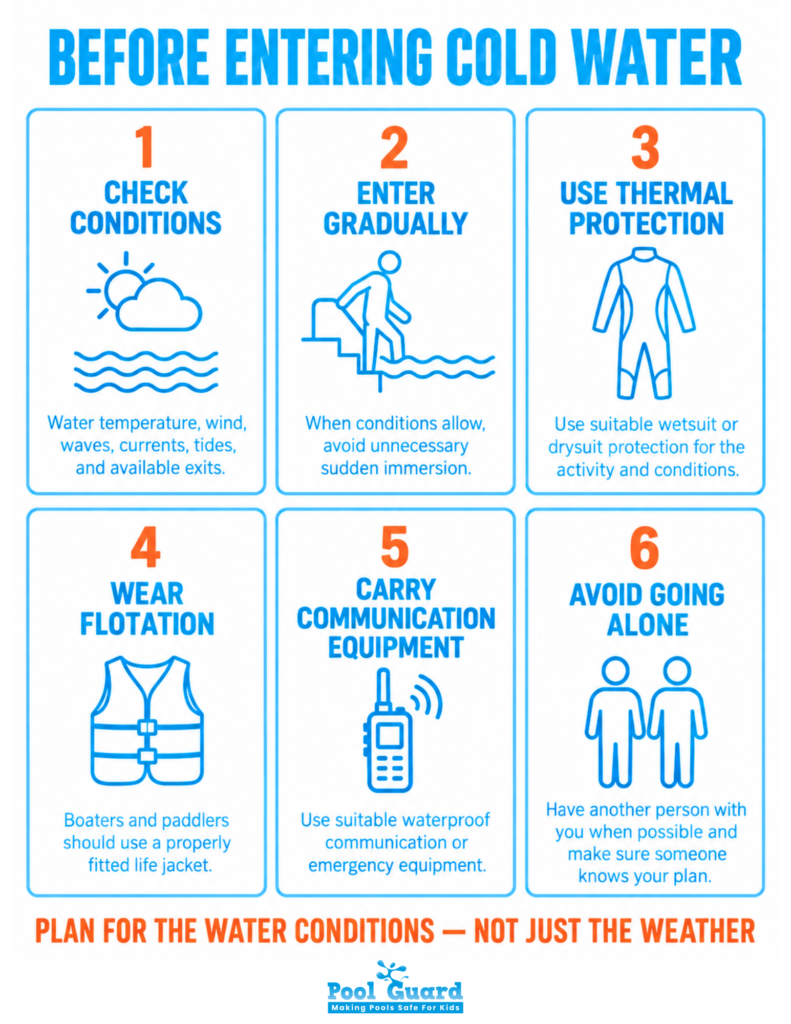
Cold water safety begins before anyone enters the water. Check the actual water temperature, wear suitable protection, use flotation when appropriate, know where you will exit, and make sure someone knows your plan.
If immersion happens unexpectedly, protect your airway before trying to cover distance. Float, regain breathing control, assess the situation, and choose the safest realistic exit. Most importantly, do not assume swimming skill or experience makes you immune. Cold water changes what your body can do.
For residential pools, that same logic holds: the safest outcome is avoiding accidental immersion altogether. At Pool Guard USA, we build removable safety fencing to help pool owners close that gap year-round, not just during swim season.
Please fill out the form below with your information. Your local dealer will be notified about your inquiry.
Please fill out the form below with your information. Your local dealer will be notified about your inquiry.