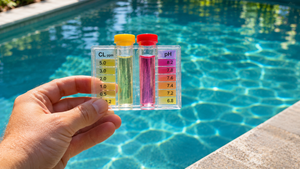
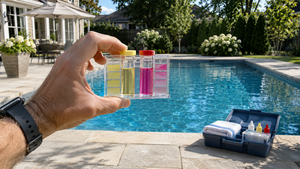
You test your pool water and notice that some chemical levels need adjusting. But how much of each product should you add? A pool chemical calculator helps estimate the appropriate doses based on your pool volume and test results. Whether you have a standard chlorine, saltwater, or above ground pool, it can help you make more accurate adjustments.
Proper chemical balance helps protect swimmers, preserve pool equipment, and maintain effective chlorine treatment. Yet safe pool maintenance goes beyond water chemistry, especially when children are nearby. This guide covers recommended chemical ranges, safe dosing practices, and ways to prevent unsupervised pool access, starting with the calculator below.
Use this pool chemical dosing calculator to estimate how much of each chemical your pool needs. Enter the required pool information to get recommended doses for adjusting your water chemistry.
How to use
Calculate pool chemical adjustments based on your water readings.
Enter your total pool volume in US gallons.
Reference ideal: 1–3 ppm
Ideal: 7.2–7.6
Required for an estimated pH chemical dose.
Ideal: 80–120 ppm
Ideal: 200–400 ppm
Ideal: 30–50 ppm
Safety: Chemical doses are estimates. Always follow the product label, add chemicals separately, circulate the water, and retest. Never mix pool chemicals.
Before adding chemicals, compare your pool test readings with the recommended target ranges. The CDC recommends a pH of 7.0 to 7.8 and free chlorine of at least 1 ppm. When cyanuric acid stabilizer is used, the minimum rises to 2 ppm.
Other readings help maintain water balance. Total alkalinity helps prevent rapid pH changes. Low calcium hardness can damage certain pool surfaces and equipment, while excessive calcium can contribute to scaling. Cyanuric acid helps protect chlorine from sunlight but also affects its disinfecting effectiveness.
Chemical targets also depend on pool surfaces and equipment. A salt water pool chemical calculator can estimate chemical doses, but the chlorine generator’s manual determines its required salt concentration. Above ground pools with vinyl liners may have different calcium hardness requirements from plaster pools.
| Parameter | Standard Chlorine Pool | Saltwater Pool | Above Ground Pool |
| Free Chlorine | 2-4 ppm | 2-4 ppm | 2-4 ppm |
| pH | 7.2-7.8 | 7.2-7.8 | 7.2-7.8 |
| Total Alkalinity | 80-120 ppm | 80-120 ppm | 80-120 ppm |
| Calcium Hardness | 200-400 ppm for certain systems; depends on surface | 200-400 ppm for certain systems; depends on surface | Depends on liner and equipment |
| Stabilizer (CYA) | 30-50 ppm when used | 30-50 ppm for some generators; others recommend 60-80 ppm | 30-50 ppm when used |
| Salt | Not required | Generator-specific; some require 2,700-3,400 ppm, others 3,000-4,500 ppm | Only with a salt system |
These are general reference ranges, not universal requirements. Follow the pool surface, equipment, and chemical manufacturers’ instructions, particularly when they specify different limits.
Follow these steps to use your pool chemical calculator results safely:
Pool chemicals keep water safe for swimming, but improper storage or handling can cause serious injuries.
Store pool chemicals in a locked, cool, dry, well-ventilated area away from children and pets. Keep containers out of direct sunlight and below 95°F (35°C). Protect them from moisture, which can trigger dangerous reactions.
Keep every product in its original, labeled container and store incompatible chemicals separately. Chlorine and acid must never come into contact because they can release toxic gas.
Never mix different pool chemicals, including different chlorine products. Follow the label for measuring and adding each product. If the label instructs you to pre-dissolve a chemical, add the chemical to water, never the reverse. Reversing that order can cause a violent reaction.
Wear protective goggles and gloves, along with any additional equipment specified on the label. Keep children and pets away while handling chemicals. Make sure no one is swimming during dosing, and follow the product’s waiting instructions before allowing swimmers back into the pool.
Safe handling also means being prepared for accidental spills. The CDC’s pool chemical safety guidance emphasizes keeping safety instructions accessible and having procedures in place for chemical spills.
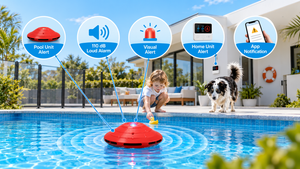
A pool chemical calculator helps estimate the doses needed to maintain balanced water. However, proper water chemistry is only one part of pool safety. Preventing unsupervised access, especially by young children, requires physical barriers and active adult supervision.
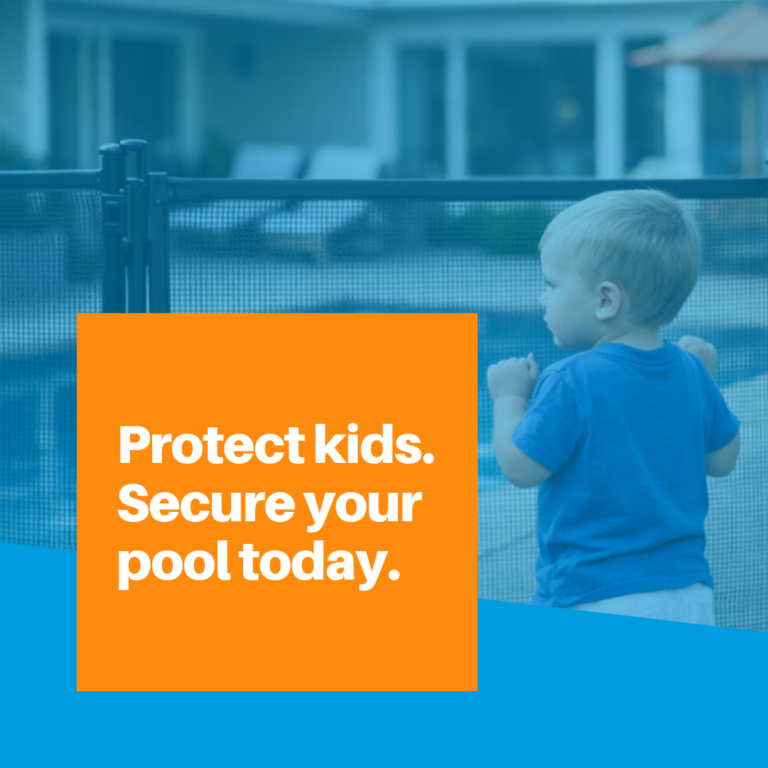
One way to improve protection is by installing a pool fence that separates the swimming area from the rest of the property. According to the American Red Cross, four-sided isolation fencing reduces a child’s drowning risk by 83% compared with three-sided fencing. To provide effective protection, the CPSC recommends barriers at least 48 inches high, with self-closing, self-latching gates that open away from the pool.
Combining proper water maintenance with secure fencing and consistent supervision helps address both water quality and drowning risks, creating a safer swimming environment for everyone.
Find your local dealer by entering your zip code above.
Please fill out the form below with your information. Your local dealer will be notified about your inquiry.