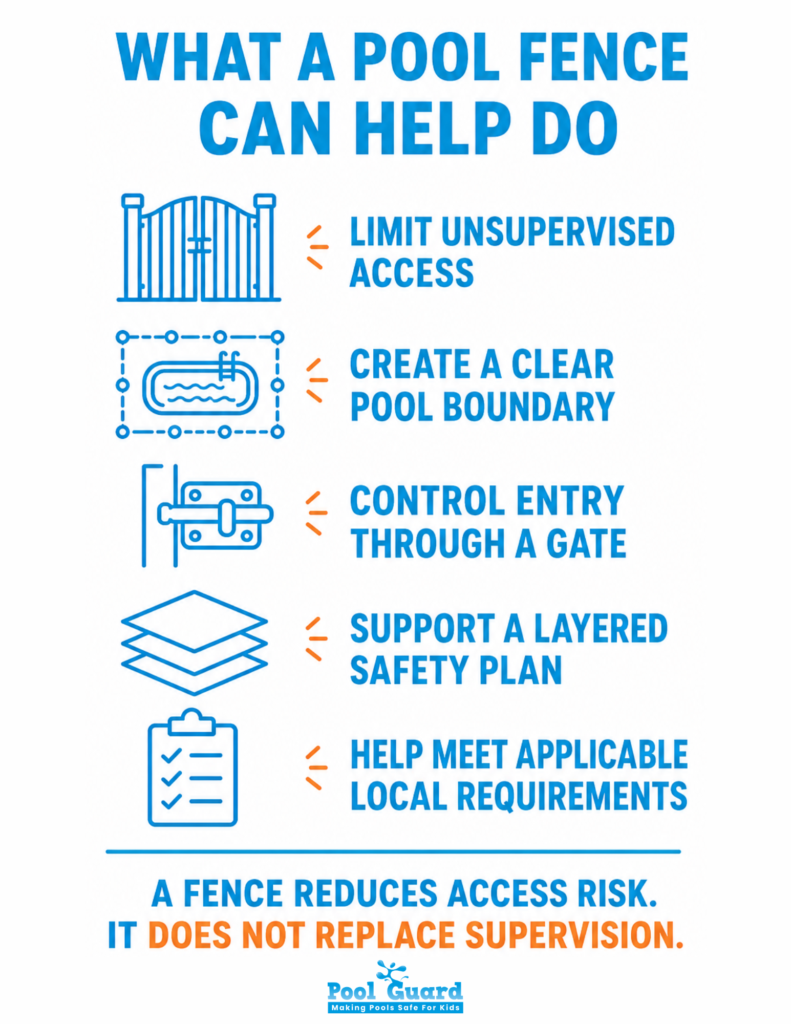
A pool can turn from a source of joy into a hazard in seconds. That’s the paradox families live with once the water goes in. The benefits of pool fences start with something simple – they buy time. A latched gate and a solid barrier close the gap between distraction and danger.
This guide covers what makes a pool fence work, from gate hardware to code requirements your insurer might flag. You’ll learn how fencing fits into a larger safety system, why mesh suits some yards, and who else benefits. Explore every layer that keeps a backyard pool safer below.
A pool fence is a physical barrier between the water and the yard. It matters most for young children, who move fast and quietly. One of the clearest benefits of pool fences is how much it slows that first step toward the water.
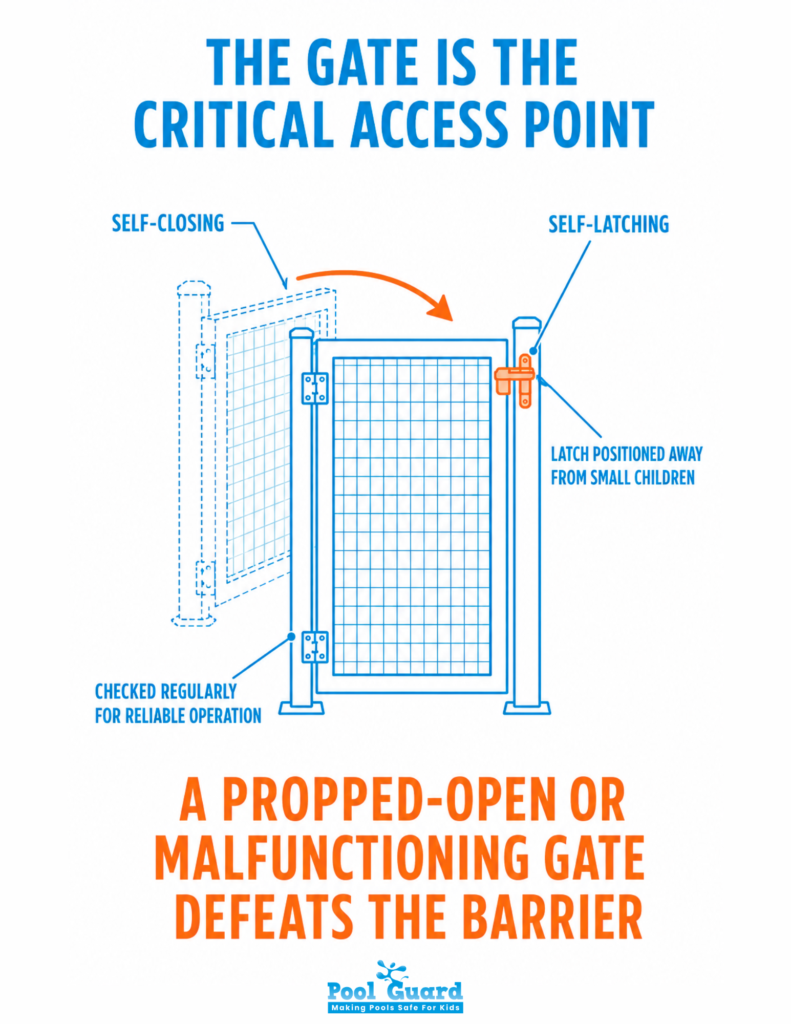
The gate is the weak point. A self-closing, self-latching gate shuts on its own, with the latch out of a small child’s reach. These mechanisms typically meet ASTM F2286, the U.S. standard that sets closing force and latch height for pool barrier hardware.
The Consumer Product Safety Commission names self-closing, self-latching gates as core to pool fence safety; a propped-open or broken gate defeats the fence.
A toddler doesn’t plan to swim. They just need an open path. Closing that path, even for seconds while an adult looks away, is what a latched fence provides. The CDC lists drowning as the leading cause of unintentional injury death for children ages one to four.
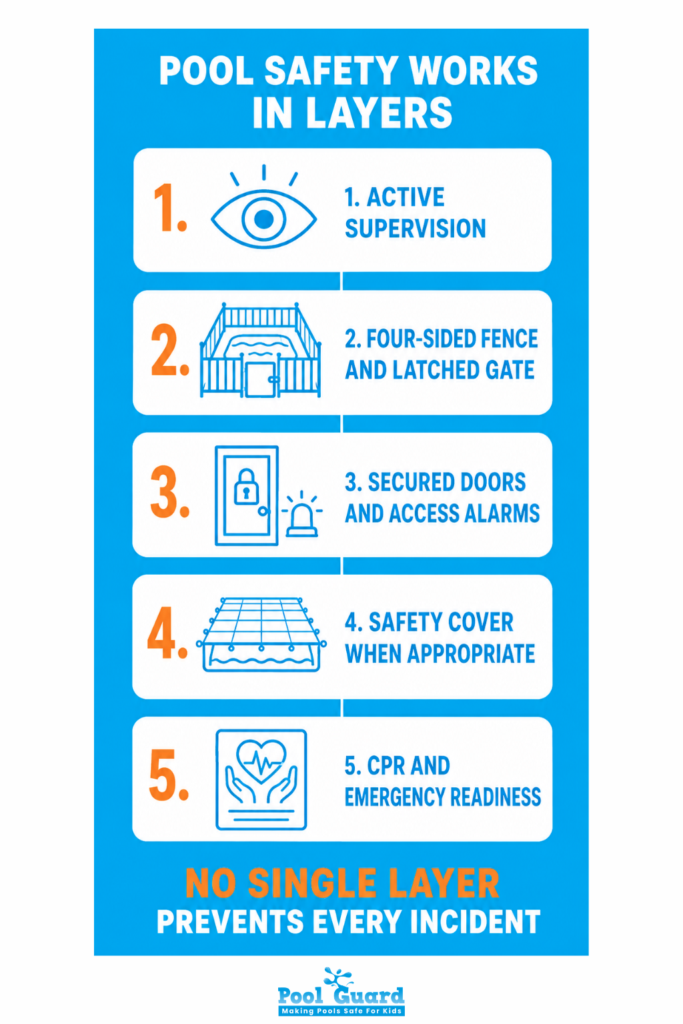
No single safeguard stops a drowning. Among the benefits of pool fences, blocking unsupervised access does the most work, but a fence and gate are still one layer in a larger system. The American Academy of Pediatrics recommends pairing barriers like fencing with active supervision, not one instead of the other.
| Layer | What It Covers |
| Supervision | One designated adult, phone down, eyes on the pool, no other task |
| Alarms | Catch anyone who slips past the fence or through a door |
| Covers and nets | Close the gap when nobody’s watching, such as overnight |
| CPR | The American Heart Association states immediate bystander CPR can double or triple survival odds after cardiac arrest |
A fence buys time and cuts risk. It doesn’t replace an adult trained to act if something still goes wrong.
Most backyards serve several purposes, like a lawn for the dog, a patio for dinner, maybe a play set nearby. Without a clear line, the pool blends into that space, and anyone can wander toward the water without thinking about it. A fence draws that line. It marks where the pool zone starts and the rest of the yard stays open.
During a party, a clear boundary protects more than just the kids; guests who’ve had a few drinks, distracted pet owners, and older relatives all benefit from a line that doesn’t depend on someone remembering to watch the water.
In a multi-use backyard, where people move between the grill, the lawn, and the patio at once, the fence keeps the pool its own space instead of an open extension of everything else.
Pool fence rules vary by location. Some counties and states set their own requirements; others follow a model code as a baseline. Many U.S. jurisdictions base local rules on the International Swimming Pool and Spa Code, published by the International Code Council, which local governments adopt and adjust.
| Requirement | Minimum |
| Barrier height | 48 inches |
| Gap between pickets | No wider than 4 inches |
| Gate | Self-closing and self-latching |
If your local government has adopted these rules, meeting them isn’t optional. A fence that looks secure but misses the height or gap requirement can still fail inspection.
Some homeowner’s policies attach conditions or higher premiums to pool ownership. If a fence falls short of the height or gap rule your jurisdiction has adopted, an insurer can treat that shortfall as a policy violation during a liability claim, even if the fence was installed in good faith. Check the exact requirements with your local building department and your insurer.
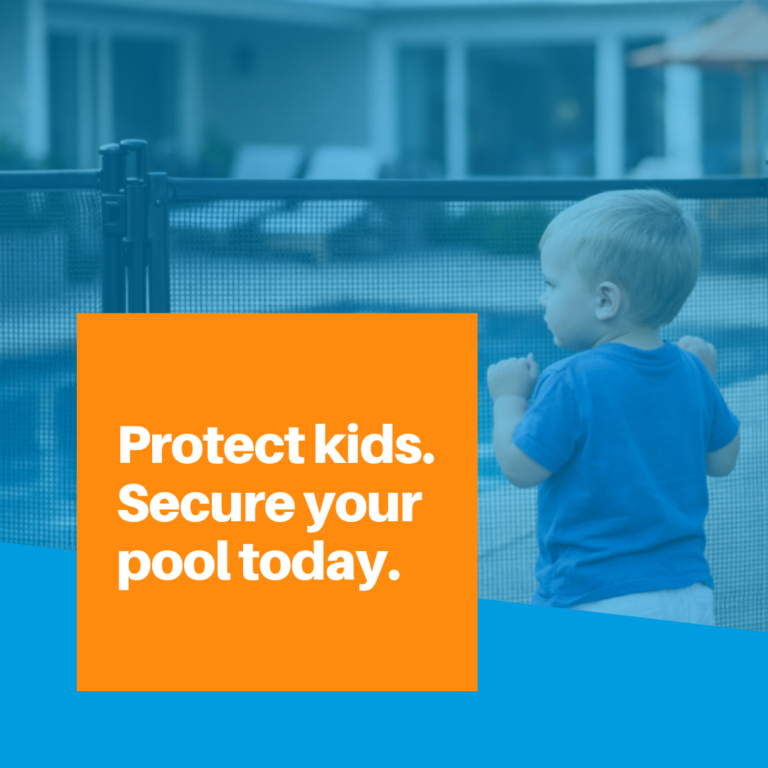
Mesh pool fences let you see straight through, which helps supervision. An adult on the patio can watch the water without a solid panel blocking the view. That visibility is one of the biggest pool fence advantages over a solid barrier, along with a lighter footprint in the yard.
Mesh adapts to curved pool edges, sloped yards, and irregular patios, where a rigid fence might need custom fitting. Some mesh systems are permanent; others come down and go back up, which suits anyone who needs the barrier for only part of the year.
A pool in a high-wind or coastal zone puts more stress on the poles and tension cables than a sheltered inland yard, which shortens replacement intervals and is worth weighing before choosing mesh over a rigid alternative.
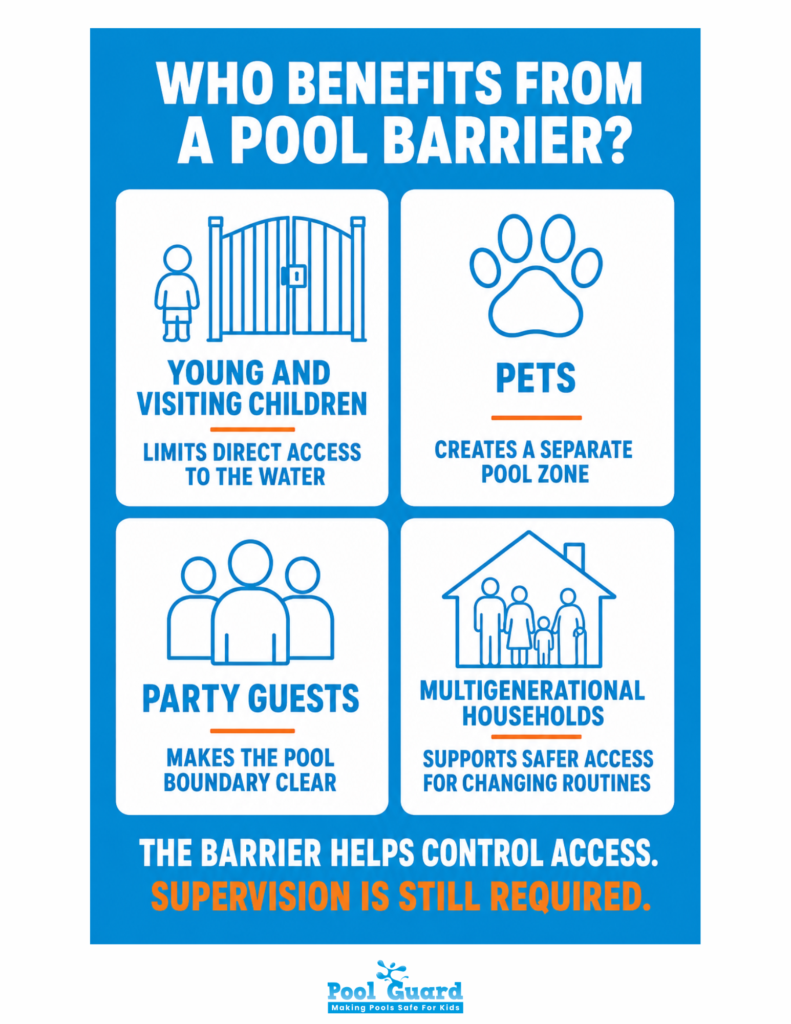
The pool fence benefits don’t stop with the homeowner’s own kids. Pets, visiting children, party guests, and grandparents all lean on the same barrier for different reasons.
| Who | Why It Matters |
| Visiting children | Don’t know the yard or where the water is; a fence removes the guesswork |
| Pets | A dog left alone can fall in and struggle to climb out, especially in a pool with steep sides |
| Party guests | A fence takes pressure off the host, who can’t watch every guest and every drink at once |
| Grandparents’ homes | A pool built for an adult household now sees grandchildren on a different schedule than daily supervision allows |
Rental properties raise the stakes further. A landlord with a pool takes on a fixed liability for every tenant and guest who steps into that yard, not just one family’s routine. A fence is one of the more direct ways to cut that exposure while keeping the pool usable.
A fence is a barrier, not a babysitter. It slows access but doesn’t watch the water, and it doesn’t cover the house itself. If a child can walk straight from the house to the pool through an unlocked back door, the fence around the yard isn’t doing its full job; the door needs its own lock, separate from the fence.
Supervision catches the moments someone’s watching. Alarms catch the moments someone isn’t. Covers close the gap when nobody’s home at all, and CPR matters when every other layer has already failed. A fence lowers the odds. It doesn’t remove the need for the rest.
The benefits of pool fences come down to one thing – they close the gap between a distracted moment and open water. A latched gate, the right mesh, and a barrier that meets code don’t replace supervision. They buy the seconds that matter when supervision slips.
No single layer stops a drowning, but a fence anchors the rest. Alarms, covers, locked doors, and CPR knowledge all work better with a solid barrier already in place. With the right setup, that combination turns a backyard pool from a daily risk into a space families can actually enjoy.
Please fill out the form below with your information. Your local dealer will be notified about your inquiry.
Please fill out the form below with your information. Your local dealer will be notified about your inquiry.