Drowning is a leading cause of accidental injury, making constant pool vigilance a necessity. While physical barriers offer foundational security, they cannot actively monitor activity or provide real-time breach updates. Adding advanced tech provides an essential layer of active defense, informing you the moment danger arises.
Smart surveillance bridges this gap by transforming passive viewing into proactive protection. Specialized systems identify true hazards and send instant smartphone alerts, minimizing false alarms. Combined with fences and adult supervision, these features help you choose the best camera for pool safety, and this guide will show you exactly what to look for.
The best camera for pool safety combines seven features:
Together, these tools turn passive recording into active protection.
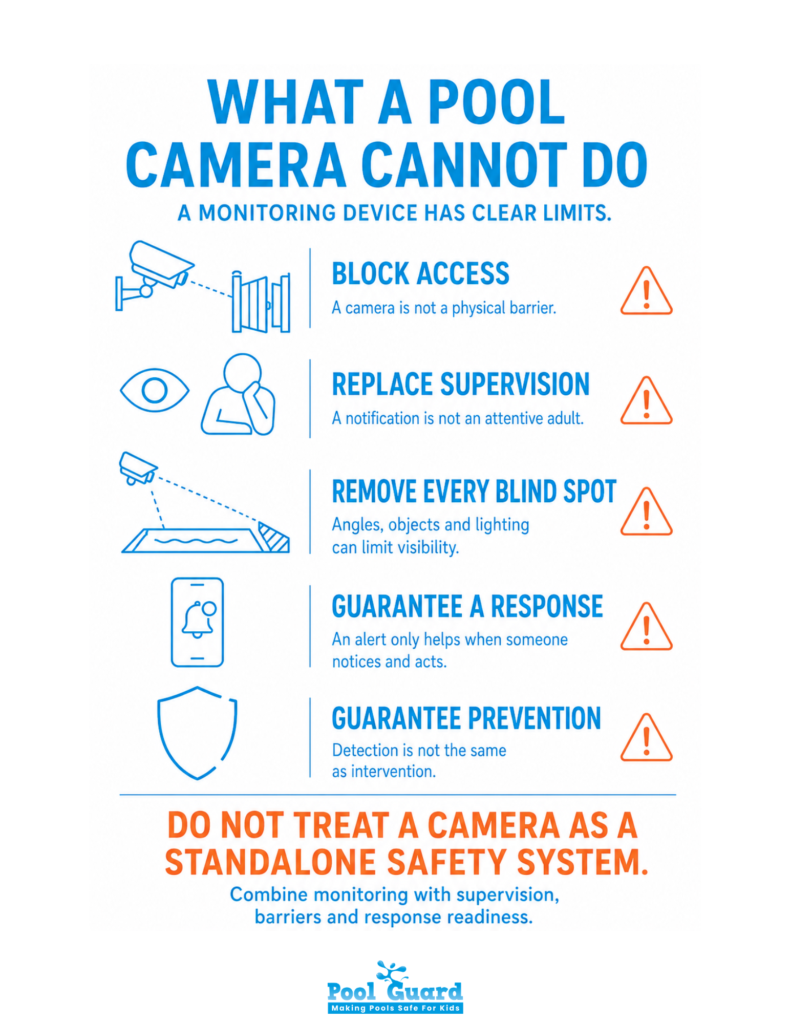
However, cameras are monitoring tools, not physical barriers. They never replace adult supervision, compliant pool fences, self-closing gates, pool covers, or safety nets. Drowning is fast and silent; most child drownings occur in familiar home pools, making a camera a tool for faster response rather than physical prevention.
Drowning remains one of the most under-discussed home safety risks in the U.S. An average of 4,000 unintentional drowning deaths occurred each year from 2012 to 2021, and drowning is the leading cause of death for children ages 1-4 in the United States. Even more troubling: CDC data comparing 2020-2022 to 2019 shows the drowning rate for children ages 1-4 increased by 28%.
Technology has started to catch up with the problem. AI-powered person detection, once limited to commercial security systems, is now built into consumer-grade pool cameras that cost less than a month of swim lessons. The question isn’t whether a camera can help; it’s which type of pool safety camera actually delivers on that promise, and what it can’t do on its own.
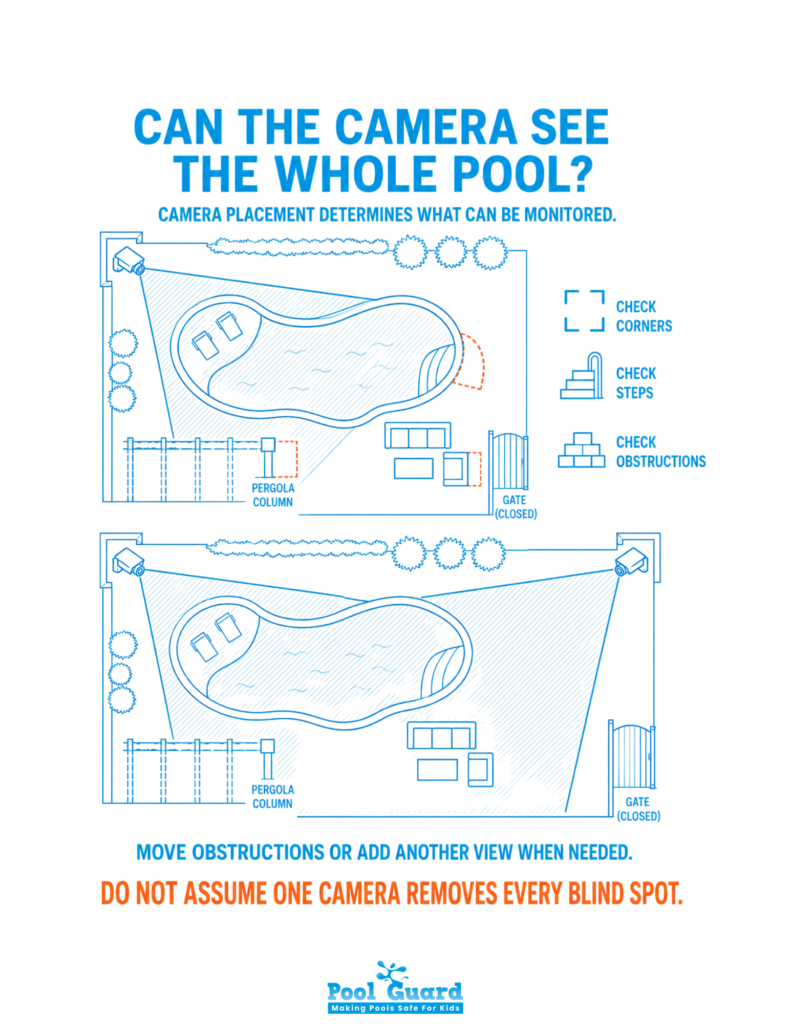
Not every camera pointed at a pool qualifies as a pool safety camera. Most home security cameras are built for general perimeter monitoring, like package theft, driveway activity, or front-door visitors. They simply weren’t engineered for water environments or the specific risk profile of a swimming pool.
| Feature | Pool Safety Camera | Regular Security Camera |
| Built for Pool Areas | Yes | Usually no |
| Person / Entry Alerts | Often | Sometimes |
| Drowning or Distress Detection | Some AI systems | No |
| Local Siren | Often | Sometimes |
| Best Use | Pool safety layer | General security |
The core difference is purpose-built detection logic. A regular security camera flags motion in general. A dedicated pool safety camera is tuned to recognize people entering a pool zone, distinguish them from a falling leaf or a pet, and, in more advanced systems, flag behavior patterns associated with distress, such as a person floating motionless or thrashing near the surface.
There are four main categories on the market today. Each solves a slightly different problem, and most well-designed pool safety plans combine more than one.
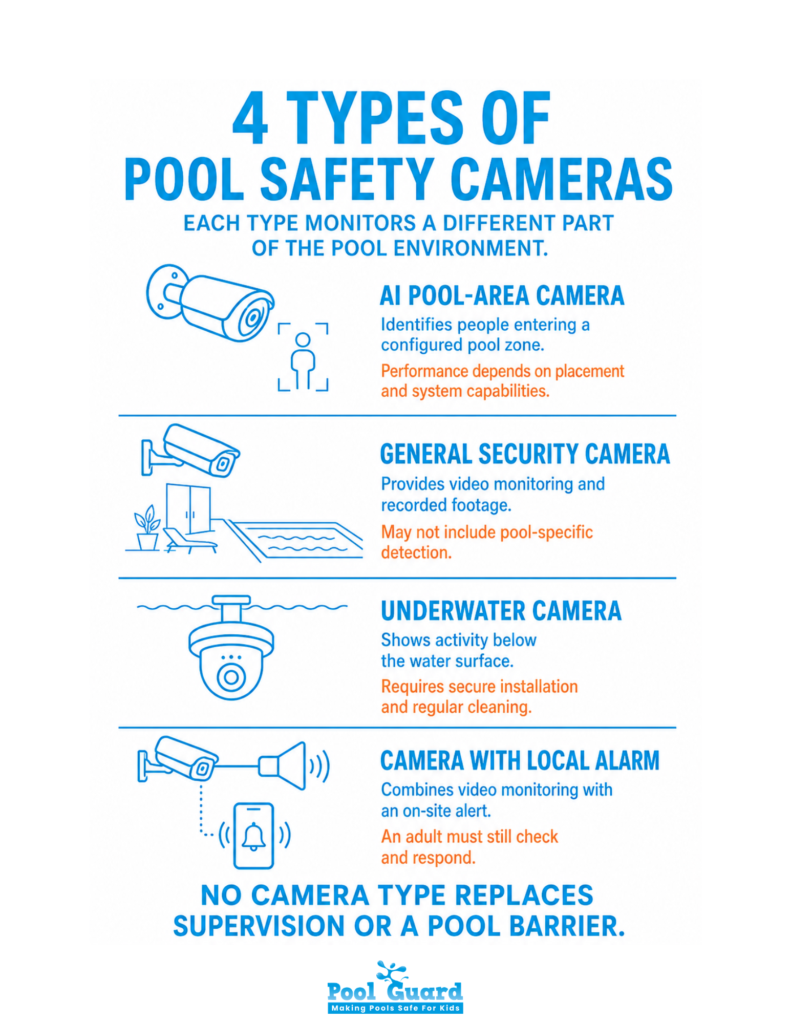
AI pool safety cameras is the newest and most capable category, and generally the strongest single option if you can only choose one. AI pool safety cameras:
Because these systems are trained on pool-specific scenarios, they tend to produce fewer false alarms from shadows, reflections, or wind-blown debris. This is a common complaint with generic motion-detection cameras pointed at water, where light reflections cause constant false triggers.
These are standard outdoor security cameras positioned to cover the pool area. They’re useful for:
What they’re not built for is drowning-specific detection. A general security camera will show you a recording of what happened; it typically won’t distinguish a swimmer in distress from ordinary swimming activity in real time.
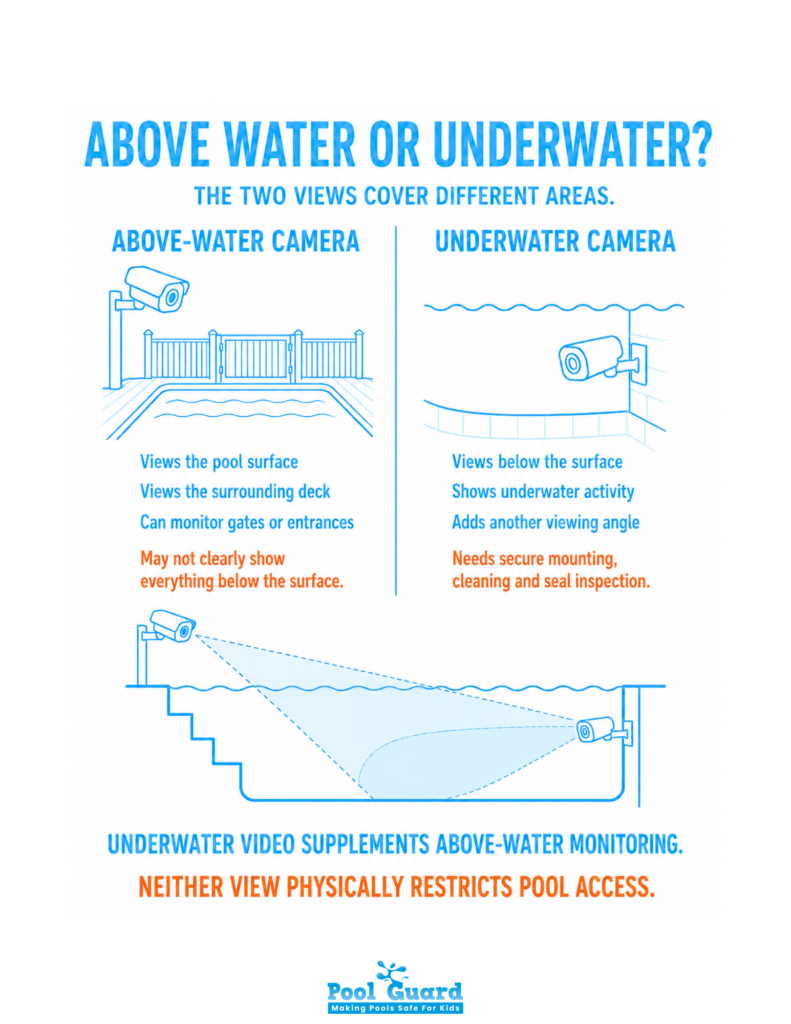
Mounted below the waterline, these cameras capture activity beneath the surface, an angle no above-water camera can capture. They can be valuable for spotting a submerged, motionless body faster than a surface-level view would.
The tradeoff is practical – underwater installation is more complex, often requires professional mounting, and demands more ongoing maintenance (algae buildup, lens fogging, and waterproof-seal wear are common issues). They work best as a supplement to an above-water camera, not a replacement.
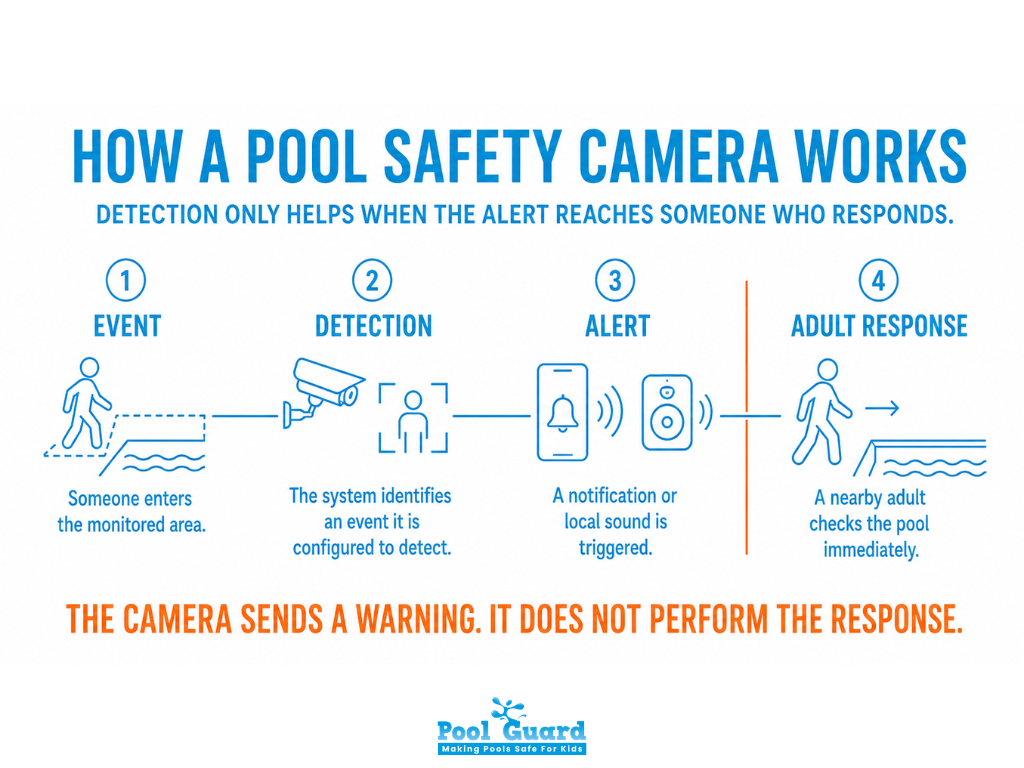
Pool alarm cameras combine video monitoring with a local siren or alarm trigger, so detection doesn’t rely solely on someone checking their phone. If a person or object enters the monitored zone, the on-site alarm sounds immediately, while the video feed and notification are sent to your device in parallel.
This dual-channel approach of local siren plus remote alert is particularly useful for larger households or properties where a caregiver might not have their phone in hand at all times.
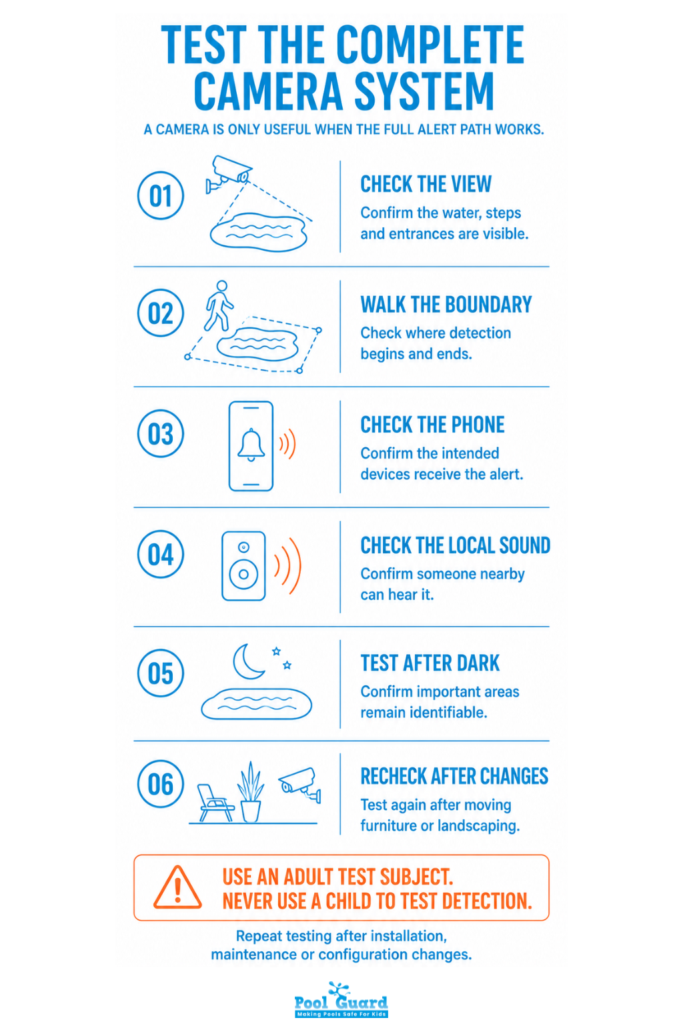
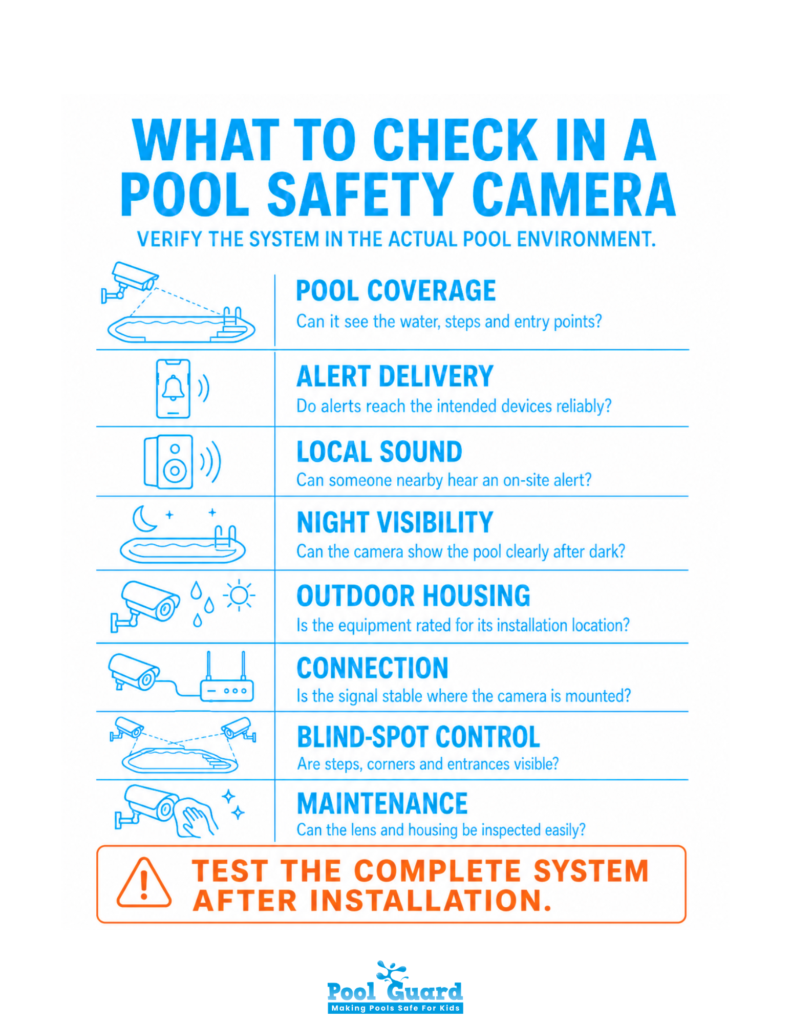
If you’re comparing products, run every candidate through this checklist before buying:
A camera can help you see and respond. It cannot physically stop a child from reaching the water. Detection and alerting take time, however small, and a toddler can travel from a back door to a pool edge in seconds. Proper pool fencing can prevent young children from gaining access to the pool area without caregivers’ awareness, closing the gap that even the fastest camera alert can’t fully cover.
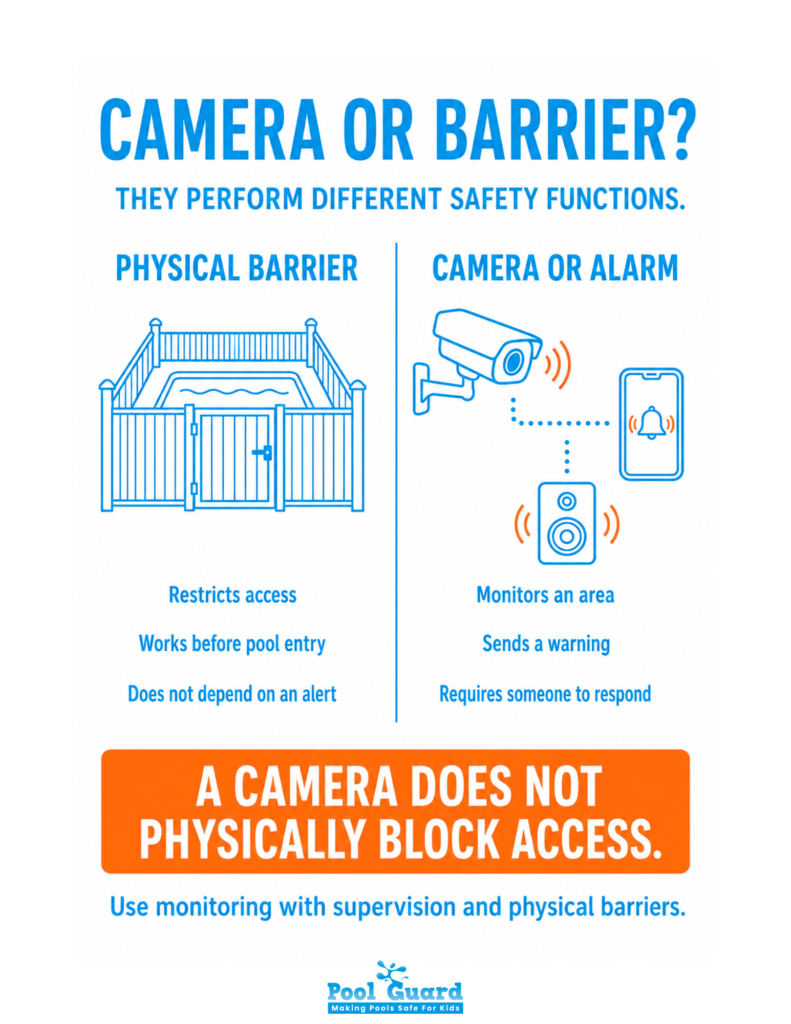
Pool fences, self-closing gates, pool covers, and pool nets all work by limiting access before someone reaches the water. Cameras work by improving response after someone is already near or in the water. These are complementary functions, not competing ones, and most public health guidance treats physical barriers as the higher-priority layer precisely because they don’t depend on anyone reacting in time.
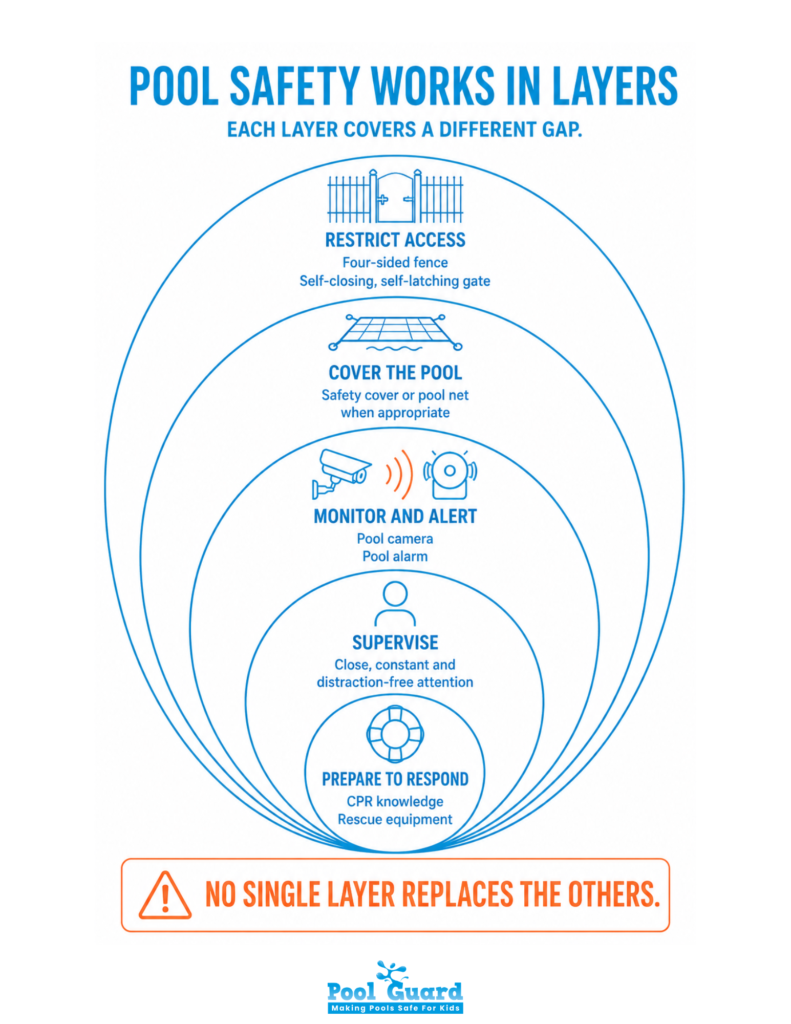
Layered protection is the standard recommended across drowning-prevention research, not a marketing phrase. No single product, camera included, closes every gap on its own. A realistic, effective setup looks like this:
Each layer covers a gap that the others miss. Fences fail if left open. Supervision fails if attention lapses. Cameras fail if alerts are ignored or delayed. Combined, the gaps shrink dramatically, which is the entire point of a layered approach.
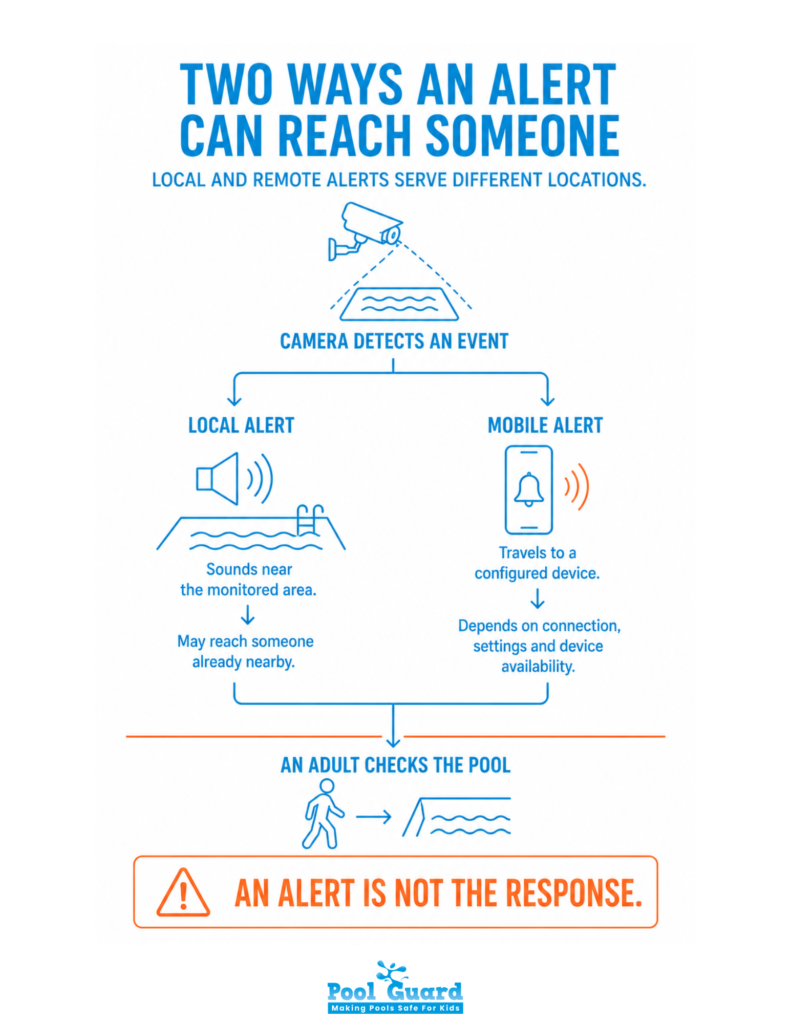
To set realistic expectations, be direct about the limits:
Being upfront about these limits isn’t a knock against pool safety cameras; it’s what makes the recommendation trustworthy. A camera bought with realistic expectations gets used correctly. A camera bought as a drowning-prevention silver bullet creates a false sense of security, which is arguably worse than having no camera at all.
The best camera for pool safety combines AI detection, wide coverage, reliable night vision, weather-resistant construction, and low false alarms.
Just as importantly, no camera should be your only safeguard. The strongest pool safety comes from layered protection, including active supervision, secure fencing, self-closing gates, safety covers or nets, and CPR readiness. Together, these measures provide far greater protection than any single device alone.
Please fill out the form below with your information. Your local dealer will be notified about your inquiry.
Please fill out the form below with your information. Your local dealer will be notified about your inquiry.