When a water test shows high pH, the next step is estimating how much acid your pool needs. A pool pH calculator helps you calculate that dose using your pool volume, test reading, desired pH, and product strength. These inputs connect your test result to an estimated treatment amount, giving you a starting point for the adjustment.
Once you have an estimate, you need to apply the chemical safely and check the result. This guide explains the calculator inputs before walking through dosing and retesting. It also covers chemical storage and how pool barriers help restrict access during treatment. Start with the calculator below, then work through the application steps.
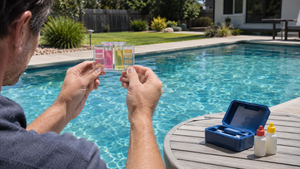
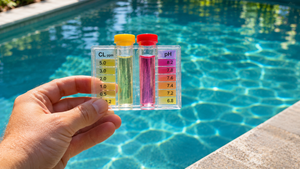
Before using the tool, test your pool water and check the concentration on your chosen product’s label. Accurate readings and product details help produce a more useful dose estimate.
[TOOL]
Review the calculated amount and follow the manufacturer’s dosing instructions before adding any chemicals.
Getting a useful estimate from a pool pH calculator depends on knowing what each input means and where to find it.
Check your pool manual or installation records for the capacity in gallons. If the volume is unknown, calculate it using your pool dimensions and average depth. For rectangular pools, multiply length × width × average depth × 7.5. For round pools, use diameter × diameter × average depth × 5.9. All measurements should be in feet, and the results are estimates in US gallons.
Test a fresh water sample taken away from return jets and the skimmer, following your test kit’s instructions. The CDC recommends keeping pool pH between 7.0 and 7.8, while PHTA guidelines identify 7.4-7.6 as ideal. Choose a target that meets your pool requirements and applicable guidance.
Acids lower pH, while products such as soda ash raise it. Check the product label for its concentration, since different strengths may require different doses. A pool chemical calculator can also help estimate the amounts needed to adjust pH, chlorine, alkalinity, and other water chemistry levels.
| Product | Effect on pH | Form |
| Muriatic acid | Lowers pH | Liquid |
| Sodium bisulfate (dry acid) | Lowers pH | Granules |
| Soda ash (sodium carbonate) | Raises pH | Powder |
| Sodium bicarbonate (baking soda) | Primarily raises total alkalinity; may slightly raise pH | Powder |
Common input mistakes include:
The amount shown by a swimming pool pH calculator is an estimate, not a guaranteed final dose. The actual pH change depends on water conditions, particularly total alkalinity, and the type and strength of the chemical used.
Before treatment, check that the calculator inputs match your pool volume, current pH, and the product you plan to use. Always follow the manufacturer’s dosing instructions if they differ from the calculated recommendation.
Measure the chemical using a suitable tool and follow the product label for proper handling and application. If gradual dosing is permitted, add the chemical in smaller portions. Never mix different pool chemicals, and follow appropriate pool chemical safety guidelines to prevent accidental exposure and dangerous reactions.
Keep the circulation system running during treatment unless the manufacturer advises otherwise. Follow the label for where and how to add the chemical, and keep swimmers out of the pool.
After the recommended circulation time, take a fresh water sample and retest the pH. Compare the reading with your target before deciding whether another adjustment is needed. Since balanced pH doesn’t guarantee proper chlorine levels, test your free chlorine as well. If it needs adjustment, you can calculate the chlorine dose based on your pool volume, current and target chlorine levels, and product strength.
Total alkalinity helps keep pH stable. Low alkalinity can cause frequent fluctuations, while high alkalinity can make pH harder to lower.
Water movement can also affect pH over time. Splashing, jets, and waterfalls release dissolved carbon dioxide, which can cause pH to rise. This explains why pH may increase again even after an adjustment.
Safe pool care includes proper chemical handling and storage. The CDC recommends keeping pool chemicals in their original labeled containers in a cool, dry, well-ventilated, locked area. Keep them away from children and pets, and store incompatible products, such as acids and chlorine, separately.
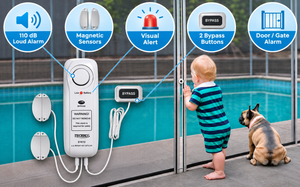
When treating the water, follow the product label for dosing and keep swimmers out until the water meets the label’s re-entry requirements. A secured barrier helps restrict access during treatment and when the pool is unattended. The CPSC recommends barriers at least 48 inches high, with self-closing, self-latching pedestrian gates. Since pool fence laws vary by state, check local requirements. A pool safety checklist can also help homeowners review precautions beyond water treatment, including gates and emergency equipment.
Water testing and chemical care are only part of keeping a pool safe. Pool Safely’s guidance emphasizes combining adult supervision with barriers and other protective measures. At Pool Guard USA, we manufacture and sell pool fences that help restrict unsupervised access to the water.

Find your local dealer by entering your zip code above.
Please fill out the form below with your information. Your local dealer will be notified about your inquiry.