Most pool covers mean a chore: you roll them out, haul them off, and find room to store them. Liquid pool covers offer a simpler alternative, with no bulky materials to handle. It sounds almost too easy, so do liquid pool covers work in a real backyard pool?
Convenience is appealing, but effectiveness matters just as much. This guide explores how these products perform, where they provide benefits, and where they fall short. You’ll also learn how they compare to physical covers and which option may be better for your pool.
A liquid pool cover is a product designed to reduce water evaporation. When added to a pool, it spreads across the surface to form an extremely thin film, known as a monomolecular layer.
These products typically contain fatty alcohols, such as cetyl or stearyl alcohol. These compounds help create the surface film and belong to a group of substances that are generally biodegradable.
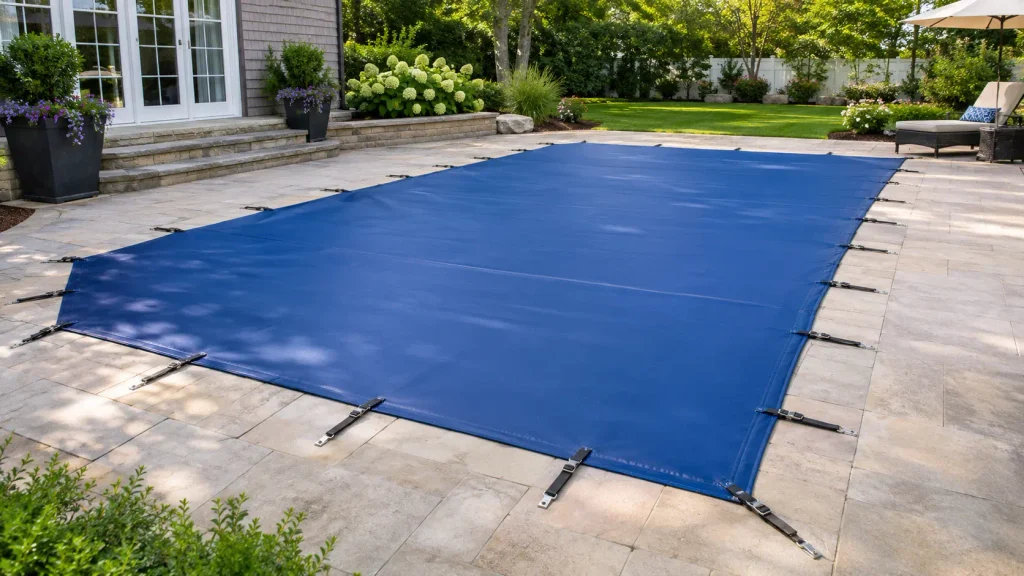
Unlike physical pool covers, liquid covers do not create a solid barrier over the water. They cannot catch leaves, provide meaningful insulation, or prevent accidental entry into the pool. This distinction matters when comparing different types of pool covers designed for heat retention, debris protection, or pool safety.
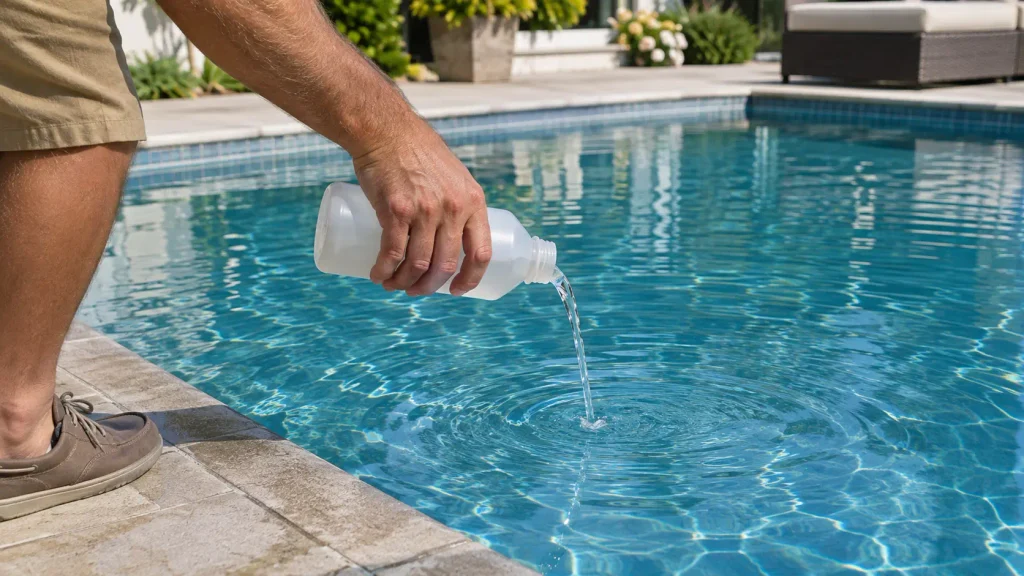
Under controlled conditions, liquid pool covers can reduce evaporation and help limit heat loss. The film remains virtually invisible and does not need to be removed before swimming.
A 2013 study published in Water Resources Management found evaporation reductions of 13% to 71% in controlled evaporation-pan tests, depending on the product and atmospheric conditions. However, continuous winds of 3 m/s (6.7 mph) disrupted the film and reduced its effectiveness. These findings demonstrate the potential of liquid evaporation barriers, although results in residential swimming pools may differ.
In Real-World Pools
Testing in actual swimming pools showed more modest results. In a 2016 study conducted at Cal Poly, two liquid pool cover products reduced evaporation by 14.4% and 15.8%. The tests were conducted without swimmers, meaning regular swimming activity could temporarily disrupt the protective film and reduce its effectiveness.
For homeowners, this means water savings may vary depending on weather conditions and how often the pool is used. A pool water evaporation chart can provide a general reference for estimating water loss before evaluating potential savings. Regular reapplication according to the manufacturer’s instructions also helps maintain the protective surface film.
Liquid pool covers help retain heat by reducing evaporation, the primary cause of heat loss in swimming pools. This allows the water to maintain its temperature for longer. However, the thin surface film provides little insulation against other forms of heat loss.
Solid pool covers are generally more effective because they create a physical barrier over the water. According to the EPA, solid pool covers can reduce evaporation by more than 90% while in use. However, mesh and solid pool covers differ in their ability to prevent evaporation and retain heat because mesh allows air and moisture to pass through.
While a liquid pool cover may slow cooling, particularly overnight, it does not generate heat. Instead, it helps preserve warmth supplied by sunlight or a pool heater.
The main advantage of a liquid pool cover is convenience. It offers a way to manage some evaporation without handling a bulky physical cover. However, that simplicity comes with trade-offs worth considering.
While the initial cost may be lower, ongoing purchases can add up over time. Homeowners should consider the total expense alongside the evaporation savings they can realistically expect. A pool cover cost calculator can also help estimate the upfront expense of a physical alternative when comparing long-term costs.
Many liquid pool cover problems come from expecting more protection than these products can provide. Wind and water movement can leave gaps in the surface film, reducing its ability to control evaporation. This means homeowners may not get consistent results, even when following application instructions.
Energy savings can also fall short of expectations. A 2016 U.S. Department of Energy report cited a 2010 study in which a liquid pool cover achieved approximately 13% energy savings compared with an uncovered outdoor pool. In comparison, traditional plastic pool covers can achieve energy savings of approximately 50% to 60%. Actual savings vary depending on pool conditions and cover usage.
The confusion often starts with treating liquid covers and solar blankets as interchangeable. Although both can help reduce heat loss, they work differently and offer different levels of protection. Choosing a liquid cover with the same expectations as a solar blanket can lead to disappointment.
Liquid and physical pool covers both help reduce evaporation, but they offer different levels of protection. The right choice depends on whether you prioritize convenience, temperature control, or overall pool maintenance.
| Factor | Liquid Pool Cover | Physical Pool Cover |
| Heat Retention | Limited reduction in heat loss | Better heat retention, depending on cover type |
| Evaporation Control | Around 15% reduction | Up to 95% reduction, depending on cover type |
| Debris Protection | None | Solid covers block leaves and dirt |
| Safety | No drowning protection | Only qualifying safety covers provide a protective barrier |
| Long-term Cost | Ongoing product purchases | Higher initial investment, eventual replacement |
| Maintenance Effort | Regular reapplication | Requires placement, removal, and occasional cleaning |
Adding a product to the water you swim in raises a fair question. Is liquid pool cover safe for regular swimming? Products made for pool use are generally designed to remain in the water while people swim. However, swimming safety is different from drowning prevention. A liquid film cannot prevent accidental entry into the pool. Only physical covers meeting ASTM F1346 safety requirements provide a qualifying safety barrier.
For homeowners with sheltered pools and relatively light swimming activity, a liquid cover can be a practical option. Its surface film performs best under light wind conditions, making it more suitable for calm pools in mild weather.
Liquid covers may also be useful as a supplement when a physical cover is temporarily removed. During short swimming seasons or periods of occasional use, they offer a convenient way to manage some evaporation without committing to covering the pool every night.
Homeowners seeking maximum water and heat conservation may find liquid covers insufficient, especially in hot, windy areas where evaporation is high. A physical cover provides more dependable surface coverage when reducing water loss is the main priority.
The same applies to pools used heavily throughout the day, where frequent activity makes consistent evaporation control more difficult. If you also need debris protection or a barrier against accidental entry, consider physical cover options designed for those specific purposes. A liquid cover cannot meet these requirements on its own.
Liquid pool covers offer a convenient way to reduce evaporation, particularly in calm pools with limited activity. They can also help retain some heat, although the benefits are generally moderate compared with physical covers.
Do liquid pool covers work well enough to justify using them? For homeowners who prioritize convenience and expect modest evaporation savings, they can be worthwhile. However, they are best treated as a supplemental option rather than a complete replacement for a physical cover.

Find your local dealer by entering your zip code above.
Recent Articles
Please fill out the form below with your information. Your local dealer will be notified about your inquiry.