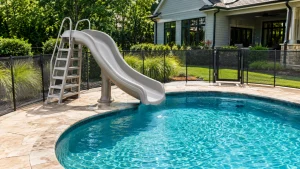
A backyard pool slide can turn an ordinary swim into an afternoon of fun. But the excitement of climbing, sliding, and splashing into the water can easily overshadow potential risks. That’s why pool slide safety deserves attention before anyone takes their first turn. With the added height and speed, even a seemingly harmless slide can lead to unexpected accidents.
Most of the risk, though, hides in details that are easy to overlook, like depth and exit clearance. In this guide, you’ll learn how to match a slide to your pool and spot problems early. Below, we’ll also cover the rules and supervision habits that keep the fun going all summer.
The federal government’s own findings show where the risk sits. When the Consumer Product Safety Commission (CPSC) issued its swimming pool slide standard in 1976, it named four injury risks. Those findings are decades old, but they still map neatly onto a modern safety routine:
| 1976 CPSC Injury Risk | Your Best Defense |
| Quadriplegia and paraplegia from head-first slides that strike the pool bottom, mostly among adults using a slide for the first time | A strict no-head-first rule, plus a pool that meets the slide’s requirements |
| Leg fractures from feet-first entry | Correct depth, floor profile, and clearance for the exact model |
| Collisions with other swimmers | One rider at a time and a clear landing area |
| Falls from the slide ladder | Secure ladder, sound handholds, careful climbing |
A slide must suit your pool’s depth, its floor profile, and the open water ahead of and beside the exit. A sloped or stepped pool bottom changes what lies beneath the exit path, and slide height and design change how a rider travels through the water.
Read the manual and every label before you buy or install. If the pool doesn’t meet the model’s requirements, change the slide or the plan. Don’t bend the requirements to fit the pool.
Swimming pool slides must meet specific federal safety requirements under 16 CFR Part 1207. The standard applies to slides manufactured after July 17, 1976, and covers ladder treads, handrails, slip resistance, runway rails, and slide exits designed to guide riders into the water at a low angle. It also provides recommendations for proper installation, maintenance, and safe use.
It doesn’t prescribe one universal depth or layout for every pool. Ask the retailer or manufacturer to confirm the slide meets the standard, then follow the documentation and installation instructions for your specific model.
Follow the minimum depth and clearance requirements for your exact slide model. Manufacturers set those requirements because slide design, pool floor shape, exit path, and the required water envelope (the open water ahead of and beside the exit) all change how a rider enters and moves through the water. Requirements often vary with slide height, so a number you saw for one model tells you nothing about yours.
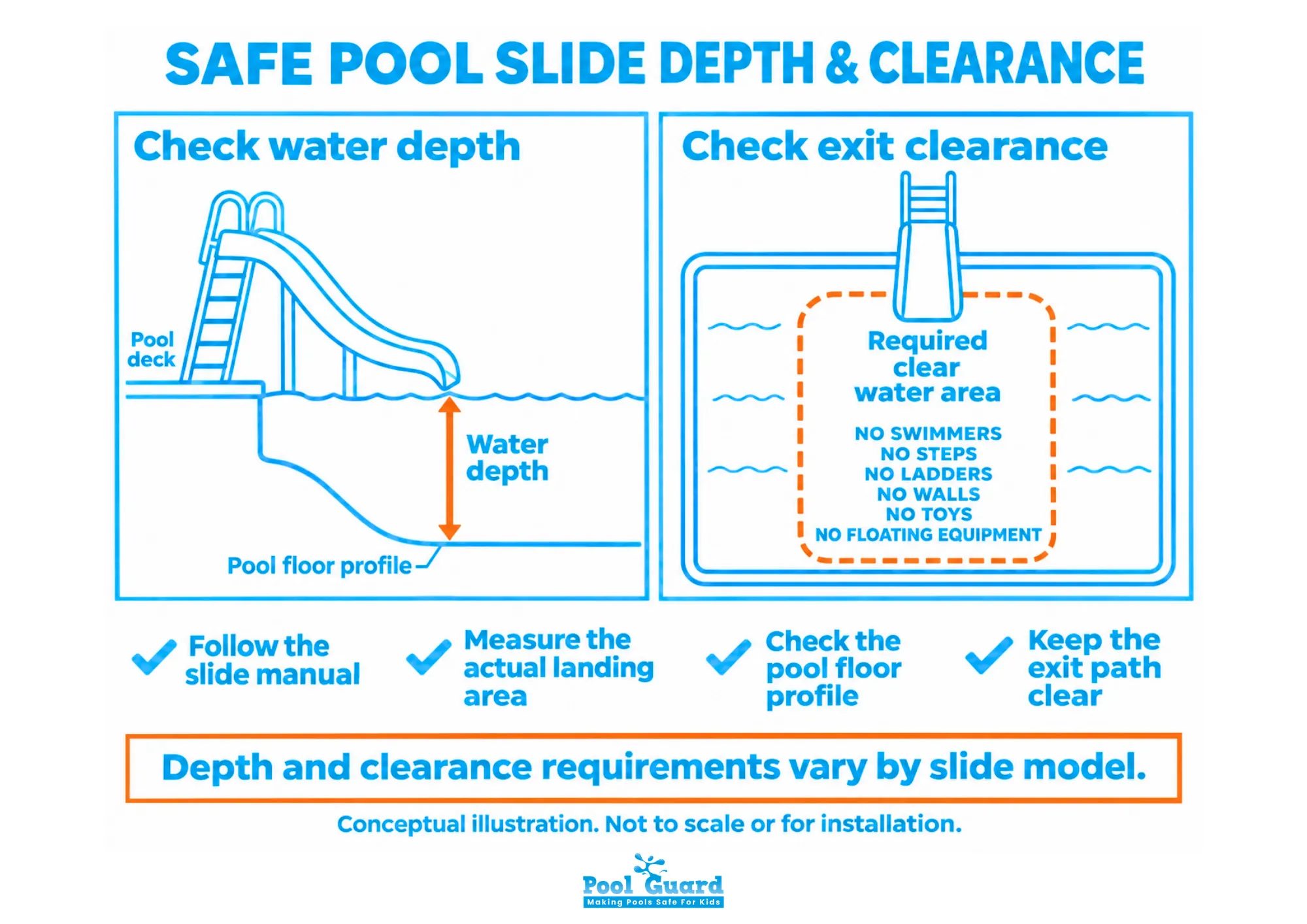
Before you install or use the slide:
Clearly visible pool depth markers help swimmers identify water depth, especially where the pool floor slopes. However, these markings don’t replace the slide’s installation specifications.
Run these checks before the first ride of the season and whenever something looks different.
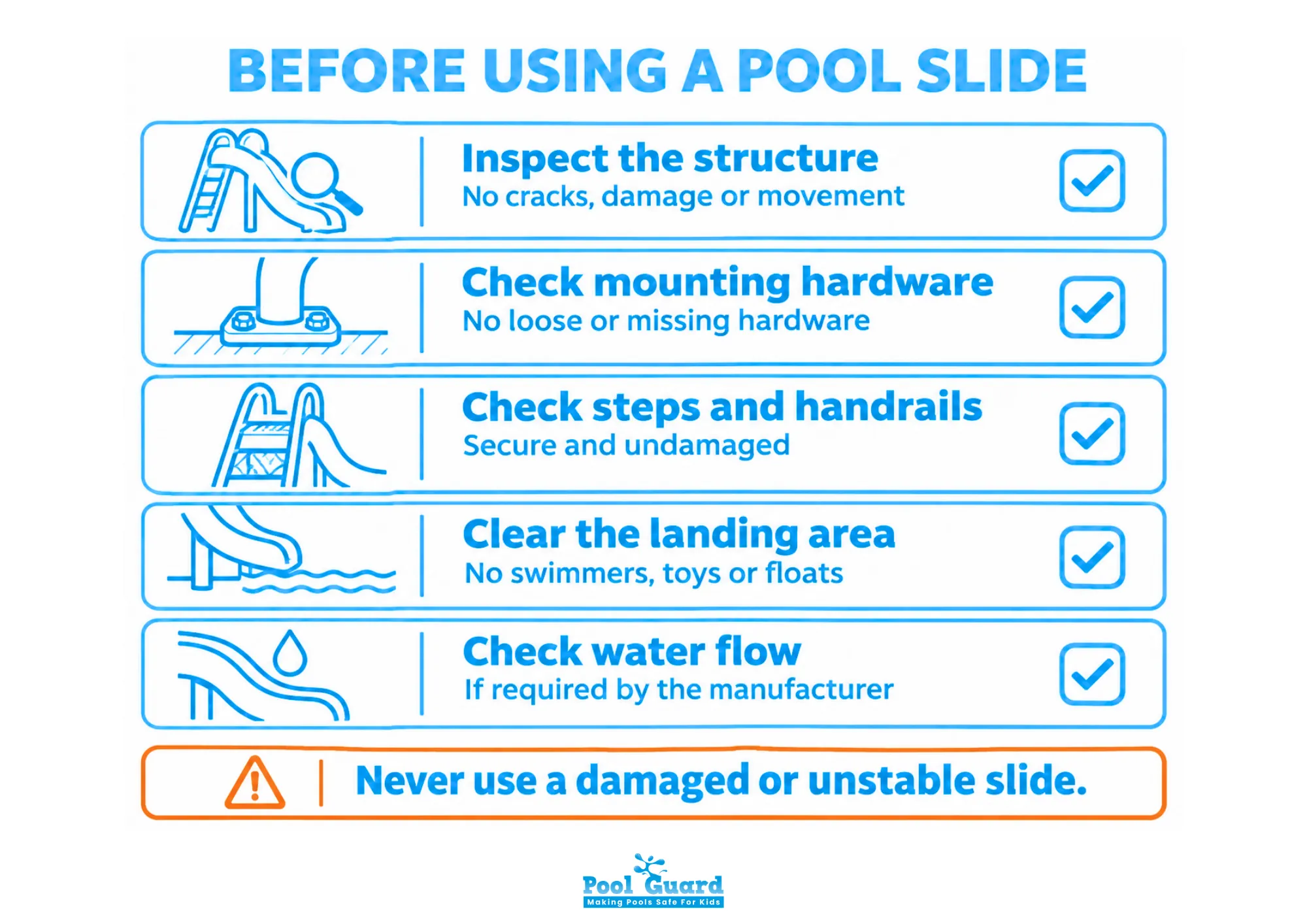
Look for cracks, movement, loose hardware, sharp edges, and worn surfaces. Push on the frame; a sound slide stays put. Run a hand along the runway to feel for rough or damaged spots. Don’t use a slide that looks damaged or unstable.
Confirm that steps and handholds sit securely and that their surfaces are intact and not slippery. Falls from the ladder made the CPSC’s 1976 list of hazards, and wet hands and feet make a worn ladder worse. The same pool ladder safety principles apply here: check for unstable steps, damaged handrails, and surfaces that could cause a fall.
Check that the exit path and surrounding water hold no swimmers, floats, toys, or other objects. If your manufacturer’s instructions call for water flow or lubrication, start it before the first ride.
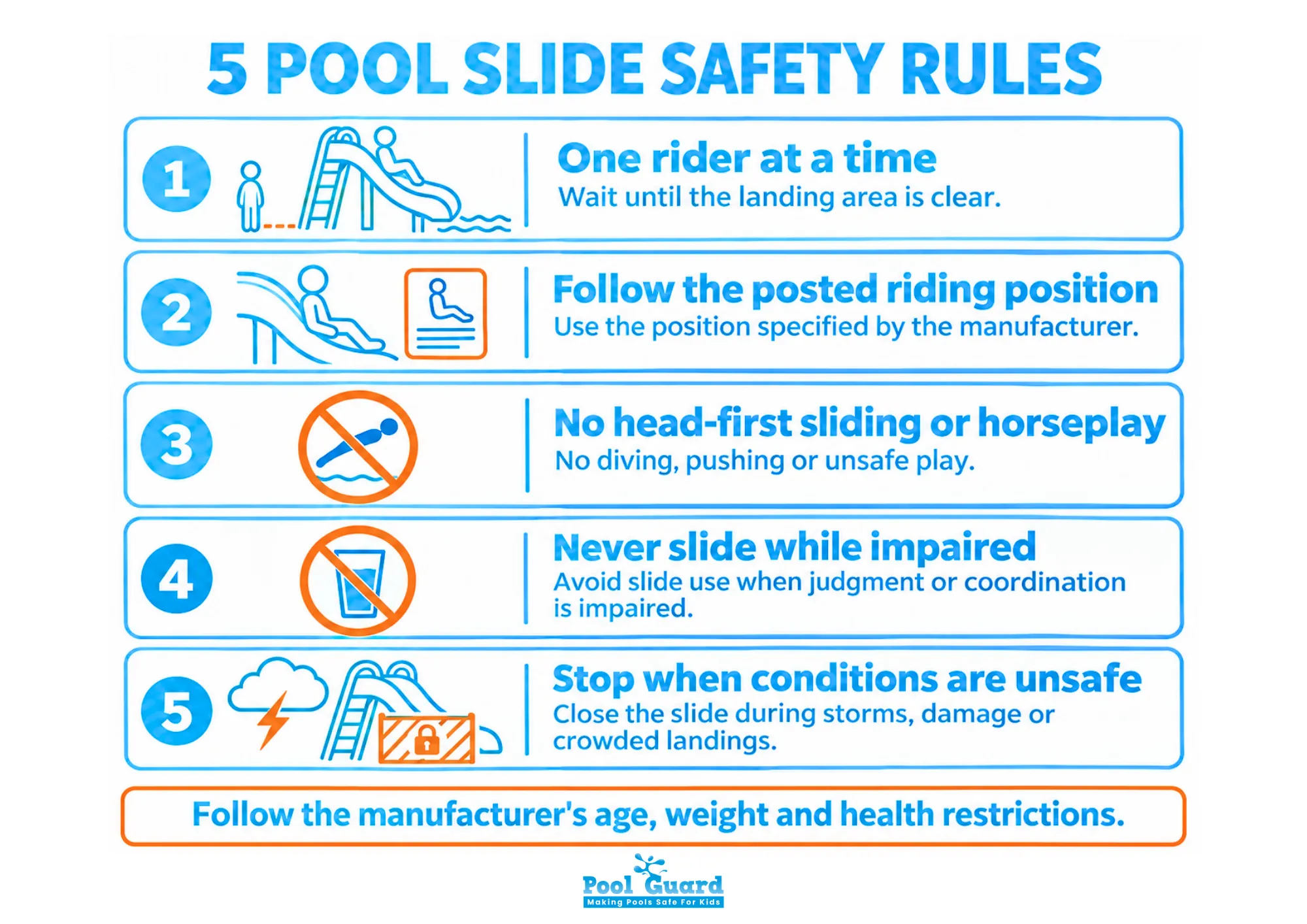
Post these pool slide safety rules near the slide and review them with every new guest:
Age, weight, and health limits vary by model, so this guide doesn’t set universal ones. Read your slide’s labels and manufacturer guidance for the limits that apply, and follow them without exceptions.
A home slide has no lifeguard. Assign an adult as the designated water watcher for every session. That person watches the water, not a phone, a grill, or a conversation, and hands the job to another adult before stepping away. Supervision matters most when children or weaker swimmers are in the pool, and an adult trained in CPR adds a second layer of protection.
Supervision and slide rules also don’t stop unsupervised access to the pool. When no one is watching, keep the pool secured with its barrier and gate, and follow your manufacturer’s guidance on securing or removing slide access. Safe slide use is only one part of pool safety; pool fencing, secure gate latches, and alarms provide additional layers of protection.
Inspect the slide before the swimming season starts and periodically during use. Stop using it immediately if it’s damaged or unstable, and follow the manufacturer’s repair guidance. Don’t improvise fixes with hardware that didn’t come with the slide.
Include the slide in your seasonal pool safety inspection alongside the barrier, gate latch, drain covers, and rescue equipment. Check these features before reopening the pool so you can address problems before swimmers return.
No. Each slide model has its own minimum depth and clearance requirements. Find them in your manual and on the slide’s labels, and confirm your pool meets them before use.
No. The pool’s depth, floor profile, and open water at the exit all have to match the manufacturer’s requirements. If your pool doesn’t, don’t install that slide. Ask the manufacturer or a qualified pool professional about your options.
Stop using it and keep everyone off. Check the manual for mounting and hardware instructions, and tighten or repair only as the manufacturer directs. If it still moves or shows damage, contact the manufacturer or a qualified professional before anyone rides again.
Good pool slide safety comes down to a few habits you can repeat every season. Your slide’s manual sets the depth and clearance, and a quick inspection tells you whether the equipment is sound. Add a clear landing area and simple rider rules, and you’ve addressed the hazards that matter most.
At the end of the day, even the best setup relies on people. Whether you’re hosting a party or enjoying a quiet afternoon, an attentive adult watching the water matters most. Treat the slide as one layer in a complete pool safety plan, alongside barriers and alarms. Get those layers right, and you can enjoy the summer with confidence.

Find your local dealer by entering your zip code above.
Recent Articles
Please fill out the form below with your information. Your local dealer will be notified about your inquiry.